French Oceania And U.S.A.
p. 25 · Read in the full issue
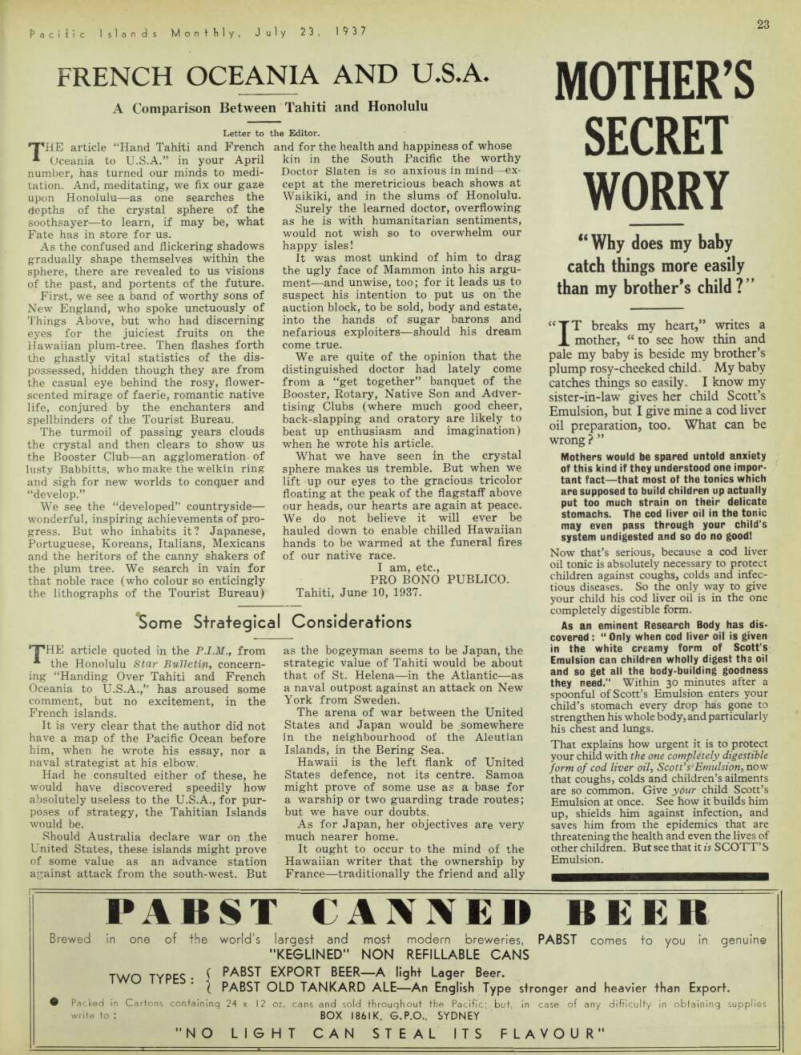
A Comparison Between Tahiti and Honolulu
Letter to the Editor.
THE article “Hand Tahiti and French Oceania to U.S.A.” in your April number, has turned our minds to medi tation. And, meditating, we fix our gaze upon Honolulu —as one searches the depths of the crystal sphere of the soothsayer—to learn, if may be, what Fate has in store for us.
As the confused and flickering shadows gradually shape themselves within the sphere, there are revealed to us visions of the past, and portents of the future.
First, we see a band of worthy sons of New England, who spoke unctuously of Things Above, but who had discerning eyes for the juiciest fruits on the Hawaiian plum-tree. Then flashes forth the ghastly vital statistics of the dis possessed, hidden though they are from the casual eye behind the rosy, flower scented mirage of faerie, romantic native life, conjured by the enchanters and spellbinders of the Tourist Bureau.
The turmoil of passing years clouds the crystal and then clears to show us the Booster Club —an agglomeration- of lusty Babbitts, who make the welkin ring and sigh for new worlds to conquer and “develop.”
We see the “developed” countryside— wonderful, inspiring achievements of pro gress. But who inhabits it? Japanese, Portuguese, Koreans, Italians, Mexicans and the heritors of the canny shakers of the plum tree. We search in vain for that noble race (who colour so enticingly the lithographs of the Tourist Bureau)
and for the health and happiness of whose kin in the South Pacific the worthy Doctor Slaten is so anxious in mind—ex cept at the meretricious beach shows at Waikiki, and in the slums of Honolulu.
Surely the learned doctor, overflowing as he is with humanitarian sentiments, would not wish so to overwhelm our happy isles!
It was most unkind of him to drag the ugly face of Mammon into his argu ment —and unwise, too; for it leads us to suspect his intention to put us on the auction block, to be sold, body and estate, into the hands of sugar barons and nefarious exploiters—should his dream come true.
We are quite of the opinion that the distinguished doctor had lately come from a “get together” banquet of the Booster, Rotary, Native Son and Adver tising Clubs (where much good cheer, back-slapping and oratory are likely to beat up enthusiasm and imagination) when he wrote his article.
What we have seen in the crystal sphere makes us tremble. But when we lift up our eyes to the gracious tricolor floating at the peak of the flagstaff above our heads, our hearts are again at peace.
We do not believe it will ever be hauled down to enable chilled Hawaiian hands to be warmed at the funeral fires of our native race.
I am, etc.,
Pro Bono Publico.
Tahiti, June 10, 1937.