The Hupi Hats Of
p. 22 · Read in the full issue
Bougainville
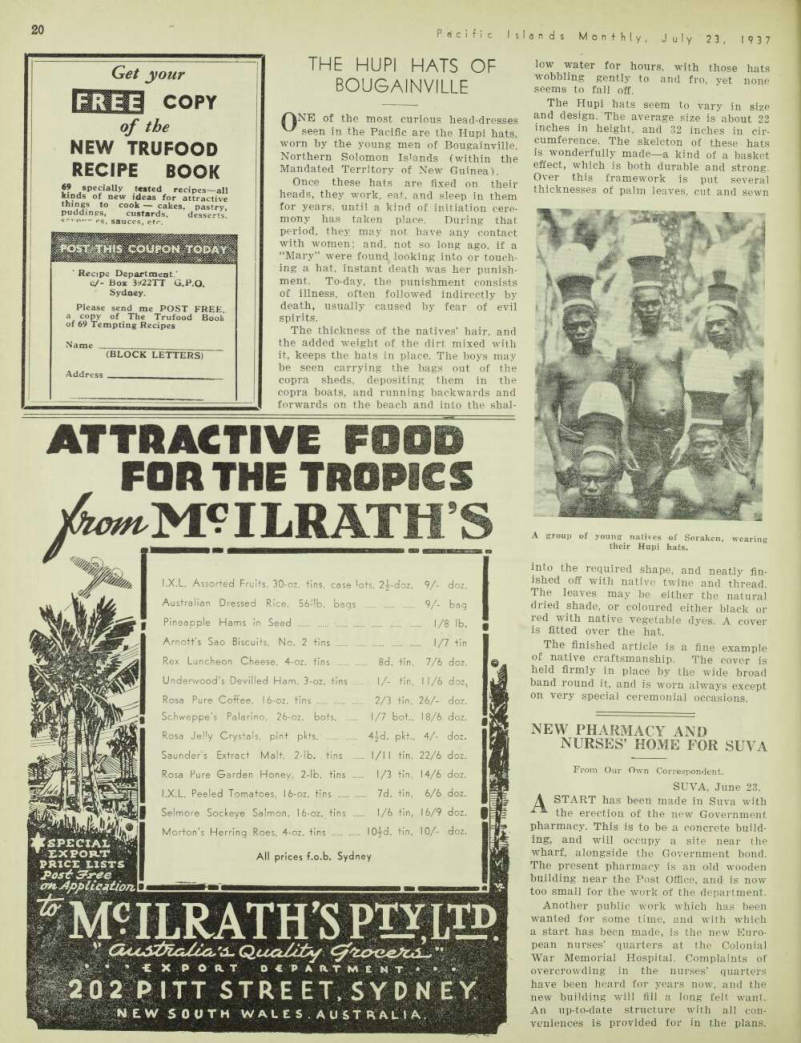
of the most curious head-dresses seen in the Pacific are the Hupi hats, worn by the young men of Bougainville, Northern Solomon Islands (within the Mandated Territory of New Guinea).
Once these hats are fixed on their heads, they work, eat, and sleep in them for years, until a kind of initiation cere mony has taken place. During that period, they may not have any contact with women; and, not so long ago, if a “Mary” were found, looking into or touch ing a hat, instant death was her punish ment. To-day, the punishment consists of illness, often followed indirectly by death, usually caused by fear of evil spirits.
The thickness of the natives’ hair, and the added weight of the dirt mixed with it, keeps the hats in place. The boys may be seen carrying the bags out of the copra sheds, depositing them in the copra boats, and running backwards and forwards on the beach and into the shal
low water for hours, with those hats wobbling gently to and fro, yet none seems to fall off.
The Hupi hats seem to vary in size and design. The average size is about 22 inches in height, and 32 inches in cir cumference. The skeleton of these hats is wonderfully made—a kind of a basket effect, which is both durable and strong.
Over this framework is put several thicknesses of palm leaves, cut and sewn
into the required shape, and neatly fin ished off with native twine and thread.
The leaves may be either the natural dried shade, or coloured either black or red with native vegetable dyes. A cover is fitted over the hat. finished article is a fine example of native craftsmanship. The cover is held firmly in place by the wide broad band round it, and is worn always except on very special ceremonial occasions.
A group of young natives o f Soraken, wearing their Hupi hats.