U.S.A. Claim To Canton Is.
p. 12 · Read in the full issue
Incident In Aviation Rivalry
The United States, quite unexpectedly, has lodged a claim for the ownership of Canton Island, the most northerly (apart from Howland and Baker) of the Phoenix Group. Britain has re-asserted her claim, and New Zealand (through an expedition recently on Canton) has sup ported Britain. It is reported that the British, American, and New Zealand en signs are all flying over Canton Island.
Phoenix is a small, uninteresting, un inhabited group in the Central Pacific,
just south of the Equator. There are eight islands in the group now—since the two northern outliers, Howland and Baker, were annexed by U.S.A. last year.
Most of them are high, wooded and fer tile, and capable of supporting a popu lation; but they have no harbours.
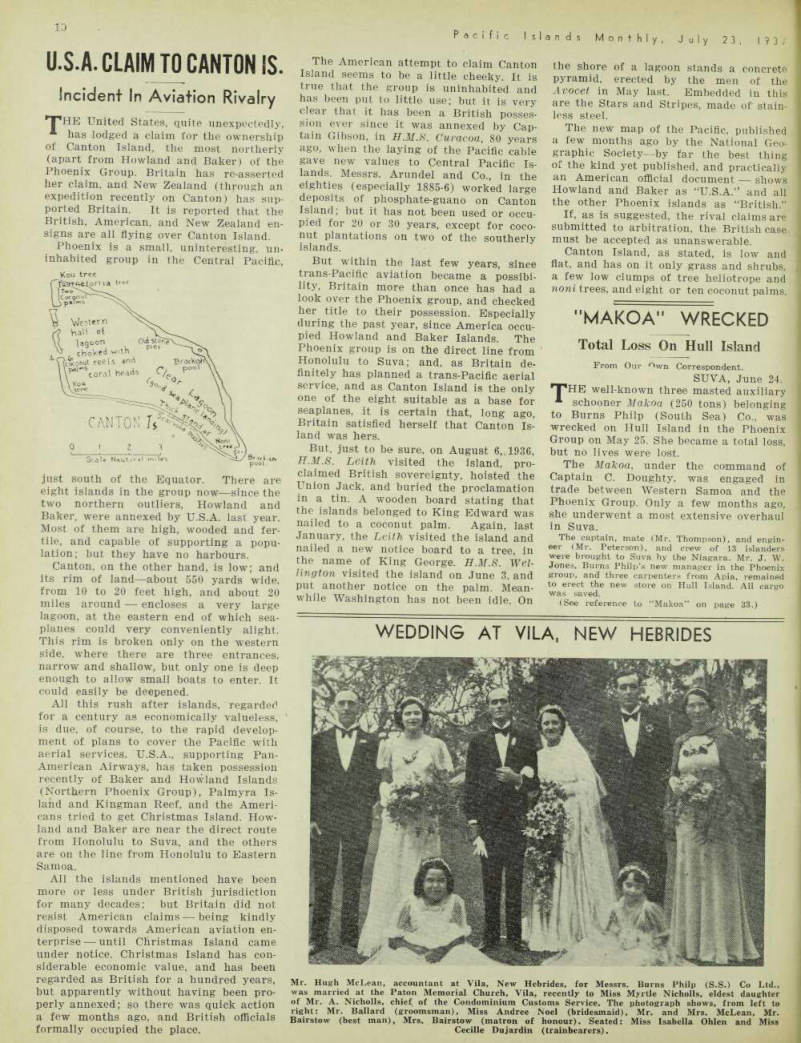
Canton, on the other hand, is low; and its rim of land—about 550 yards wide, from 10 to 20 feet high, and about 20 miles around encloses a very large lagoon, at the eastern end of which sea planes could very conveniently alight.
This rim is broken only on the western side, where there are three entrances, narrow and shallow, but only one is deep enough to allow small boats to enter. It could easily be deepened.
All this rush after islands, regarded for a century as economically valueless, is due, of course, to the rapid develop ment of plans to cover the Pacific with aerial services. U.S.A., supporting Pan- American Airways, has taken possession recently of Baker and Howland Islands (Northern Phoenix Group), Palmyra Is land and Kingman Reef, and the Ameri cans tried to get Christmas Island. How land and Baker are near the direct route from Honolulu to Suva, and the others are on the line from Honolulu to Eastern Samoa, All the islands mentioned have been more or less under British jurisdiction for many decades; but Britain did not resist American claims being kindly disposed towards American aviation en terprise until Christmas Island came under notice. Christmas Island has con siderable economic value, and has been regarded as British for a hundred years, but apparently without having been pro perly annexed; so there was quick action a few months ago, and British officials formally occupied the place.
The American attempt to claim Canton Island seems to be a little cheeky. It is true that the group is uninhabited and has been put to little use; but it is very clear that it has been a British posses sion ever since it was annexed by Cap tain Gibson, in H.M.B. Curacoa, 80 years ago, when the laying of the Pacific cable gave new values to Central Pacific Is lands. Messrs. Arundel and Co., in the eighties (especially 1885-6) worked large deposits of phosphate-guano on Canton Island; but it has not been used or occu pied for 20 or 30 years, except for coco nut plantations on two of the southerly islands.
But within the last few years, since trans-Pacific aviation became a possibi lity, Britain more than once has had a look over the Phoenix group, and checked her title to their possession. Especially during the past year, since America occu pied Howland and Baker Islands. The Phoenix group is on the direct line from Honolulu to Suva; and, as Britain de finitely has planned a trans-Pacific aerial service, and as Canton Island is the only one of the eight suitable as a base for seaplanes, it is certain that, long ago, Britain satisfied herself that Canton Is land was hers.
But, just to be sure, on August 6, 1936, H.M.B. Leith visited the island, pro claimed British sovereignty, hoisted the Union Jack, and buried the proclamation in a tin. A wooden board stating that the islands belonged to King Edward was nailed to a coconut palm. Again, last January, the Leith visited the island and nailed a new notice board to a tree, in the name of King George. H.M.S. Wel lington visited the island on June 3, and put another notice on the palm. Mean while Washington has not been idle. On
the shore of a lagoon stands a concrete pyramid, erected by the men of the Avocet in May last. Embedded in this are the Stars and Stripes, made of' stain less steel.
The new map of the Pacific, published a few months ago by the National Geo graphic Society—by far the best thing of the kind yet published, and practically an American official document shows Howland and Baker as “U.S.A.” and all the other Phoenix islands as “British.”
If, as is suggested, the rival claims are submitted to arbitration, the British case must be accepted as unanswerable.
Canton Island, as stated, is low and flat, and has on it only grass and shrubs, a few low clumps of tree heliotrope and noni trees, and eight or ten coconut palms.