Rabaul's Future
p. 10 · Read in the full issue
Inquiry By Vulcanologist
A LTHOUGH the influence of higher officialdom is thrown sternly against any suggestion that a new capital should be sought for New Guinea, as an alter native to volcano-threatened Rabaul, the subject has been receiving a good deal of quiet discussion.
From the Administration viewpoint, which naturally is dominated by finance, the idea has nothing to commend it. The cost of placing the departments else where —at Madang, for example—would run probably far into six figures.
But there are two or three factors which may influence the future. The first is pumice-dust. Probably not for years— and certainly if they be dry years—will Rabaul be free from this unpleasant and unhealthy nuisance. The second is the condition of the harbour; Is there a risk of this hitherto fine haven being more or less silted up? The third, of course, is the ever-present risk of another erup tion —which is a matter for experts.
If, under these three heads, the out look is unfavourable to Rabaul, several strong reasons will be advanced for the removal of the capital to the western end of the Territory. Most of the Territory’s industrial activity is there; the mainland is much more accessible by air-mail from Australia, and it also is on the future direct aerial route from Eastern Aus tralia to Eastern Asia; and the establish ment of the capital there should give a stimulus to the development of the vast, rich central plateaus of New Guinea.
However, the whole subject now awaits, first, a report by an expert on volcanoes; second, a report by an expert committee.
Expert Survey At Rabaul
Dr. C. E. Stehn, who has been ap pointed by the Federal Government to advise whether it is safe to retain Rabaul as the capital, has had extensive experi ence in the Dutch East Indies, where occur volcanic eruptions similar to that which recently shook Rabaul.
It is stated that Dr. Stehn possesses qualifications which are not held by any one in Australia.
Dr. Stehn has been vulcanologist attached to the geological survey in the Netherlands East Indies with head quarters at Bandoeng, and has investi gated similar eruptions in the East Indies. The East Indies lie along the same line of volcanic activity on which Rabaul is situated. It was considered desirable to obtain the services of a scientist who has worked on that line.
Dr. Stehn and Dr. W. G. Woolnough, Commonwealth geologist, left Brisbane for Rabaul by the Tanda on July 16.
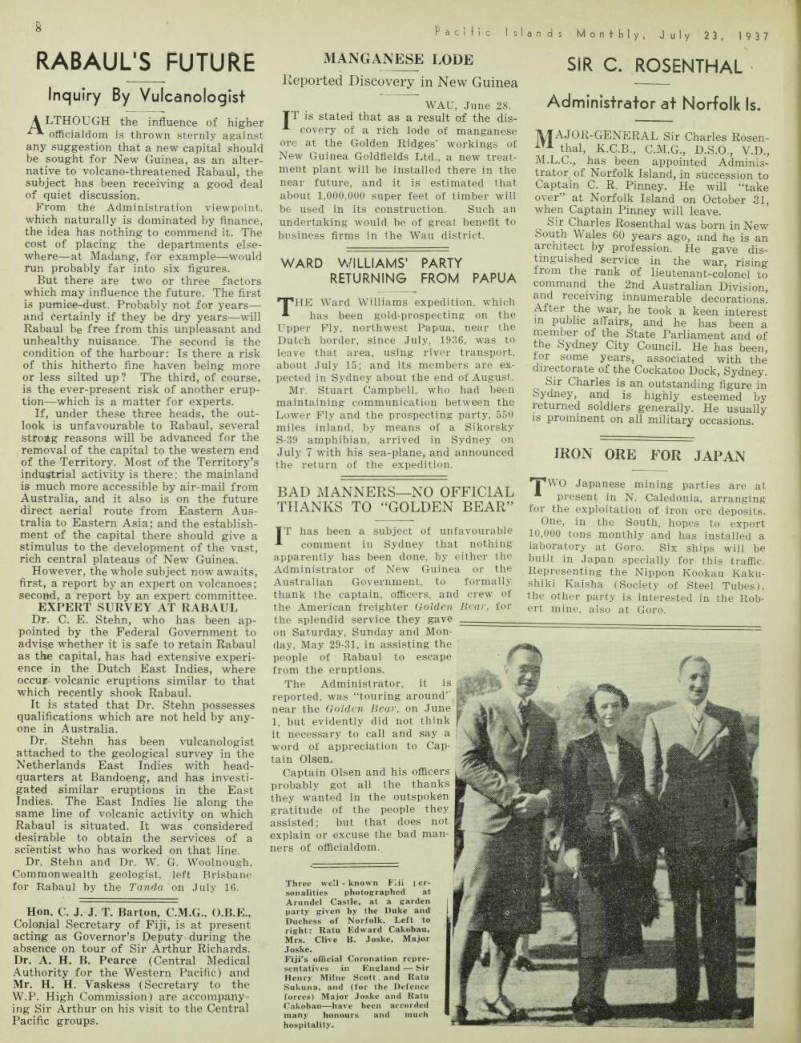
Hon. C. J. J. T. Barton, C.M.G., 0.8. E.,, Colonial Secretary of Fiji, is at present acting as Governor’s Deputy during the absence on tour of Sir Arthur Richards.
Dr. A. H. B. Pearce (Central Medical Authority for the Western Pacific) and Mr. H. H. Vaskess (Secretary to the W.P. High Commission) are accompany ing Sir Arthur on his visit to the Central Pacific groups.