In Dutch New Guinea
pp. 57-60 · Read in the full issue

A New Mountain and New People
(Written for the “ P.l.Mhy C. R.
SHELDON, of Doha, Aroe Islands ) ABOUT the middle of 1936, it was decided that an exploration party from the Netherland New Guinea Petro leum Coy., should organise a party to climb the Carstensz Mountains in Dutch New Guinea, in order to carry out cer tain research work, and collect speci mens of geological and botanical value.
In addition to this, the exploration party was to make contact with the native Kapankos tribe, who are really pygmies, and make a study of their habits, etc.
An exploration party, led by Dr, A.
Colijn (son of the Prime Minister of Holland) assisted by Mr. F. J. Wissel and Mr. J. Dozy, started on their first trek to the Carstensz mountains in the middle of November, 1936, the jumping off place being a small base camp at Aika on the South Coast of Dutch New Guinea.
Earlier in the- year, an advance party, under the charge of Mr. H. Schilfgaarde, had, in addition to opening up the base camp at Aika, also started to blaze the trial for the exploration party, through the thick jungle, before the mountains could be reached, in order to establish another base camp at an altitude of 1500 metres. This track was necessary in order that food and other supplies required by the exploration party could be taken to
the base camp. Mr. Schilfgaarde had also to make a landing-ground for the Sikor sky planes at this camp and, in addition, had to make contact with the Kapanos natives.
The exploration party travelled by Sikorsky seaplanes—which are amphi bian—from Aika, and landed at the base
camp, 1500 metres up in the mountains.
From this camp the real trek started to the summit.
It took the party ten days to reach the summit, situated 5040 metres above sea level, and seven days to make the des cent. The party stayed 20 days at the summit, collecting their specimens and carrying out excursions over the large snow-fields.
The conditions at the summit were very trying, the weather treacherous during their stay, and almost every day snow and hail storms took place. The nights were bitterly cold, but clear, causing the snow to become frozen; but as soon as the sun reached a certain height, its heat made the snow soft, making it almost impossible to carry out any explorations.
Therefore most of the exploring had to be carried out at night, so that the camp could be reached while the snow was hard.
So, for the greater part of the day light, the exploring party had to shelter in their small tents, just big enough to hold three people. Adopting this method of doing their exploring by night and early morning, quite a lot was done, and a number of excursions made over the large snow fields. The party even reached the northern side of the mountain.
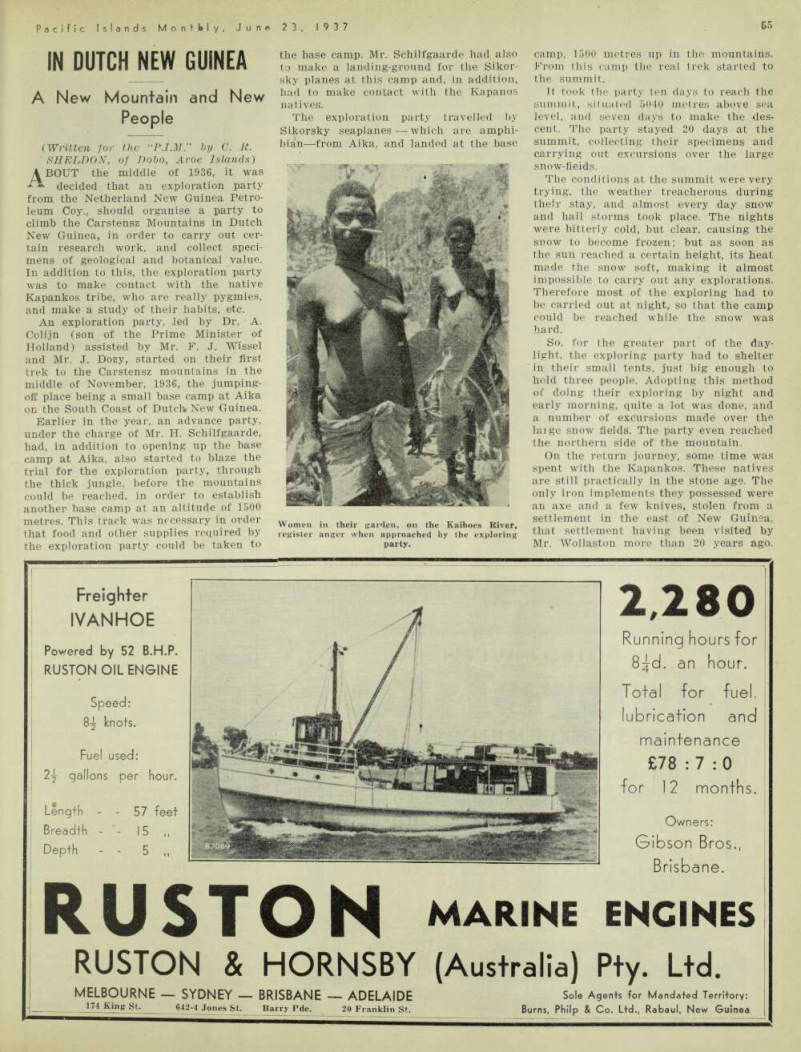
On the return journey, some time was spent with the Kapankos. These natives are still practically in the stone age. The only iron implements they possessed were an axe and a few knives, stolen from a settlement in the east of New Guinea, that settlement having been visited by Mr. Wollaston more than 20 years ago.
Women in their garden, on the Kaiboes River, register anger when approached by the exploring party.
He came through on his way to the Carstensz mountains, but failed to reach the summit—he only reached the snow line—
and then only stayed an hour. Physically, these natives are well built, strong, and make excellent carriers. At first they are very suspicious of the white man and everything with him, but once their con fidence is gained they soon become very friendly—too friendly, in fact —even tak ing it as a matter of course that they sit inside the tents. They became very “attached” to small things such as spoons, empty tins, flash-light torches, etc., etc.
Their diet consists principally of Oehi (sweet potatoes), but they also cultivate extensively Kladie (Taro), Sugar Cane, Ginger and Bananas. They rear pigs in their villages, but these are killed only on special ocfcasions.
The natives, seeing the exploration party arrive by plane and take their departure by the same means, naturally though that the party had come from “heaven.” It was their ambition to go along to “heaven,” so that they could shed their black skin and become white —it was hard to make them understand that they would have to die before this change could come about.
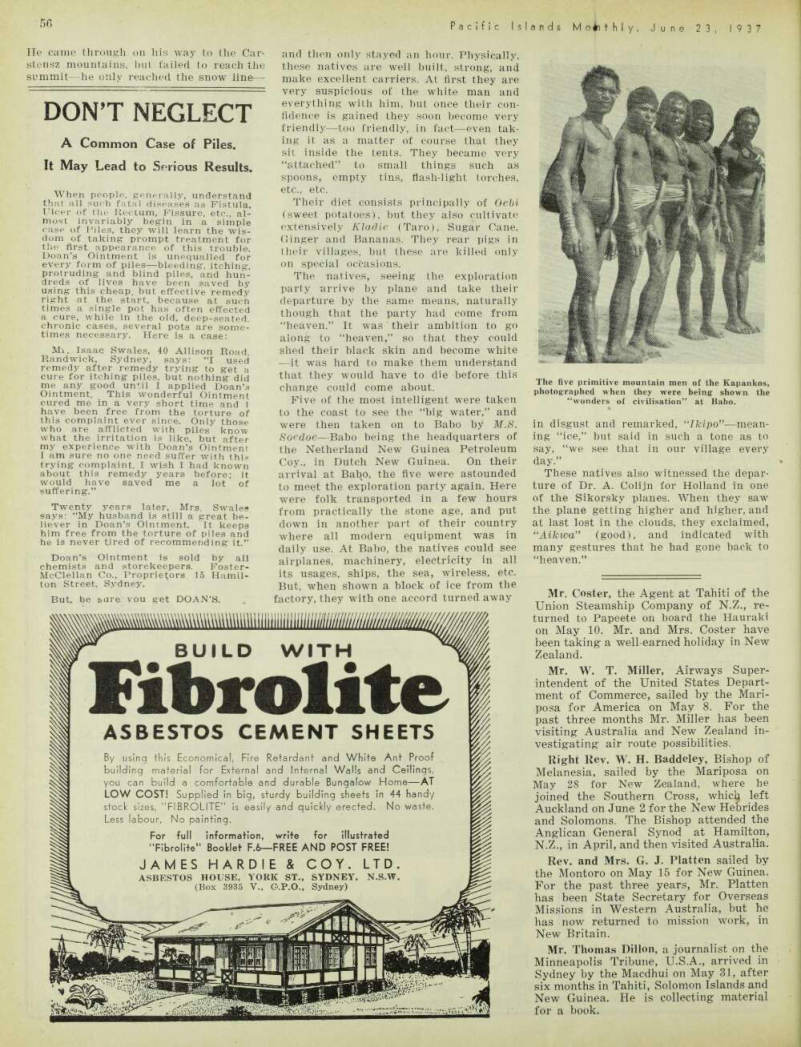
Five of the most intelligent were taken to the coast to see the “big water,” and were then taken on to Babo by M.B.
Soedoe —Babo being the headquarters of the Netherland New Guinea Petroleum Coy., in Dutch New Guinea. On their arrival at Babo, the five were astounded to meet the exploration party again. Here were folk transported in a few hours from practically the stone age, and put down in another part of their country where all modern equipment was in daily use. At Babo, the natives could see airplanes, machinery, electricity in all its usages, ships, the sea, wireless, etc.
But, when shown a block of ice from the factory, they with one accord turned away
in disgust and remarked, “7/dpo”—mean ing “ice,” but said in such a tone as to say, “we see that in our village every day.”
These natives also witnessed the depar ture of Dr. A. Colijn for Holland in one of the Sikorsky planes. When they saw the plane getting higher and higher, and at last lost in the clouds, they exclaimed, “ Aikwa ” (good), and indicated with many gestures that he had gone back to “heaven.”
Mr. Coster, the Agent at Tahiti of the Union Steamship Company of N.Z., re turned to Papeete on board the Hauraki on May 10. Mr. and Mrs. Coster have been taking a well-earned holiday in New Zealand.
Mr. W. T. Miller, Airways Super intendent of the United States Depart ment of Commerce, sailed by the Mari posa for America on May 8. For the past three months Mr. Miller has been visiting Australia and New Zealand in vestigating air route possibilities.
Right Rev. W. H. Baddeley, Bishop of Melanesia, sailed by the Mariposa on May 28 for New Zealand, where he joined the Southern Cross, whici* left Auckland on June 2 for the New Hebrides and Solomons. The Bishop attended the Anglican General Synod at Hamilton, N.Z., in April, and then visited Australia.
Rev. and Mrs. G. J. Flatten sailed by the Montoro on May 15 for New Guinea.
For the past three years, Mr. Flatten has been State Secretary for Overseas Missions in Western Australia, but he has now returned to mission work, in New Britain.
Mr. Thomas Dillon, a journalist on the Minneapolis Tribune, U.S.A., arrived in Sydney by the Macdhui on May 31, after six months in Tahiti, Solomon Islands and New Guinea. He is collecting material for a book.
The five primitive mountain men of the Kapankos, photographed when they were being shown the “wonders of civilisation” at Babo.
Sir Henry and Lady Marks and Mr. and Mrs. B. H. Marks returned to Suva on May 21.
Hon. Alport Barker, of Suva, has been elected president of the Fiji Rugby Union for 1937.