How Pacific Cable Was Laid
pp. 42-45 · Read in the full issue
The Plan To Seize Necker Island
By A. A. Henkel
TT is not generally known that Necker -*■ Island, in the Hawaiian Group, was much sought after as the first point of landing of the Pacific cable, after leaving Canada.
This island was discovered by La Per ouse on November 1, 1786, but was not considered, at the time, worth claiming.
Fanning Island was such a distance from Canada that it was not considered pos sible to lay such a long length of cable to there, and Necker Island received great attention as it lessened the distance by approximately 1,000 miles, and gave an all-British route.
Sir Sanford Fleming had urged, in 1879, that a submarine cable be laid across the Pacific to connect with the Canadian land lines, and it was due mainly to his efforts that the plan was put into operation. He is regarded as the father of the Pacific cable.
The opposition to this scheme was great and terrible disasters and difficul ties were foreseen. In particular one expert witness said that there were pre cipes with jagged edges, as tortuous as the path of a man with “a jag on,” and with a ten-acres field to perform his gyrations in. The torpedo, also, would plunge to hitherto unknown depths after the cable, and speedily bring about its end by boring through the insulation.
Sir Sanford, despite many setbacks and years of weary waiting, continued to
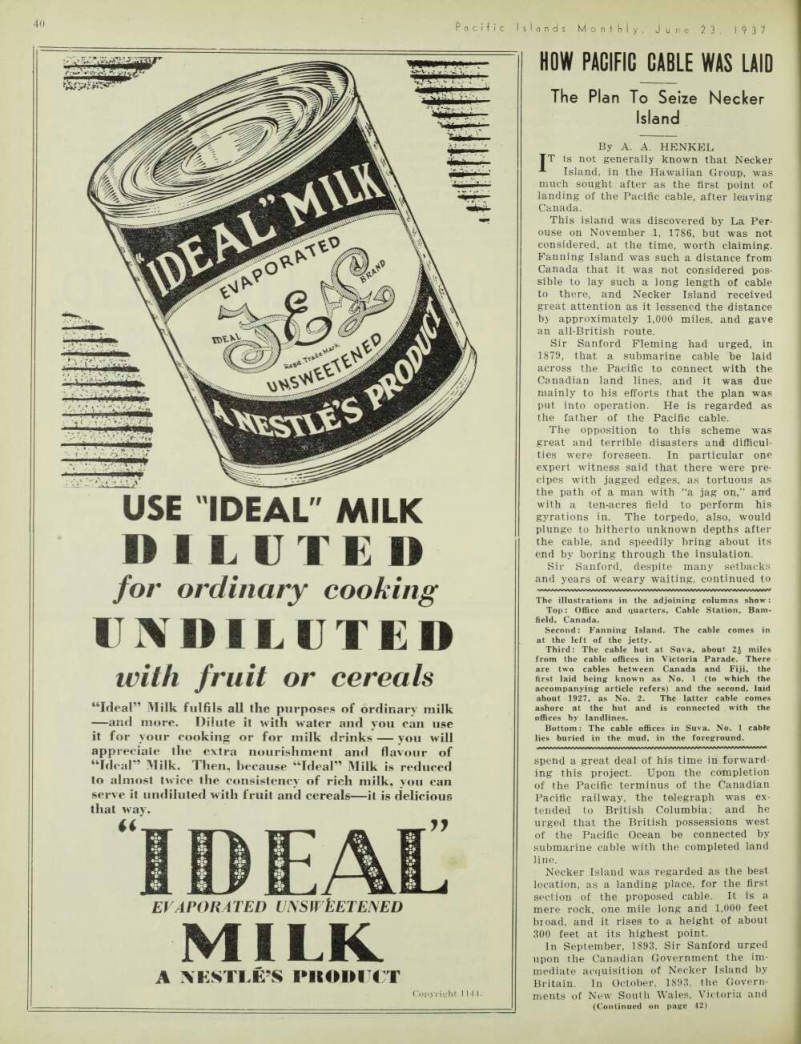
The illustrations in the adjoining columns show: Top: Office and quarters. Cable Station, Bam field, Canada.
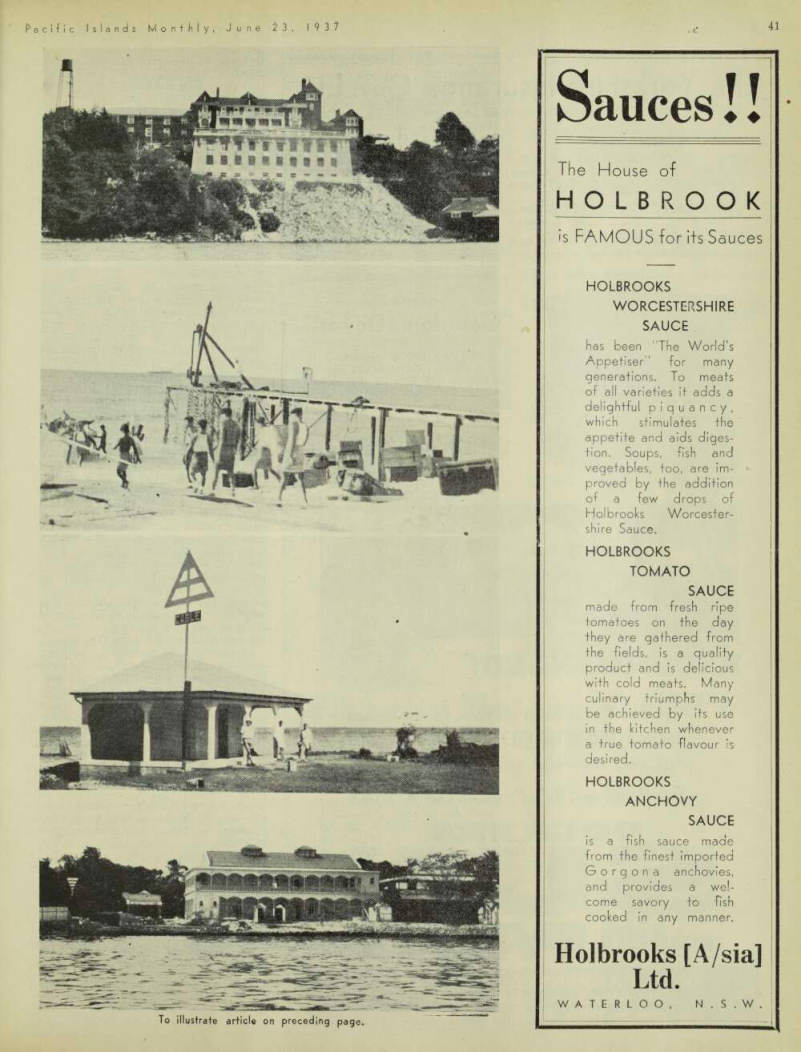
Second: Fanning Island. The cable comes in at the left of the jetty.
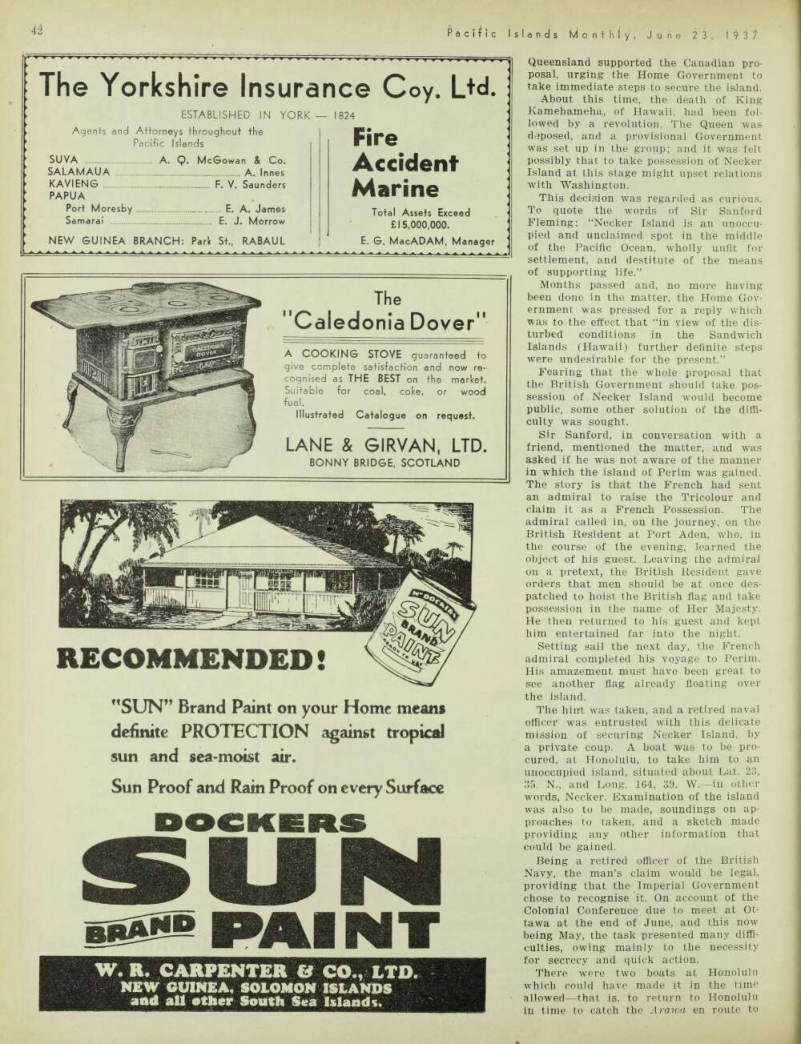
Third: The cable hut at Suva, about 2£ miles from the cable offices in Victoria Parade. There are two cables between Canada and Fiji, the first laid being known as No. 1 (to which the accompanying article refers) and the second, laid about 1927, as No. 2. The latter cable comes ashore at the hut and is connected with the offices by landlines.
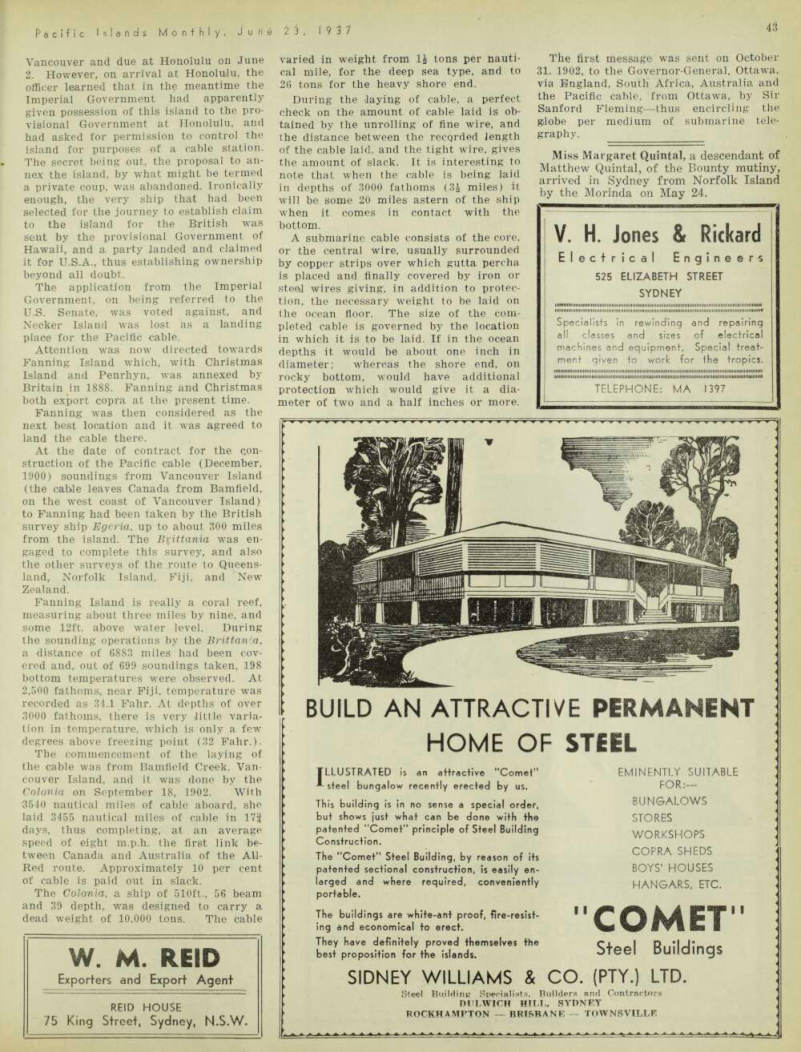
Bottom: The cable offices in Suva. No. 1 cable lies buried in the mud, in the foreground.
spend a great deal of his time in forward ing this project. Upon the completion of the Pacific terminus of the Canadian Pacific railway, the telegraph was ex tended to British Columbia; and he urged that the British possessions west of the Pacific Ocean be connected by submarine cable with the completed land line.
Necker Island was regarded as the best location, as a landing place, for the first section of the proposed cable. It is a mere rock, one mile long and 1,000 feet broad, and it rises to a height of about 300 feet at its highest point.
In September, 1893, Sir Sanford urged upon the Canadian Government the im mediate acquisition of Necker Island by Britain. In October, 1893, the Govern ments of New South Wales, Victoria and
(Continued on page 42)
To illustrate article on preceding page.
Queensland supported the Canadian pro posal, urging the Home Government to take immediate steps to secure the island.
About this time, the death of King Kamehameha, of Hawaii, had been fol lowed by a revolution. The Queen was deposed, and a provisional Government was set up in the group; and it was felt possibly that to take possession of Necker Island at this stage might upset relations with Washington.
This decision was regarded as curious.
To quote the words of Sir Sanford Fleming; “Necker Island is an unoccu pied and unclaimed spot in the middle of the Pacific Ocean, wholly unfit for settlement, and destitute of the means of supporting life.”
Months passed and, no more having been done in the matter, the Home Gov ernment was pressed for a reply which was to the effect that “in view of the dis turbed conditions in the Sandwich Islands (Hawaii) further definite steps were undesirable for the present.”
Fearing that the whole proposal that the British Government should take pos session of Necker Island would become public, some other solution of the diffi culty was sought.
Sir Sanford, in conversation with a friend, mentioned the matter, and was asked if he was not aware of the manner in which the island of Perim was gained.
The story is that the French had sent an admiral to raise the Tricolour and claim it as a French Possession. The admiral called in, on the journey, on the British Resident at Port Aden, who, in the course of the evening, learned the object of his guest. Leaving the admiral on a pretext, the British Resident gave orders that men should be at once des patched to hoist the British flag and take possession in the name of Her Majesty.
He then returned to his guest and kept him entertained far into the night.
Setting sail the next day, the French admiral completed his voyage to Perim.
His amazement must have been great to see another flag already floating over the island.
The hint was taken, and a retired naval officer was entrusted with this delicate mission of securing Necker Island, by a private coup. A boat was to be pro cured, at Honolulu, to take him to an unoccupied island, situated about Lat. 23, 35, N., and Long. 164, 39. W.- —in other words, Necker. Examination of the island was also to be made, soundings on ap proaches to taken, and a sketch made providing any other information that could be gained.
Being a retired officer of the British Navy, the man’s claim would be legal, providing that the Imperial Government chose to recognise it. On account of the Colonial Conference due to meet at Ot tawa at the end of June, and this now being May, the task presented many diffi culties, owing mainly to the necessity for secrecy and quick action.
There were two boats at Honolulu which could have made it in the time allowed —that is, to return to Honolulu in time to catch the Arawa en route to
Vancouver and due at Honolulu on June 2. However, on arrival at Honolulu, the officer learned that in the meantime the Imperial Government had apparently given possession of this island to the pro visional Government at Honolulu, and had asked for permission to control the island for purposes nf a cable station.
The secret being out, the proposal to an nex the island, by what might be termed a private coup, was abandoned. Ironically enough, the very ship that had been selected for the journey to establish claim to the island for the British was sent by the provisional Government of Hawaii, and a party landed and claimed it for U.S.A., thus establishing ownership beyond all doubt.
The application from the Imperial Government, on being referred to the U.S. Senate, was voted against, and Necker Island was lost as a landing place for the Pacific cable.
Attention was now directed towards Fanning Island which, with Christmas Island and Penrhyn, was annexed by Britain in 1888. Fanning and Christmas both export copra at the present time.
Fanning was then considered as the next best location and it was agreed to land the cable there.
At the date of contract for the con struction of the Pacific cable (December, 1900) soundings from Vancouver Island (the cable leaves Canada from Bamfield, on the west coast of Vancouver Island) to Fanning had been taken by the British survey ship Egeria, up to about 300 miles from the island. The Byittania was en gaged to complete this survey, and also the other surveys of the route to Queens land, Norfolk Island, Fiji, and New Zealand.
Fanning Island is really a coral reef, measuring about three miles by nine, and some 12ft. above water level. During the sounding operations by the Brittania, a distance of 6883 miles had been cov ered and, out of 699 soundings taken, 198 bottom temperatures were observed. At 2,500 fathoms, near Fiji, temperature was recorded as 34.1 Fahr. At depths of over 3000 fathoms, there is very little varia tion in temperature, which is only a few degrees above freezing point (32 Fahr.).
The commencement of the laying of the cable was from Bamfield Creek, Van couver Island, and it was done by the Colonia on September 18, 1902. With 3540 nautical miles of cable aboard, she laid 3455 nautical miles of cable in 17i days, thus completing, at an average speed of eight m.p.h. the first link be tween Canada and Australia of the All- Red route. Approximately 10 per cent of cable is paid out in slack.
The Colonia, a ship of 510 ft., 56 beam and 39 depth, was designed to carry a dead weight of 10,000 tons. The cable
varied in w r eight from lh tons per nauti cal mile, for the deep sea type, and to 26 tons for the heavy shore end.
During the laying of cable, a perfect check on the amount of cable laid is ob tained by the unrolling of fine wire, and the distance between the recorded length of the cable laid, and the tight wire, gives the amount of slack. It is interesting to note that when the cable is being laid in depths of 3000 fathoms (3J miles) it will be some 20 miles astern of the ship when it comes in contact with the bottom.
A submarine cable consists of the core, or the central wire, usually surrounded by copper strips over which gutta percha is placed and finally covered by iron or steel wires giving, in addition to protec tion, the necessary weight to be laid on the ocean floor. The size of the com pleted cable is governed by the location in which it is to be laid. If in the ocean depths it would be about one inch in diameter: whereas the shore end, on rocky bottom, would have additional protection which would give it a dia meter of two and a half inches or more.
The first message was sent on October 31. 1902, to the Governor-General, Ottawa, via England, South Africa, Australia and the Pacific cable, from Ottawa, by Sir Sanford Fleming—thus encircling the globe per medium of submarine tele graphy.
Miss Margaret Quintal, a descendant of Matthew Quintal, of the Bounty mutiny, arrived in Sydney from Norfolk Island by the Morinda on May 24.