Men Who Knew Yesterday
pp. 30-33 · Read in the full issue
William Blacklock, of Samoa
By Eric Ramsden
FROM the pages of the past they trooped, a goodly throng—kings and queens, chiefs and chieftainesses, sol diers, sailors, missionaries, beachcomers.
In fact,, there is hardly a name in the extensive Samoan bibliography of the last half century that William Blacklock. once Consul-General for the United States of America in Apia, does not recall.
From the windows of his home on the bush-clad slopes above Brisbane Water, he gazed east across the mangrove swamps and blue waters of the inlet, a
view that was framed by tall, slender gums. The shadows lengthened. Soon the sun would sink behind the rocky, age-scarred mountains to the west.
But his thoughts were far away from the fading Australian landscape. The swamp oaks and gums were replaced by gently waving palms. Brisbane Water faded into the beach at Apia, once men aced by the guns of Britain, Germany, and the United States. In memory, the mountains of Tutuila were sharply etched against the tropical sunset, and within their embrace lay Pago Pago, now the most important naval station in all Polynesia . . .
Only the other day a giant American clipper of the air spread her wings on the waters of Pago Pago. When William Blacklock first saw that harbour, the echo of the paddles of the war-canoes had not yet died aw r ay. To him was entrusted the duty, on behalf of the U.S.
Government, of completing the settle ment of all claims, both Samoan and
European, to the future naval base; the negotiations for which were initiated by Consul-General Sewall in 1890.
A Pawn In The Game
He had seen the warships of the Great Powers assemble off Apia at a time when the whole world had watched, with no little anxiety, the battle for supremacy between rival chieftains for the kingship of those islands —a pawn in the inter national game.
William Blacklock had seen the war vessels of the United States and Ger many pounded by the great hurricane of 1889, when every vessel then in port, with the exception of H.M.B. Calliope . had been destroyed, or hopelessly crippled by that appalling storm. In Rear- Admiral Kimberley’s report to the U.S.
Government occurs this passage: “Of the foreign residents of Apia, the U.S. vice- Consul, Mr. W. Blacklock. was pre-emin ently conspicuous for his energy and good
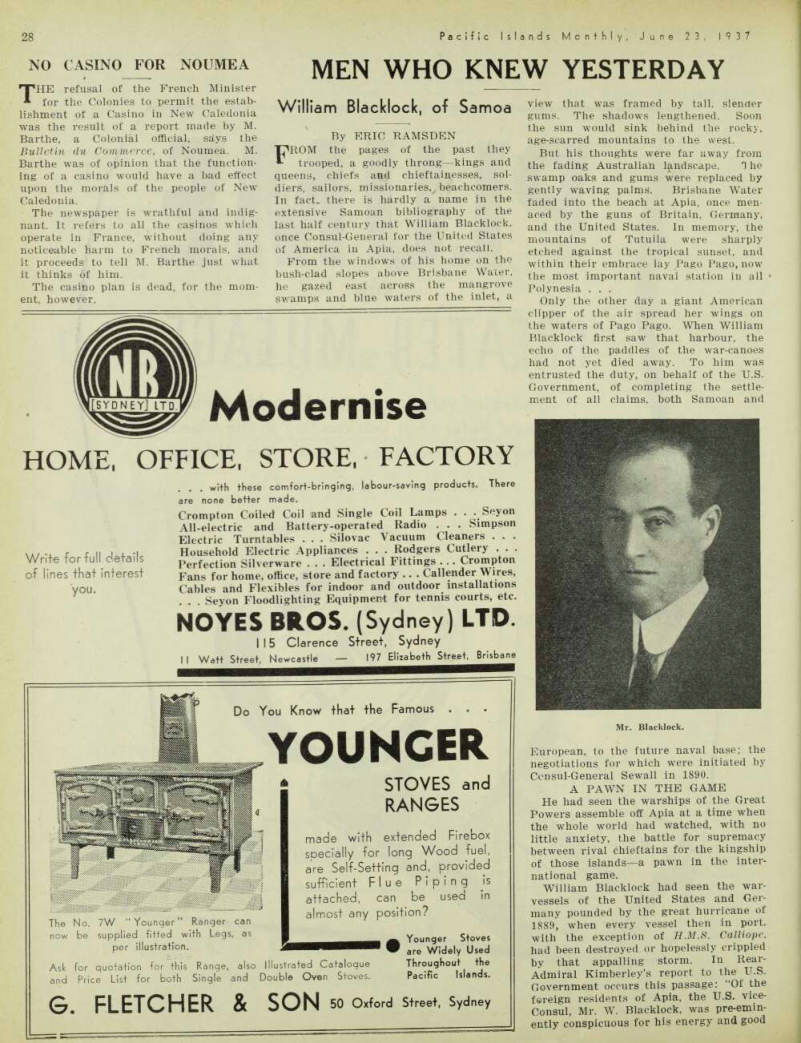
Mr. Blacklock.
services, not only in saving life, but in caring for the immediate and pressing wants of the survivors of the Vandalia, most of whom were taken to the Consul ate. Too much cannot be said in justice to his exertions and hospitality on this occasion.”
Hand-in-hand with the chief Seumanu tafa and a number of Samoans and Europeans, he waded into the swirling in-shore waters of Apia harbour, follow ing the memorable hurricane, and res cued bodies. After some difficulty they secured the body of a young mid-shipman from the U.S.S. Vandalia. The lad was more dead than alive. In time, however, he recovered, and lived to return to the Pacific in 1925 as Rear-Admiral H. A.
Wiley, in command of the West Virginia and the battleship division of the U.S.
Fleet, then on a goodwill cruise. Unfor tunately, Mr. Blacklock and the Admiral did not meet when the Fleet was in Sydney harbour. It was not until the eve of departure that Admiral Wiley learnt of Mr. Blacklock’s presence in Australia. However, they have been in communication since.
Storekeeper, trader, auctioneer, and finally Islands merchant in Sydney, Wil liam Blacklock has observed the Samoan drama since 1883. Born in Victoria of Scots parentage more than 80 years ago, he settled in Southland, New Zealand, with his family as a child. When a lad of 16 he sailed from Port Chalmers for the United States, and obtained his first glimpse of Islands life when passing through Honolulu in 1872. During a stay of 11 years in the United States, spent principally in the then still pion eering state of Oregon, he obtained American citizenship, a privilege that was subsequently forfeited on returning to his native land many years later.
Malietoa And Mataafa
When he first landed in Apia, apart from the missionaries and their wives, there was but a handful of Europeans in the group. There was no regular mail service. Foreign residents received their letters two or three times a year by schooner from Fiji.
He has lived through the most stirring period in Samoan history. As the official representative of his Government, in subsequent years he played an important part, both in the negotiations that fol lowed the Malietoa and Mataafa episodes, and behind the scenes* He was one of the three Consuls who, with King Malietoa,
signed the Berlin Treaty of 1890. Britain, Germany, and the United States were all vitally concerned in the fate of Samoa.
Fnally, the islands were partitioned be tween Germany and the United States.
Britain, compensated by being given a free hand in the Solomons and Tonga, agreed to withdrawal.
Since 1905, Mr. Blacklock has made his home in Australia.
The German administration so success fully initiated by Dr. W. H. Solf in W.
Samoa, has been replaced by that of N.Z. under mandatory powers from the League of Nations. But the real solution for the settlement of Samoa’s internal difficulties is no nearer finality than it was half a century ago. The Samoans still remain the “Irishmen of the Pacific.”
Across the pages of history pass a not able assembly There are Mata’afa, three times selected King of Samoa, and even tually exiled to Jaluit, in the Marshalls; and Malietoa, his predecessor, who had an even more extensive experience of exile in Germany, the Cameroons, and finally in Jaluit; Bassett ' Haggard (brother of the famous novelist), then a Land Commissioner in Samoa, once referred to Malietoa as that “poor bat tered old sovereign.”
Haggard, then a British official, was a contemporary of William Blacklock’s at Apia. On one occasion they were out shooting pukeko together. The English man, when jumping a ditch in a taro plantation, put a charge of shot through the rim of the American Consul’s tropi cal hat. “He was most apologetic, of course,” commented Mr. Blacklock, “hut it was, nevertheless, a close shave!”
Bassett Haggard was the author of a reply to R. L. Stevenson, which he titled “An Object of Pity” by “A Gentleman of Quality.” In satirical verse, he ex plained: “ Friend , I have written at your bidding.
Things until notv kept in hiding . . .”
The book is now keenly sought after by South Sea collectors. A copy is in the Mitchell Library in Sydney.
Association With Stevenson
Mr. Blacklock was associated with “Tusitala” and William Cooper, (a brother of the late Mr. Justice Cooper, of New Zealand), then a municipal magistrate in Apia, in establishing the Samoa Herald. Owing to its repeated attacks on the Germans, the Samoa Times had been closed up and the press taken to Fiji. “So we had to establish another paper.” Mr. Blacklock explained.
“Stevenson and Cooper were chiefly pro minent. Naturally enough, I had to keep in the background.”
In those days an editor’s job in the South Seas was no sinecure. On one occasion a party of German ratings was detailed off to administer chastisement to the editor of the Samoa Times. How ever, they mistook their quarry, and Jones, the German Government printer (who was, of course, in German employ) received the punishment! In the dark, the ratings mistook their man.
“Socially, Stevenson was one of the whitest men and a most charming host,” said Mr. Blacklock. “He was kind-hearted and generous, but he was also a man with a most violent temper. I regarded him as a past-master in the art of swearing!”
But. politically, he considered R.L.S. was dangerously ambitious, and a menace to the peace of the islands. “So much so that at one time he was threatened by the British Government with deporta tion,” he added. “It must also be remem bered, however, that Stevenson was an ill man, and I consider that his life was ruined through the influences of matri monial entanglements.”
Among his photographs Mr. Blacklock found one of a young and handsome ga*, typical of the Samoan aristocracy of oo years ago. The girl was Sueiga’s sister.
Sueiga was the wife of the second Tama sese who, replete in uniform and epam ettes, smiled grimiy from the opposite page. Sueiga achieved some notonty by dancing faa Samoa with a bust of Kaiser Wilhelm I. in her arms. The bust had come ashore with other flotsam and jet som from one of the German war-vessels after the hurricane of ’B9. “Sueiga meant no harm,” said Mr. Blacklock, “but the German Consul took her action seriously, and demanded a very heavy fine!”
Incidentally, several pieces of plate that once belonged to the Trenton's wardroom and were recovered from the wreck, now grace the former Consul s sideboard as souvenirs of the great hur ricane.
Dr. Shirley Baker
A Pacific personality known to Mr.
Blacklock was the Rev. Dr. Shirley Baker, Premier of Tonga, and holder of almost every portfolio within the gift of the old king, George Tubou I. They met at a time when the missionary-Prime Minister visited Samoa for the purpose of obtaining American citizenship.
The British authorities in Suva were becoming a trifle too inquisitive for Dr.
Baker’s liking, and he though that, if he secured American nationality, the Governor of Fiji would not have such a hold over him. “However, he found from Consul-General Sewall that he could not take out American papers in Samoa,” observed Mr. Blacklock. “Although Baker was primarily first for Baker, and Tonga came next, he was a man of great ability and he did a great deal of good for Tonga. The splendid land system which native-born Tongans enjoy to-day was the result of his vision, and they should be thankful to him. After all, Tonga is to day the only independent kingdom in the Pacific.”
Dr. Sole
Another figure that emerged from the past was Dr. Solf, the first German ad ministrator of note in Western Samoa, whose memory is still revered by many Samoans. He was not entirely a novice in colonial affairs when he arrived in Samoa for he had served in what was then German East Africa, and he had also the good sense to study British admini stration in Fiji.
Mr. Blacklock instanced Dr. Solf as an example of the success of a well-trained civilian as Governor of Samoa. “It is no use sending a military man there.” he added. “Whites or natives will have none of them!”
Captain “Bully” Hayes was dead when Mr. Blacklock went to Samoa, but he knew his widow and two daughters.
“Queen -Emma” Of New Britain
“A slendid woman, and most capable in business,” was his description of “Queen Emma,” the daughter of Jonas M. Coe, an American resident of Apia, and his wife, a high-caste Samoan. “Koe”, as Emma was once known, and hed friend Moe. were such pretty girls that they were the toast of Apia. In later years “Queen Emma,” as the former became
known, pioneered settlement in New Britain and acquired considerable wealth.
She was married in Apia and her son still asides at Vaucluse, near Sydney.
The Purchase Of Pago Pago
One of Mr. Blacklock’s most important duties was to secure the purchase of Pago Pago harbour for his Government.
This was partly achieved on the island of Aunu, near the harbour entrance, the rightful chiefs having been driven out of Pago Pago by rebel warriors. “My instru ctions were to buy each and every claim outright,” he remarked, “and money was no object.” 100,000 dollars was appropri ated for that purpose.
One of the results of the famous hur ricane of 1889 was the birth of the American Navy as it is known to-day.
The war vessels sent to Samoa at Mr.
Blacklock’s request had been built in Confederate days. The United States Government realised that if her flag was to be respected in the Pacific and else where, modern ships must be built.
One of Mr. Blacklock’s most exciting memories was the concealment of the American journalist, Kleibe, in the Apia Consulate. The Germans were anxious to secure him, and if they had done so, they would have hanged him from the yard arm of one of their ships. However, Mr.
Blacklock managed to get him into the Consulate, and later, through the conni vance of Commander Mullen, of the U.S.S. Nipsic , he was taken on that vessel away from the group and transferred to a mail-boat.
Samoa has witnessed some dramatic interludes since the former U.S. Consul left her shores for good. Yet there are few people alive to-day who can claim to have greater personal knowledge of the historic happenings of the past.