“Fijian” Lost
pp. 23-24 · Read in the full issue
Result of Explosion Near Marshalls
From a Special Correspondent JALUIT, April 21.
HN March 25, an S.O.S. was picked up ” by the wireless operator here. It was then reported that something had
happened to a steamer in the neighbour hood of Aur, an atoll about 150 miles N.E. of Jaluit. Later, it was learned that the vessel was on her way to this port under her own power. Later, still, there were further S.O.S. signals, then silence.
A small Japanese inter-island steamer, equipped with wireless, that happened to be at a nearby atoll, was instructed by the local authorities, to go to the rescue.
Three days later the vessel arrived here with 10 white men all Norwegians and 20 Chinese on board the captain and crew of the vessel that had sent out the distress signals.
It appears that this craft, the Fijian, 6,000 tons vessel, powered with Diesel motors, port of registration, Panama, was on her way from San Francisco to New Guinea with a cargo of gasoline, kero sene, lubricating oil and lumber. About 5 a.m. on March 25. the weather being fine and clear, a terrific explosion oc curred in the fore-hold: the hatch was blown open, the derrick was smashed, and a lot of lumber on deck shot over board. Two of the Chinese crew were injured, one of them seriously, and an other thrown overboard.
The chief engineer states that from the shock of the explosion, he thought the vessel had struck a reef. Rushing on deck, he saw lumber floating past, and a man with an arm over a piece, waving his other arm to the vessel as she sped onward. Then the bell rang, and the vessel stopped.
What appeared to be columns of smoke poured out of the damaged hatch. Fear ing a similar explosion aft, which would have certainly destroyed the boats, these
were lowered immediately, the Chinese crowding into the lar ger. A little later the captain and officers took to the other boat, but stood by the vessel at a little distance.
A couple of hours later dan ger signals subsiding, all re turned on board. The motors were started once again, and the course was set for Jaluit.
A leak had developed, and the pumps were kept going, but the leak gained, so the course was altered for Mejuro, an atoll, much nearer than Jaluit.
About 5 p.m., when about 12 miles north of Mejuro, the vessel began to list badly to
port, and it became evident that she could not be kept afloat long enough to reach safety in that lagoon, so all hands took to the boats once more. Fifteen minutes later, the vessel turned turtle, and then sank bow foremost.
Sails were then hoisted in the boats, which were headed in the direction where the land was supposed ta be. The wind being light, and the sails small, little progress was made during the night. Just before daybreak, the lights of an approaching steamer were sighted.
It proved to be the inter-island steamer
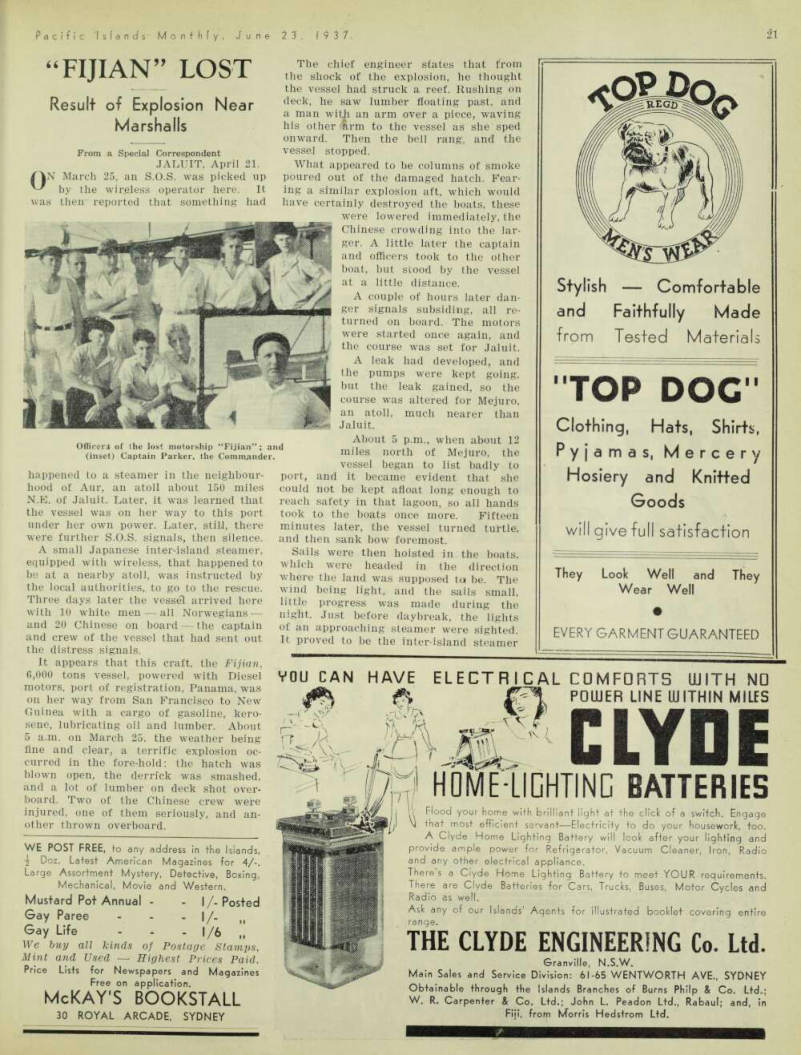
Officers of (he lost motorship “Fijian”; and (inset) Captain Parker, the Commander.
which had been despatched in response to the S.O.S. A few days after arrival here, one injured man died. It is ex pected that the crew will leave for Japan within a few days.
Within a week of the sinking of the Fijian, much of her cargo drifted ashore at Mejuro and Arno. The exact quantity is not yet known, but probably there is between two and three thousand drums of gasoline, many cases of kerosene, ben zine, etc., and a large quantity of lumber.
Just what will become of all this is not yet apparent.