Volcanic Eruptions Compel Evacuation Of Rabaul
pp. 11-75 · Read in the full issue
Residents Endure Many Days of Terror, Dirt and Discomfort—Followed By Period , of Administrative Discord—Two Europeans and Several Natives Killed
VOLCANIC ERUPTIONS, long-expected, occurred near Rabaul, chief town of New Guinea, on May 29. A new crater formed at Vulcan Island, and the old Matupi crater exploded.
Rabaul and countryside were smothered under a huge fall of ashes and dust.
The whole population, after a night of terror, was removed to Kokopo. Many women and children have been brought to Australia.
A section of the civil population is in sharp conflict with the Administrator, on the question of whether Rabaul is suitable for re-occupation.
'THE story of the eruptions, the evacua * tion of Rabaul, and many events associated therewith, has been told in scores of newspaper despatches from Rabaul and Kokopo.
From those disconnected despatches, the following account of the disaster has been compiled. So that the events may be followed, they have been chronologi cally arranged.
Friday, May 28.
■THERE was a sharp earth tremor at 1.15 p.m. The harbour waters receded and returned. There were landslides along the Kokopo road. Matupi crater commenced to send out heavy smoke.
Mrs. G. Further, wife of a Rabaul storekeeper, was lying in bed in her
home, eight miles from Rabaul, suffering from a broken hip when a tremor shook her house down. She was thrown to the floor. A wardrobe in her room blocked the door and native boys had to climb through the windows to get her out,
The “Black-Out”
Saturday, May 29.
tremors commenced at dawn, and continued, with growing inten sity. Great earth-cracks opened on Matupi Island. From noon onwards, there was a feeling of uneasiness among the people.
Between 4 and 4.30 p.m. (approxi mately 4.20) Vulcan Island blew up in a succession of terrifying explosions.
Masses of smoke, steam and volcanic dust covered the sky; ashes and dust were
showered over the entire countryside northwest and north of Vulcan, including Rabaul; total darkness supervened within 30 minutes. Matupi crater also became very active, shaking the town continu ously. Frequent bursts of flame over Vulcan had the effect of lightning dis charges which continued all night.
White-hot rocks were thrown to a great height out of Vulcan crater. The town was literally smothered in dust—people could not see more than a few yards.
Thus commenced a night of terror, in which few slept. Yet there was no panic.
The people gathered in groups, at first, to discuss the situation. Their hair be came matted with dust and their mouths filled with mud. There was dust every where.
Vulcan’s activity continued severely for some two hours, and then subsided somewhat, and by 9 p.m. it was notice ably reduced. Conditions continued very alarming and unpleasant, however.
With the darkness, there presently came torrential rain, turning the du»t into mud and adding to the terrors of the night. The downpour quickly formed raging torrents on the hillsides northwest of Rabaul, and these tore at least three gaping canyons across the road to Wuna watung and the north coast, and cut off road communication in that direction.
This exceptional rain was the result of the condensation in the cold upper air of the masses of steam being ejected from the volcanoes.
Exodus
A general exodus from Rabaul com menced early in the evening’.
Many people tried to get away by Kokopo and North Coast roads, but they were mostly blocked by debris and land slides. A number of Europeans went aboard the American freighter Golden Bear, which had come in for copra, and was lying in the harbour, between the town and Vulcan.
Early on Saturday evening, while
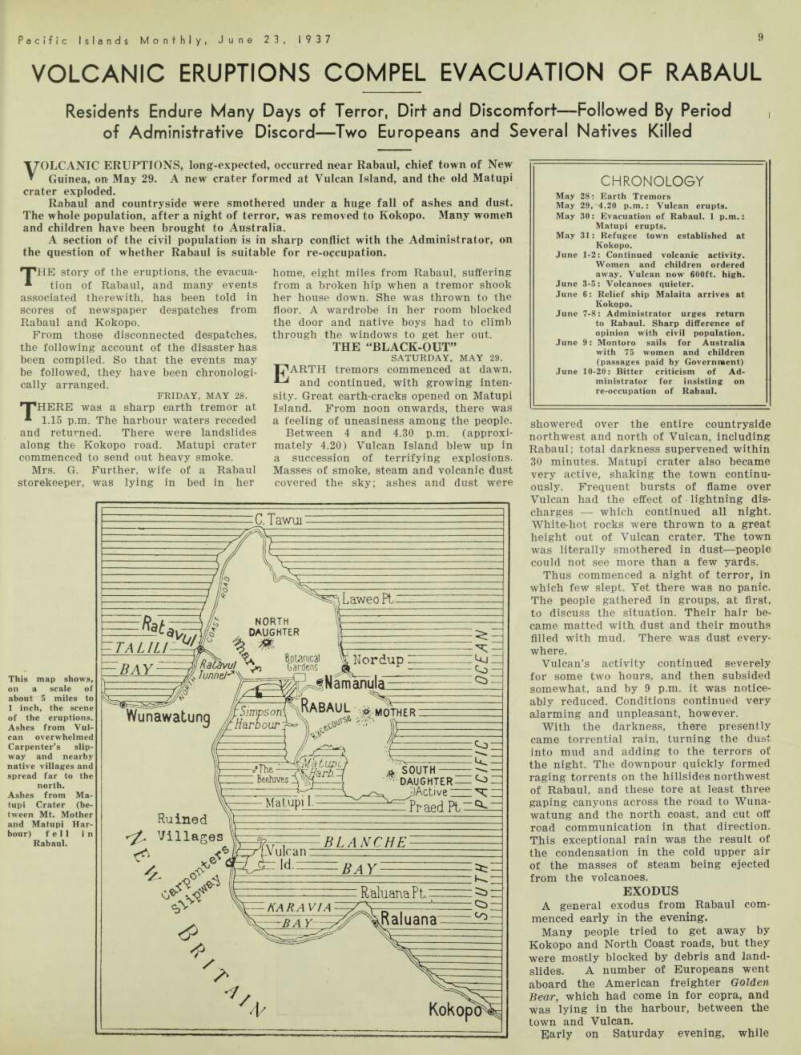
This map shows, on a scale of about 5 miles to 1 inch, the scene of the eruptions.
Ashes from Vul can overwhelmed Carpenter’s slip way and nearby native villages and spread far to the north.
Ashes from Ma tupi Crater (be tween Mt. Mother and Matupi Har bour) fell in Rabaul.
Vulcan was erupting in a terrifying man ner, large numbers of private cars, filled with fleeing families, went up the eastern road, towards Namanula and Nordup.
Women with small children crowded into the Namanula hospital, and the doors were closed, to keep out the dust and the sulphur fumes. The fumes, outside, were overpowering, while inside, the heat was unbearable.
Cars continued to arrive, adding to the dirt and confusion. The later arrivals were literally covered with ashes and pumice dust. There were innumerable urgent inquiries after friends and rela tions, but no panic. The children were gathered into special rooms at the hospi tal, out of the dust and fumes. The par ents sat up all night.
Captain Eugene Olsen, of the Golden Bear, decided to get out of the harbour, and in the darkness he ran the gauntlet between Vulcan and Matupi, through water covered with masses of dust and cinders. He got his ship safely out into Blanche Bay, and then he went around to Nordup, where he lay for the rest of the night.
The New Guinea people expressed much gratitude to this American captain and crew.
Radio Men’S Troubles
The radio operator on the Golden Bear, Victor Castner, an American, aged 45, was ashore when Vulcan erupted, and was never seen again. Probably, he fell into the harbour when trying to get aboard, through the dust and darkness.
Because the eruption was threatening the radio station in Rabaul, the mainten ance of the Golden Bear outfit was neces sary; and Mr. S. W. Faulkner, a member of the staff of W. R. Carpenter and Co., volunteered to take over the station.
Mr. Faulkner was confronted with a great pile of official and private messages, awaiting transmission, but he stuck gal lantly to his big task. For a time when the A.W.A. men were driven out by sul phur fumes and ash, Mr. Faulkner’s radio
was the only means of communication with the outside world.
The radio receiving station at Mala guna (two miles from Rabaul) was in danger, and the Rabaul inspector, Mr.
Twycross, advised the operator on duty, Mr. L. C. Coleman, to leave. Mr. Coleman remained, however. Meanwhile, Mr. C. H.
Sturgeon, another operator, got the wo men of the radio station into a car, and set out for the north coast. They en countered dust, ashes, mud and torrential rain; Mrs. Thomas fell and broke her leg; but they got through. Mr. Sturgeon tried to return, but was held up by a cloudburst and washaways.
At the transmitting station, in Rabaul, Mr. C. B, Alexander was making every effort to keep the equipment in action, but when cinders, sulphurous smoke, and mud overwhelmed him, and the power plant broke down, and he could no longer see, he gave it up. Thus, for a little while only, was Rabaul station off the air —actually, from 6 p.m. on Saturday until 12.15 a.m. on Sunday.
Evacuation Of Town
Sunday. May 30.
DY Sunday morning, Vulcan had become quieter, but Matupi’s activity had markedly increased.
Judge Phillips, in the absence of the Administrator and Deputy Adminis trator, took charge of the situa tion. He decided upon the immediate evacuation of the town’s population to Kokopo, via Namanula and Nordup. He found that, during Saturday night and in the early hours of Sunday, a large pro portion of the European population had gathered on the hill at Namanula, be hind Rabaul, where there are a few resi dences, Government House and the Euro pean hospital: and women and children had been cared for there.
An emergency organisation was quickly put into operation, to take care of mobi lisation, transport and supplies. Police and special messengers were sent out in all directions, instructing the people (800 Europeans, 1,000 Chinese and over 5,000
natives) to assemble quickly at Naina nula and Nordup.
The organisation was:—Judge Phillips in charge of Rabaul and district; Mr.
W. B. Ball in charge of police and essen tial services; Mr. R. Melrose in charge of stores; Mr. H. A. Gregory in charge of Nordup Beach; Mr. D. Waugh, assisted by a committee of officials and residents, in charge of Kokopo and district. On the medical side, Dr. R. W. Cooper was in charge of Rabaul and district, and Dr. T. C. Backhouse of Kokopo and dis trict.
These officers were assisted by bodies of officials and civilians and, in the cir cumstances, extraordinarily good work was done. The difficulty of removing some 8,000 people, from a smothered town, over choked roads, with improvised transport, supplies and shelter, can be better imagined than described.
As the people assembled, they were drafted to cars, and taken to Stony Beach at Nordup. It is about two miles from Rabaul to Namanula, and another two miles from Namanula to Nordup. Trans port was exceedingly difficult. The roads were choked with dust, ashes and smash ed trees, and many cars had been buried.
There were hours of weary waiting in the heavy, humid heat, amid dust and discomfort, but there were few com plaints. They were “all in it together.”
The Golden Bear, which had come round to Nordup during Saturday night, was the first to receive refugees from' Nordup beach. But all sorts of schooners and small craft were pressed into ser vice. There was only*a small wharf — the larger craft had to lie off, both at Nordup and Kokopo.
The officials, willingly assisted by vol unteers, worked tirelessly. They not only had to shift the entire population, but they also had to provide for their shelter and food. It was declared to be “a state of emergency,” and transport and sup plies were commandeered as required.
That some 8,000 people, with food and equipment, and including aged folk and the inmates of hospitals, were got away from Nordup beach between 6 a.m. and 6 p.m., with improvised transport, was a masterpiece of organisation, co-opera tion and hard work, for which full credit must be given to Judge Phillips and his officials.
Patients from the European hospital were carried out, and down the beach by natives, on stretchers and mattresses.
Native patients from the Rapindik hospital were similarly removed. Some went crazy with fear and fled, however.
Four, one of them a woman, were found on Monday, wandering naked in the de serted town.
The gaol was opened and the prisoners set free. In the following week, they helped to clean the streets and returned to gaol of their own accord.
Matupi Eruption
HTHE embarkation was proceeding with orderliness at Nordup, and the Golden Bear was on her way to Kokopo with a load of Europeans and natives, when Matupi exploded (about 1 p.m. on Sunday). There was a momentary panic
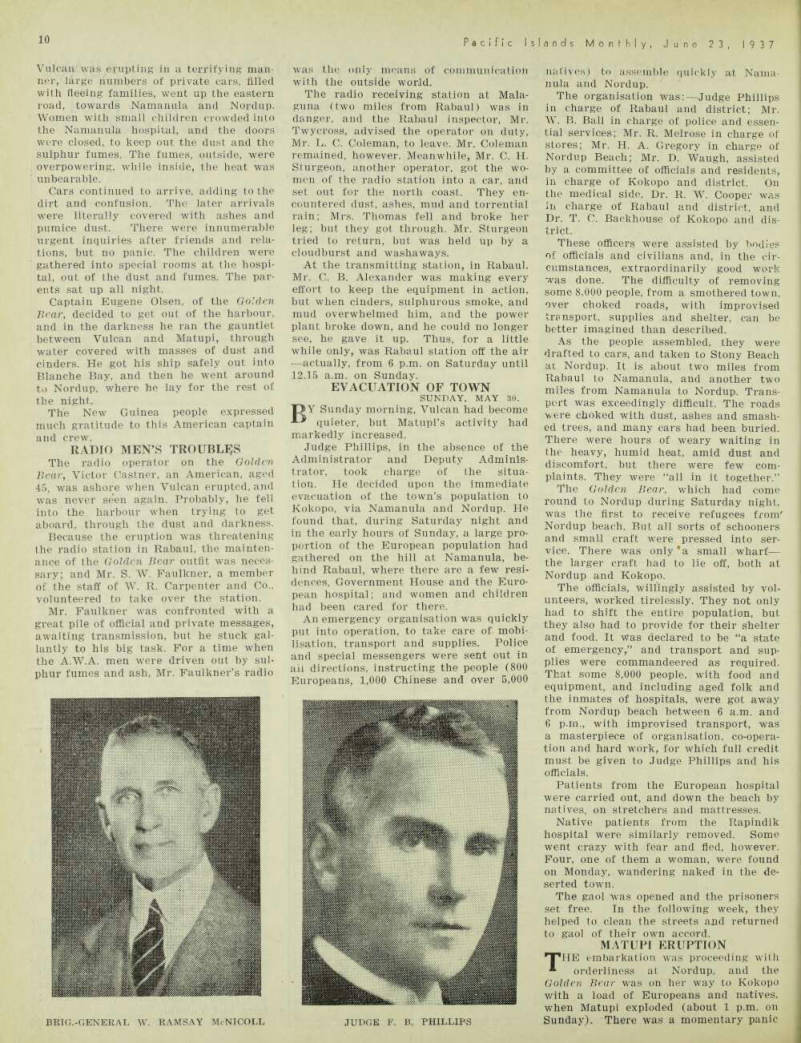
Brig.-General W, Ramsay Mcnicole
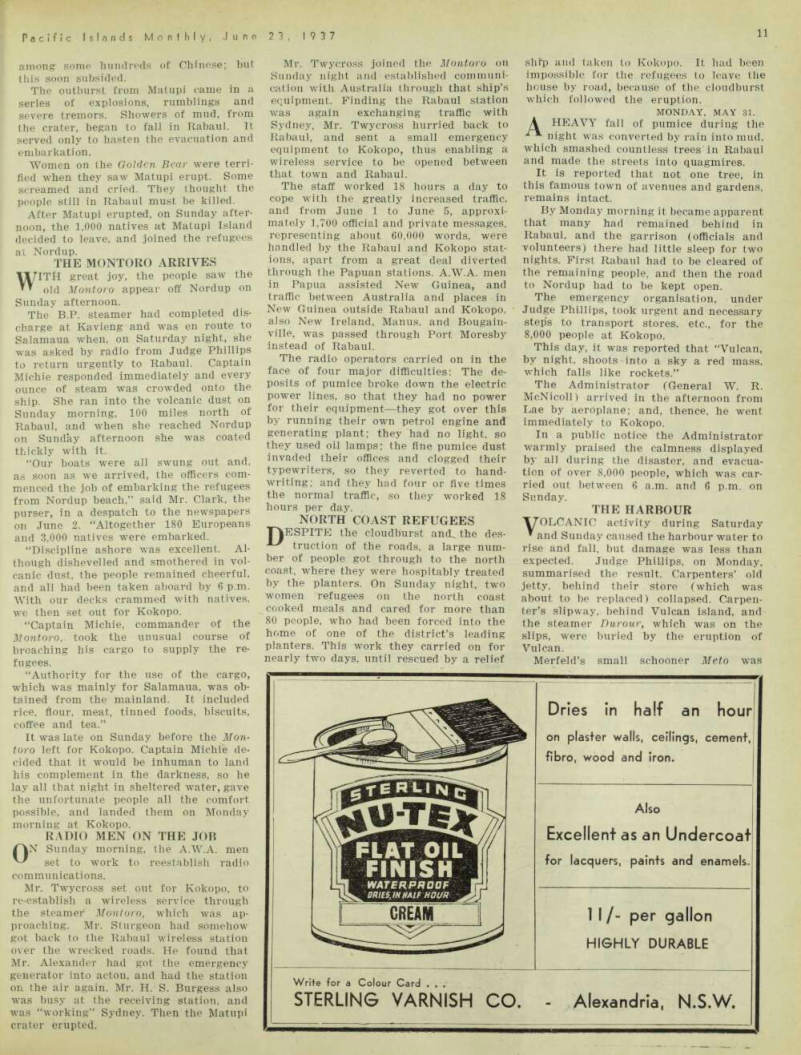
Judge F, B, Phillips
among some hundreds of Chinese; but this soon subsided.
The outburst from Matupi came in a series of explosions, rumblings and severe tremors. Showers of mud, from the crater, began to fall in Rabaul. It served only to hasten the evacuation and embarkation.
Women on the Golden Bear were terri fied when they saw Matupi erupt. Some screamed and cried. They thought the people still in Rabaul must be killed.
After Matupi erupted, on Sunday after noon, the 1,000 natives at Matupi Island decided to leave, and joined the refugees at Nordup.
The Montoro Arrives
linTH great joy, the people saw the ▼▼ old Montoro appear off Nordup on Sunday afternoon.
The B.P. steamer had completed dis charge at Kavieng and was en route to Salamaua when, on Saturday night, she was asked by radio from Judge Phillips to return urgently to Rabaul. Captain Michie responded immediately and every ounce of steam was crowded onto the ship. She ran into the volcanic dust on Sunday morning, 100 miles north of Rabaul, and when she reached Nordup on Sunday afternoon she was coated thickly with it.
“Our boats were all swung out and, as soon as we arrived, the officers com menced the job of embarking the refugees from Nordup beach,” said Mr. Clark, the purser, in a despatch to the newspapers on June 2. “Altogether 180 Europeans and 3,000 natives were embarked.
“Discipline ashore was excellent. Al though dishevelled and smothered in vol canic dust, the people remained cheerful, and all had been taken aboard by 6 p.m.
With our decks crammed with natives, we then set out for Kokopo.
“Captain Michie, commander of the Montoro, took the unusual course of broaching his cargo to supply the re fugees.
“Authority for the use of the cargo, which was mainly for Salamaua, was ob tained from the mainland. It included rice, flour, meat, tinned foods, biscuits, coffee and tea.”
It was late on Sunday before the Mon toro left for Kokopo. Captain Michie de cided that it would be inhuman to land his complement in the darkness, so he lay all that night in sheltered water, gave the unfortunate people all the comfort possible, and landed them on Monday morning at Kokopo.
Radio Men On The Job
/'AN Sunday morning, the A.W.A. men ” set to work to reestablish radio communications.
Mr. Twycross set out for Kokopo, to re-establish a wireless service through the steamer Montoro, which was ap proaching. Mr. Sturgeon had somehow got back to the Rabaul wireless station over the wrecked roads. He found that Mr. Alexander had got the emergency generator into acton, and had the station on the air again. Mr. H. S. Burgess also was busy at the receiving station, and was “working” Sydney. Then the Matupi
crater erupted.
Mr. Twycross joined the Montoro on Sunday night and established communi cation with Australia through that ship’s equipment. Finding the Rabaul station was again exchanging traffic with Sydney, Mr. Twycross hurried back to Rabaul, and sent a small emergency equipment to Kokopo, thus enabling a wireless service to be opened between that town and Rabaul.
The staff worked 18 hours a day to cope with the greatly increased traffic, and from June 1 to June 5, approxi mately 1,700 official and private messages, representing about 60,000 words, were handled by the Rabaul and Kokopo stat ions, apart from a great deal diverted through the Papuan stations. A.W.A. men in Papua assisted New Guinea, and traffic between Australia and places in New Guinea outside Rabaul and Kokopo, also New Ireland, Manus, and Bougain ville, was passed through Port Moresby instead of Rabaul.
The radio operators carried on in the face of four major difficulties: The de posits of pumice broke down the electric power lines, so that they had no power for their equipment—they got over this by running their own petrol engine and generating plant; they had no light, so they used oil lamps; the fine pumice dust invaded their offices and clogged their typewriters, so they reverted to hand writing: and they had four or five times the normal traffic, so they worked 18 hours per day.
North Coast Refugees
TAESPITE the cloudburst an<L the des truction of the roads, a large num ber of people got through to the north coast, where they were hospitably treated by the planters. On Sunday night, two women refugees on the north coast cooked meals and cared for more than 80 people, who had been forced into the home of one of the district’s leading planters. This work they carried on for nearly two days, until rescued by a relief
ship and taken to Kokupo. It had been impossible for the refugees to leave the house by road, because of the cloudburst which followed the eruption.
Monday, May 31.
A HEAVY fall of pumice during the night was converted by rain into mud, which smashed countless trees in Rabaul and made the streets into quagmires.
It is reported that not one tree, in this famous town of avenues and gardens, remains intact.
By Monday morning it became apparent that many had remained behind in Rabaul, and the garrison (officials and volunteers) there had little sleep for two nights. First Rabaul had to be cleared of the remaining people, and then the road to Nordup had to be kept open.
The emergency organisation, under Judge Phillips, took urgent and necessary step's to transport stores, etc,, for the 8,000 people at Kokopo.
This day, it was reported that “Vulcan, by night, shoots into a sky a red mass, which falls like rockets.”
The Administrator (General W. R.
McNicoll) arrived in the afternoon from Lae by aeroplane; and, thence, he went immediately to Kokopo.
In a public notice the Administrator warmly praised the calmness displayed by all during the disaster, and evacua tion of over 8,000 people, which was car ried out between 6 a.m. and 6 p.m. on Sunday.
The Harbour
'l/'OLCANIC activity during Saturday * and Sunday caused the harbour water to rise and fall, but damage was less than expected. Judge Phillips, on Monday, summarised the result. Carpenters’ old jetty, behind their store (which was about to be replaced) collapsed. Carpen ter’s slipway, behind Vulcan island, and the steamer Durour , which was on the slips, were buried by the eruption of Vulcan.
Merfeld’s small schooner Meto was
washed into the garden of Mr. Townsend, the treasurer at Rabaul.
The schooner Feads sunk at her moor ings.
Two Carpenter steamers —Durour (820 tons) and Duris (671 tons), which were trapped in the harbour and lost—were valued at £20,000.
The little wooden motorship Desikoko, though trapped in the harbour, even tually escaped, on June 2. Half-way out her engine, clogged with pumice, stopped, but it was restarted, and the vessel got clear.
The smaller of the two “beehives,” which are coral outcrops in the centre
of the harbour and well-known land marks, disappeared beneath the water.
A New Mount
Tuesday, June 1.
volcano was now reported to * be a cone over 600 feet high. On Saturday morning, it was a small, very low island, which appeared after an eruption in 1878. The crater which erupted on Saturday was quiescent; but, at 12.20 p.m., another violent eruption occurred, and a new crater appeared on the eastern side of the cone. This time, the ashes did not fall on Rabaul.
It was reported, this day, that the uprising of Vulcan had filled up the for mer deep water between the island and the mainland; and that land had ap peared between Vulcan and Matupi is land, suggesting that the harbour (Simp scnhaven) had become landlocked. Sub sequent inquiry showed that what ap peared land was really floating pumice, and that the channel was open.
Destruction Of Cars
A NEWS despatch of this date:— Evidence of the hurried escapes from Rabaul can now be seen.
Cars which apparently refused to run, and others which have been wrecked, are scattered along most of the outer roads.
At Nordup beach, where many hundreds ot people were embarked, there are two paddocks choked with cars.
Scores of cars were nearly buried in the wrecked streets, where they stood before the eruption occurred. It is esti mated that damage in this respect alone amounts to £200,000.
Several cars on the north coast road at the time of the cloudburst after the eruption were caught up in torrents of water and swept into the sea.
All the remaining cars in Rabaul and in Kokopo were commandeered by the Administration, which supplied, the pet rol necessary, and used them under the state of emergency. Owners among the refugees, who up to this time had com plained very little, were now anxious to find out the possibilities of compen sation.
It was reported, only in April, that there were over 1,000 motor cars and trucks centred on Rabaul.
Administrator’S Summary
IN a statement circulated throughout the community at Kokopo, on June 1, the Administrator said:- “A state of emergency continues to exist, and the Administration has taken over control of all essential services.
“Rabaul will be untenable for many weeks. The water supply has become polluted, and no sanitation arrangements are at present possible.
“The present bad position will be in tensified when the rain comes, as the roofs of all houses are thickly covered with volcanic dust, which will become thick mud immediately it rains.
“In the circumstances, it is necessary to restrict the number of persons who may visit Rabaul.
“Only those officials on duty and others with urgent business to attend to will
be allowed to proceed from Kokopo and land at Nordup. Written authority must first be obtained.
“The public can assist greatly by selec ting from among themselves messengers to collect needed household articles left behind in the hurried evacuation. Heavy articles, other than cases containing es sential clothing requirements, may not be removed.
“The roads at present are fit for traffic only from Nordup to the Burns, Philp garage. Beyond that, the roads are strewn with fallen branches, so that the col lection of more than essential require ments is impossible.
“On my arrival at Kokopo from Lae I was greatly relieved to observe the stoic calm with which the residents of Rabaul and district were accepting the unfor tunate situation that has been forced upon them.
“We will hasten the work of clearing the debris in every way, but some little time must elapse.
“It is extremely desirable that as many women and children as possible proceed to Australia.”
Wednesday, June 2.
A LL three volcanoes, Vulcan, New Vul can and Matupi, were active; but the wind was favourable, and the show ers of ash and pumice missed the town.
Said one commentator, on the 2nd: “The pall of black ash over the land and sea contrasts vividly with the towering column of white smoke, reflecting the brilliant sunshine.”
Friday, June 4.
'"PHE Administrator declared that every * thing at Rabaul would be functioning normally within a week; but the business community and the public service would not accept this view.
Saturday, June 5.
HPHE Rabaul-Kokopo road had now been partly cleared, and motor transport was able to make two return trips per day, with supplies for the people at Kokopo.
Administrator V. Civil
Population
Monday, June 7.
*T*HE Administrator on June 7 issued a * despatch announcing that he con sidered that Rabaul was habitable, that the departments would be brought back from Kokopo within a few days, and that no further rations would be issued to refugees at Kokopo after midnight on Wednesday, June 9.
On June 7, the Administrator informed the Australian Minister, Mr. White, by radiophone: “There was no reason why Rabaul should not be in full occupation as a capital by the end of the week.”
This day, it became apparent that there was a sharp division of opinion between the Administration and commercial in terests on the question of the immediate re-occupation of Rabaul. Representatives of business firms were unanimous that it would be wiser to wait and make sure that there would not be any recurrence of the volcanic activity, but they agreed to co-operate by giving the Administra tion control of their goods and equipment until the present emergency passed.
On Monday, June 7, for the first time, women were allowed to visit Rabaul—
but only to collect personal belongings, to take to Australia. They were pre pared for the worst, but they said later they had not believed that such condi tions of dirt, destruction and disorder could be possible.
Tuesday, June 8.
DY June 8, electric light and power services had been practically res tored, thus allowing the two freezers (Carpenters and the Rabaul Freezing Co.) to regularly supply fresh food, and other establishments to operate.
In an interview on June 8, General McNicoll said that suggestions for the transfer of the capital away from Rabaul could be classed as a form of hysteria.
Wednesday, June 9.
9 1 ’HE heads of the leading firms were * emphatic on June 9 that they would
not take their full staffs back to Rabaul while it remained as at present—a mass of dried mud and penetrating, nauseous dust.
“We are not going back at present; my opinion has not been changed by any despatch,” said Mr. P. Coote, manager of Burns, Philp and Co. Ltd., in New Guinea. He said the company would operate on a small scale to serve the small population which would be return ing to Rabaul. As the population of the town increased the operations of the firm would increase. He said that he preferred to take medical advice before that of anyone else.
The general manager for New Guinea of W. R. Carpenter and Co. Ltd., (Mr.
W. H. Carpenter) said that the only way to clean Rabaul was to get everything possible out of the town and to send 2,000 or 3,000 labourers to scour the place. His company had no intention of abandoning Rabaul, but its premises would only be kept open at present for the use of the plantations, and not for ordinary business. His idea was to keep a skeleton staff of 10 there for that pur
pose, and to remove everything he could to Kokopo.
Mr. Carpenter said that he refused to let his staff work at a place where there was 2,000,000 tons of dirt to shift, and which was filthy. He could not ignore the health of the employees, and the 10 men who would work at Rabaul would return to Kokopo each night. He had learnt that the chiefs of the native tribes had ad vised their people not to go back, to Rabaul, and it was well known that many natives had refused to go back.
He thought that the Administrator’s despatch suggesting a return to normal had been issued several months too soon.
It was reported this day that some public servants do not disguise the fact that they are opposed to returning to Rabaul. They state that they will not return unless ordered to do so. They are anxious for the Commonwealth Govern ment to take some action..
On June 9, the Administration called the eruptions a “nine days’ wonder’’; declared that the majority of people were anxious to return to Rabaul; and declared that a radio broadcast descrip tion of Rabaul by the A.B.C. was “largely exaggerated and inaccurate.”
The latter statement was sharply chal lenged by the chairman of the A.B.C.
Thursday, June 10.
THERE was a sharp tremor, in which buildings rocked noticeably, early on Thursday evening, followed by a burst of activity from Vulcan, but there were no serious developments.
By this time, all residents of Rabaul had taken to wearing masks in the streets to avoid breathing the irritating dust. The Administration, in an effort to cope with the dust nuisance, began pumping water from the harbour through fire hoses, on to the nearer streets.
Many live electric wires were still ly ing about, and one native, coming in con tact with a wire, was killed.
It was noted, this w r eek, that pumice was floating so thickly upon the harbour that vessels had difficulty in moving through it. Persons could walk easily over the surface of the water, upon the pumice.
Friday, June 11.
HUNDREDS of Chinese responded to the Administrator’s invitation to go back to Rabaul and reopen their shops.
In a large number of cases, however, they just took one look at their shops— and returned to Kokopo. Consequently, it was reported on June 11 that very few of the shops in Chinatown, Rabaul, were open.
Occupation Of Rabaul
OIGHT up until June 20, daily reports in Australian newspapers described the choking dust which filled the streets of Rabaul. the unwillingness of the people to return, and their resentment of the attitude of the Administrator.
Sir George Pearce, Australian Minister for Territories, on June 16, publicly an nounced that he was ignoring the com
(Continued On Page 71)
plaints against the Administrator, who was being left alone by the Government to carry out his difficult work.
Women And Children Leave
THE Administration agreed to pay the cost of the passages of women and ch Idren sent away from Rabaul.
As a result 75 women and children and two invalids sailed from Kokopo by the Montoro on June 9. (See section “Pacific Travellers” for names).
Others were to leave for Australia by the Tanda on June 15 and Neptuna on June 22.
Absent Executives
BY a coincidence, both the Administra tor and his deputy (Judge Wanliss) were away when the disaster struck the town.
The Administrator was over in Wau, on the Morobe goldfield. On Sunday, Mr.
Harry Balfour, radio operator for Guinea A’rways at Lae, chanced to hear the news in a broadcast from Australia. Mr.
Chater, general manager for G.A., at once sent the new r s to the Administrator at Wau. The Administrator, that day, flew down to Lae; and, next day, in a three* engined Ford plane, in charge of Messrs.
Turner and Isler (two of Guinea Airways best men) he flew 500 miles along the south coast of New Britain to the new aerodrome near Rabaul. The plane car ried enough petrol for the return trip had a landing been impossible.
Judge Wanliss has been in poor health and he has been, at nights, an inmate of the European hospital. On Saturday, May 29, accompanied by one of the nurses, he was allowed to motor to Kokopo; and on Saturday evening, when Vulcan erupted alongside the Kokopo road he could not get back to Rabaul.
On Sunday, he made a most determined effort to get back by using an old track round the back somewhere near Keravat to the north coast road, at Tovakundum plantation. Here, however, he found that the road had been cut to pieces by tor rents, and he could motor no further. He then took passage on a Japanese trading schooner Asakaze , but that vessel ran aground near Natava. The judge even tually got back to Kokopo, on the schooner, via Nordup, after the evacua tion had been carried out by Judge Phillips.
Damage To Plantations
damage has been done to the country northwards and west wards of Rabaul—not half the tale has yet been told. Two things smote the countryside simultaneously a heavy, suffocating shower of ashes and pumice, and a cloudburst (the result of condensed steam from the volcanoes) which liter ally swept away wide areas of planta tions. Tens of thousands of trees will have to be replaced.
There are few details, yet, of damage on individual plantations.
It is reported that Mr. George Wash ington’s Kaibara plantation has been
practically wiped out. He was about to retire.
Natava (Mr. J. C. Mullaly) escaped lightly. A small part of Tovakundum (Mr. Heron) was damaged.
Mr. George Murray, Director of Agri culture, told the newspapers that many of the blackened coconut palms will re cover, but they will take two years to bear again. “On the other hand," he added, “many thousands must be ruined.
But it is the effect of the pumice on the soil which worries me. I am having samples of this pumice sent to the Waite Institute in Adelaide for analysis, and I shall watch anxiously for the result.”
Walked On Floating Pumice
jyfANY stories of individual acts of bravery are being recounted. An out standing example of heroism was that of Mr. Frank Venning, formerly one of the best-known swimmers in Queensland.
Venning was a member of a party which left Rabaul after the eruption. Torren tial rains fell, causing the formation of new rivers.
As the party was crossing one of these streams near its mouth a Mrs. Ellis was washed away. Venning swam after her, and after a long struggle he brought her ashore. He swam across a second river with a rope, by which other members of the party followed.
Rather than attempt to cross another river, the party made for the sea and passed the mouth of the river by walk
ing on floating pumice for about 50 yards.
The pumice was so thick that it easily bore their weight.
£30,000 In Transit
\ SUM of £30,000 in specie, etc., was hurriedly removed from the banks in Rabaul to Kokopo on Sunday night. In the transfer, says one report, the wealth was nearly lost in the sea.
It was packed into dinghies at Nordup beach while the craters were erupting, and in the silver moonlight of a tropical night was rowed by kanakas to a schooner standing half a mile off the shore. A strong surf was running, and on several occasions the dinghies were nearly upset.
Fatalities Among Natives
r T , HERE have been fatalities among the * natives, but most contradictory re ports have been received concerning the numbers. Catholic missionaries, about
June 5, estimated that 261 natives had been killed by the smothering showers of pumice and ash from Vulcan, which fell upon the villages of Tavui and Walaur on the coast nearby.
The Administrator, on the other hand, declared that the natives were only mis sing, and probably would be found to have escaped to other tribes. On June 12, he estimated the dead at 18.
Mr. T. V. Wallace, it is reported, climbed over the pumice-covered area of Keravia, adjacent to Vulcan, to find that nine European houses, including his own, had completely disappeared. Two hun dred feet of ashes cover most of the area.
The native villages of Tavaua, Vuna mame, Valaur, and Rapollo have also dis appeared. Keravia is mostly covered, and Upper Rapollo smashed.
Loss Of Life
TWO Europeans lost their lives. * The disappearance of Mr. Costner (a ship’s radio officer) is referred to else where.
Mr. W W. Elworthy, 28, engineer, at the light and power station, left Rabaul in his car about 3 p.m, on Saturday, to take close-up photographs of Malupi crater and did not return. Although Matupi’s biggest explosion did not occur until Sunday, it became exceedingly ac tive soon after 4 p.m. on Saturday, and there is little doubt that Mr. Elworthy was overwhelmed and killed. He was very popular in Rabaul. His parents live in Sydney. He had resigned, and would have returned to Australia within a few weeks.
Dairyman’S Loss
jVfR. H. R. Reed, the only dairyman in Rabaul, has lost everything, but says he is going to start all over again.
His farm was at Valaur, the nearest point on the land to Vulcan Island. His 18 imported Holsteins and Jerseys are all dead. Some of their carcasses have been seen floating in the harbour. His house has been completely buried, and there is no trace of it. Mr. Reed esti mates his loss at £l4OO. He intends to begin operations afresh at some different part of Rabaul.
Narrow Escapes
OFFICERS from the Durour, lying on the slip opposite Vulcan Island, were interested to see the island rising slowly on Saturday, May 29, and went in a boat to investigate. They got away just in time—and, as they landed and ran, they were pelted with cinders and pumice.
They lost all their personal possessions on the Durour.
Similar curiosity almost cost two lead ing officials their lives. Mr. E. W. P.
Chinnery, Director of Native Affairs, his wife, and Mr. G. H. Murray, Director of Agriculture, borrowed a motor boat belonging to the Durour and went to inspect the new reefs. Suddenly the north end of Vulcan Island rose out of sea and shut off their return to the Durour. They turned to go back to Rabaul, but 100 yards away an eruption took place. They were in an awkward predicament, so they ran the boat aground, hastily scrambled out, and rushing to the slipway, found that their car had gone. They took pos session of another one, and luckily got out of a dangerous situation. After driving his wife into Kokopo, Mr. Chinnery re turned to Rabaul, and assisted in evacua tion work until Sunday. He received severe head injuries when a car in which he was a passenger crashed into a falling palm tree. He was taken to the Vuna pope Mission Hospital.
Help Given By Ships
SEVERAL ships assisted the distressed people of Rabaul.
The American freighter Golden Bear was in Rabaul on May 29, and willingly gave most valuable help. The 8.. P. liner Montoro arrived on May 30, and assisted in the evacuation. The inter-island steamer Island Trader arrived at Kokopo on June 3, with a much-needed supply of fresh water. H.M.A.S. Moresby, Austra lian survey ship, was rushed from the Gulf of Carpentaria to Rabaul, where she arrived on June 5; she surveyed the har bour, pronounced it safe, and left/ on June 12. The inter-island steamer Maiwarra arrived off Kokopo on June 5 with stores and fresh water. The liner Malaita, specially diverted from the Solomon Is. run as a relief ship, arrived off Kokopo on June 6, from Brisbane direct, with food and equipment supplied by the Australian Government.
Offers Of Help
OFFERS of help were received by the Administrator from all directions.
Sir Walter Carpenter offered his firm’s hotels at Salamaua, Wau and Madang, for the use of refugees. Guinea Airways Ltd. offered to place aeroplanes unreser
vedly at the disposal of the officials and, if necessary, to send a big freight-carrier from Lae to Kokopo with three tons of foodstuffs. The Bishop of Melanesia of fered to send the Mission ship Southern Cross. Radiograms poured in from Aus tralia. Fortunately, these special relief measures were not needed.
Ravuvu Wrecked And Pillaged
INURING the first week of the evacua tion, officials ridiculed the report that there had been pillaging and looting of empty houses by natives. Later infor mation shows that losses from this cause have been fairly widespread and severe.
Natives have helped themselves, and then apparently escaped into the bush.
One of the worst sufferers was Mrs.
H. R. Garton, 73 years of age. Before the eruptions she conducted a popular tearoom and a private swimming bath at Ravuvu, three miles from Rabaul, on the edge of the harbour. She returned to find her place a wreck.
It was evident that a tidal wave had gone right through the house, and that both the house and the beautiful garden had been smothered in ashes; but, what was even worse, the interior had been thoroughly and systematically pillaged by natives.
Archdeacon H. Mayo Harris, the Anglican vicar of Suva, has left for England at the request of the Polynesian Synod to obtain support for an endow ment fund of £lO,OOO, an appeal for which was recently launched by the re vised Polynesian Association in Britain.