Passing Of The Old Tahitian Tunes
p. 65 · Read in the full issue
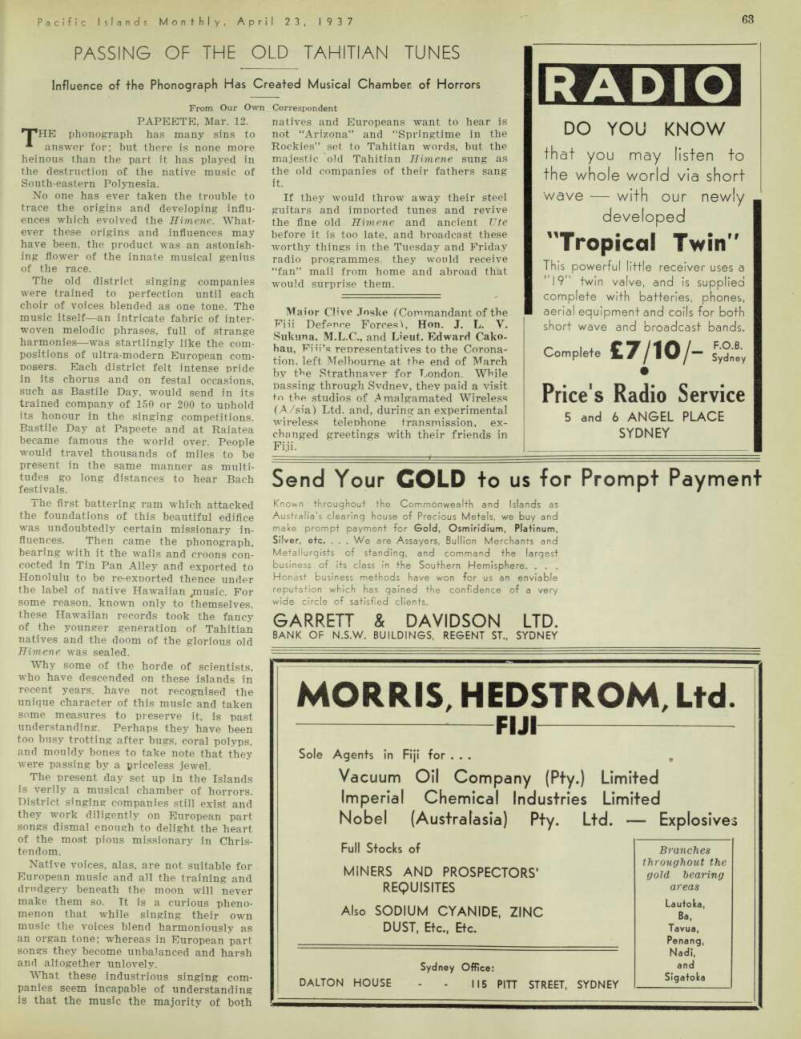
Influence of the Phonograph Has Created Musical Chamber of Horrors
From Our Own Correspondent
Papeete, Mar. 12.
*T*HE phonograph has many sins to * answer for; but there is none more heinous than the part it has played in the destruction of the native music of South-eastern Polynesia.
No one has ever taken the trouble to trace the origins and developing influ ences which evolved the Himene. What ever these origins and influences may have been, the product was an astonish ing flower of the innate musical genius of the race.
The old district singing companies were trained to perfection until each choir of voices blended as one tone. The music itself —an intricate fabric of inter woven melodic phrases, full of strange harmonies—was startlingly like the com positions of ultra-modern European com posers. Each district felt intense pride in its chorus and on festal occasions, such as Bastile Day, would send in its trained company of 150 or 200 to uphold its honour in the singing competitions.
Bastile Day at Papeete and at Raiatea became famous the world over. People would travel thousands of miles to be present in the same manner as multi tudes go long distances to hear Bach festivals.
The first battering ram which attacked the foundations of this beautiful edifice was undoubtedly certain missionary in fluences. Then came the phonograph, bearing with it the wails and croons con cocted in Tin Pan Alley and exported to Honolulu to be re-exported thence under the label of native Hawaiian ,music. For some reason, known only to themselves, these Hawaiian records took the fancy of the younger generation of Tahitian natives and the doom of the glorious old Himene was sealed.
Why some of the horde of scientists, who have descended on these islands in recent years, have not recognised the unique character of this music and taken some measures to preserve it, is past understanding. Perhaps they have been too busy trotting after bugs, coral polyps, and mouldy bones to take note that they were passing by a priceless jewel.
The present day set up in the Islands is verily a musical chamber of horrors.
District singing companies still exist and they work diligently on European part songs dismal enough to delight the heart of the most pious missionary in Chris tendom.
Native voices, alas, are not suitable for European music and all the training and drudgery beneath the moon will never make them so. It is a curious pheno menon that while singing their own music the voices blend harmoniously as an organ tone; whereas in European part songs they become unbalanced and harsh and altogether unlovely.
What these industrious singing com panies seem incapable of understanding is that the music the majority of both
natives and Europeans want to hear is not “Arizona” and “Springtime in the Rockies” set to Tahitian words, but the majestic old Tahitian Himene sung as the old companies of their fathers sang it.
If they would throw away their steel guitars and imported tunes and revive the fine old Himene and ancient Ute before it is too late, and broadcast these worthy things in the Tuesday and Friday radio programmes, they would receive “fan” mail from home and abroad that would surprise them.
Maior Clive Joske (Commandant of the Fiii Defence Forces'!, Hon. J. L. V.
Sukuna, M.L.C., and Lieut. Edward Cako bau, Flips representatives to the Corona tion. left Melbourne at the end of March by tbe Strathnaver for London. While passing through Svdnev, they paid a visit tr» the studios of Amalgamated Wireless (A/sia) Ltd. and, during an experimental wireless telephone transmission, ex changed greetings with their friends in Fiji.