Memorial To First L.M.S. Missionaries In Tahiti
pp. 40-42 · Read in the full issue
From Our Own Correspondent.
Papeete, Mar. 2
\ CEREMONY of much historic inter est was the dedication, at Mahina, on Tahiti, on December 30, 1936, of a memorial marking the graves of the two first missionaries of the London Mission ary Society to die in the Islands • Thomas Lewis, who died in 1799, and John Jefferson, who died in 1807.
Matavai Bay, in the district of Mahina, is illustrious as having been the anchor age of Wallace, the discoverer of Tahiti; of Cook, during his several visits to the island; of Bligh, of the Bounty; and of the ship Duff, while her missionary pas sengers were establishing themselves on the adjacent coast.
It was at Mahina that the first mission was founded; the first structure dedicated to Christian worship was erected; and it is near the site of this early church that the two first of their company to die, lie buried.
The passage of time, the lack of suit able markings and their scattered isola tion had well-nigh obliterated from mem ory the identity of the lonely graves of the early missionaries on Tahiti and Moorea. That of Henry Nott (the great est among the pioneers) had, indeed,
been rescued from oblivion 20 years ago.
But the last resting places of the others lay neglected until the patient researches of Mr. W. W. Bolton and the re-awakened interest of the London Missionary Society saved them from being lost for ever from the memory of the living.
The recent ceremony of dedication was conducted by Rev. Charles Vernier, (the presiding pastor of the Protestant Mis-
sion in French Oceania) in the presence of a large company of Tahitians and Europeans. Notable among the assembly were: Paraita, grandson of the high chief of the same name, who was regent of Tahiti during the years Queen Pom are IV. remained in exile on Raiatea (1844-1847); members of the Vehiatua family, whose ancestors, from time im memorial, were the paramount chiefs of Taiarapu, or Little Tahiti; Paofai, the constructor of the memorial, whose an cestor, Paofai, was, in the time of Queen Pomare IV., Chief Justice of the king dom and the greatest orator of his day; Mr Isaac Walker, a direct descendant of Henry, of the Duff, and of other early missionaries.
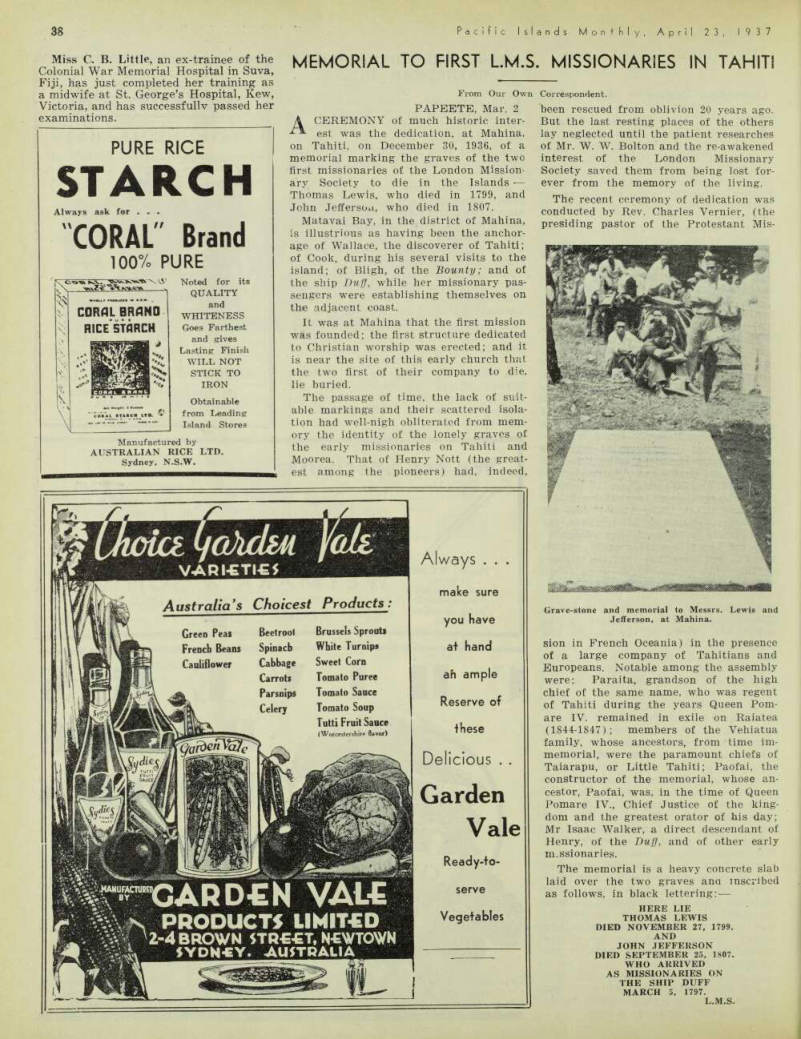
The memorial is a heavy concrete slab laid over the two graves ana inscribed as follows, in black lettering:
Here Lie
Thomas Lewis
Died November 27, 1799.
And
John Jefferson
Died September 25, 1807.
Who Arrived
As Missionaries On
The Ship Duff
March 5, 1797.
L.M.S.
Grave-stone and memorial to Messrs. Lewis and Jefferson, at Mahina.
Monsieur Vernier, in an eloquent ad dress in the Tahitian language, recalled the history of the early London Society Mission and the priceless services of those who founded it, banished heathen worship from the island, and translated into the language of the people the word of God.
Mr. Bolton stressed the necessity of care of the memorial so that the graves of the first missionaries and the memory of their services may never again fall into neglect. He urged his hearers to preserve with even greater care the stone nearby—this was the stepping stone at the entrance and marks the site of the first structure in all Polynesia erected for and dedicated to the worship of the God of the Christians. As such
this stone is the supreme relic to-day on Tahiti of missionary history. The build ing was put up by the missionaries in 1800. In 1802 it was pulled down by the missionaries themselves owing to a threatened attack by warriors of Ate huru. It was raised again on the same site in 1803 to be torn down in the wreck age of the whole district by the pagans, in December, 1808, when King Pomare and every missionary had fled from the island.
Terii (the chief of Mahina) and Tei hoarii Orometua (the pastor of the Pro testant church of the district) expressed the gratitude of their people to Mr. Bol ton for his eminent services in preser ving the last resting-places and teaching the present generation the history and
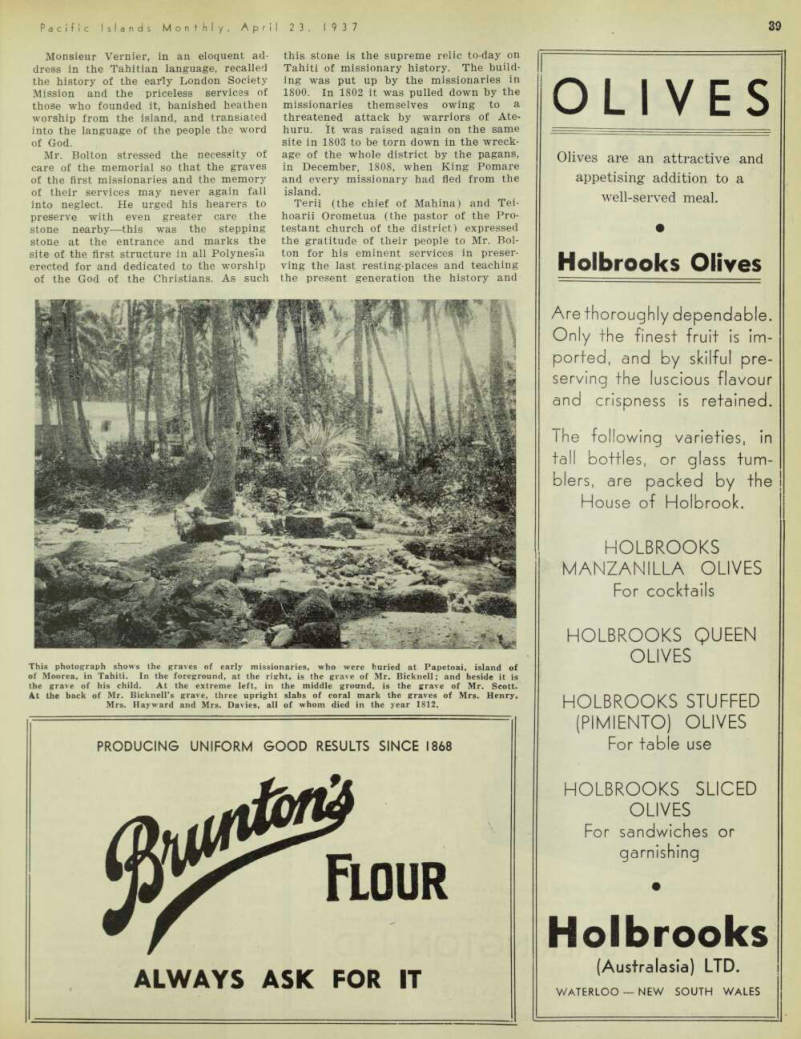
This photograph shows the graves of early missionaries, who were buried at Papetoai, island of of Moorea, in Tahiti. In the foreground, at the right, is the grave of Mr. Bicknell; and beside it is the grave of his child. At the extreme left, in the middle ground, is the grave of Mr, Scott.
At the back of Mr. Bicknell’s grave, three upright slabs of coral mark the graves of Mrs. Henry, Mrs. Hayward and Mrs. Davies, all of whom died in the year 1812.
achievements of those who first brought the Gospel to the Islands.
While Thomas Lewis and John Jeffer son were the first Englishmen to die on Tahiti, they were not the first white men buried on the island. These w r ere Cap tain Don Domingo Boenechea, of the Spanish frigate Aguila, who died at Tau tira (district of Tahiti) on January 26, 1775, and w T as buried there; and a Span ish seaman, of Boenechea’s crew, named Vasquez, who was accidentally killed shortly before.
M. Michel Dessert, of Noumea, arrived in Sydney from New Caledonia with his wife and grand-daughter, Georgette, by the Capitaine Illiaquer on March 24 expressly to see the Royal Easter Show.
He explained through an interpreter that he had heard about the Sydney Show in Noumea, which also had a show, revived last year after a lapse of 30 years.