Hand Tahiti And French
pp. 20-21 · Read in the full issue
Oceania To U.S.A.!
Interesting Rian Advocated In Honolulu
DR. A. W. SLATEN, In the "Hololulu Star Bulletin" of January 16, presents most Interesting arguments to show why French Oceania (Tahiti, Marquesas, etc.) should be ceded to the United States. Ihe cogent part of his article Is reprinted below:—
■"PHE arguments to be offered for the * cession of French Oceania by France to the United States are partly historical, partly humanitarian and party commer cial (says Dr. Slaten). Incidentally, they bear upon that extension of American responsibilities in the Pacific which it would seem natural to expect.
Theoretically—from the tendency of a great political body to attract smaller units to itself —and practically—from the beginnings made bv American relation ships with Samoa, Hawaii, the Philip pines, Guam, our optional right in Yap, and latterly with Howland, Jarvis and Baker Islands, it is reasonable to anti
cipate that American interests in the Pacific will increase rather than decrease.
That pioneering in air communication between remotely separated Pacific com munities which awakens our astonished admiration is but a hint of the wa ,f in which, after a few more years, the armadas of the air will be shuttling to and fro. We shall need islands, and more islands!
Historically, the United States had a prior claim to the Marquesas, as Great Britain had to the Society group. These two most important archipelagoes of the entire area became French, as it were, by default.
Should the occasion ever arise, it would be a gallant Gallic gesture to restore them to the original owners to whom they were lost by negligence. In such an event, Great Britain would no doubt vield to her closely related colleague, having no care for further extension, by the addition of a handful of remote islands, of her already enormous empire.
Historically, then, the cession of French Oceania to the United States would be well grounded.
Humanitarian considerations also urge the transfer. There is a notable improve ment in health conditions in quarters that come under American control, whether the region be American Samoa or Puerto Rico or the five mile strip that borders the Panama canal.
It would not be too much to expect in the event of France’s cession of her possessions in Oceania to the United States some reparation for the white man’s curse in the past would result and the decline in the once flourishing Marquesan population would be stayed.
Commercial considerations add their not insignificant weight to those of his tory and humanity.
The cold facts are that France owes the United States Government more than four billion dollars —to be exact, an original principal of $4,041,152,329 and
no cents. On this huge obligation there has been paid an amount far less than two hundred million—to be precise $177,502,329. The accrued interest alone runs a rather close second to the amount by which the principal has been reduced.
It stands at $138,865,829. The total of principal and accrued interest has, then, been reduced in round millions by 177 minus 138, or, to be again exact, by $38,636,500 —ridiculously inadequate even as a token offering from such a nation as France—which has repeatedly de
faulted in the payment of a single sou while at the same time making large loans and lavishing enormous revenues upon her underground border-line forti fications of concrete and steel.
If, therefore, the French Government and that of the United States should come to an agreement bv which France should as an evidence of good faith and as a material abatement of her legally contracted obligation to the United States —repudiation of which or continued default in payment of which will, in
accordance with act of congress, stop her from securing loans in the United States—such an arrangement might well be of three way benefit, viz., to the native Islands populations, to the United States as receiver and to France itself, to whom the colony has been hardly more than self-supporting, and not always that.
It is not meant, to be sure, that the cession of 1,520 square miles of territory in the remote South Seas should wipe out a four billion dollar debt, but it would be something. As matters stand, nothing at all is being paid and interest charges are mounting up.
Incidentally, the transfer of this little South Sea empire would give people who shiver on cool mornings in Hawaii some place to go in the winter.
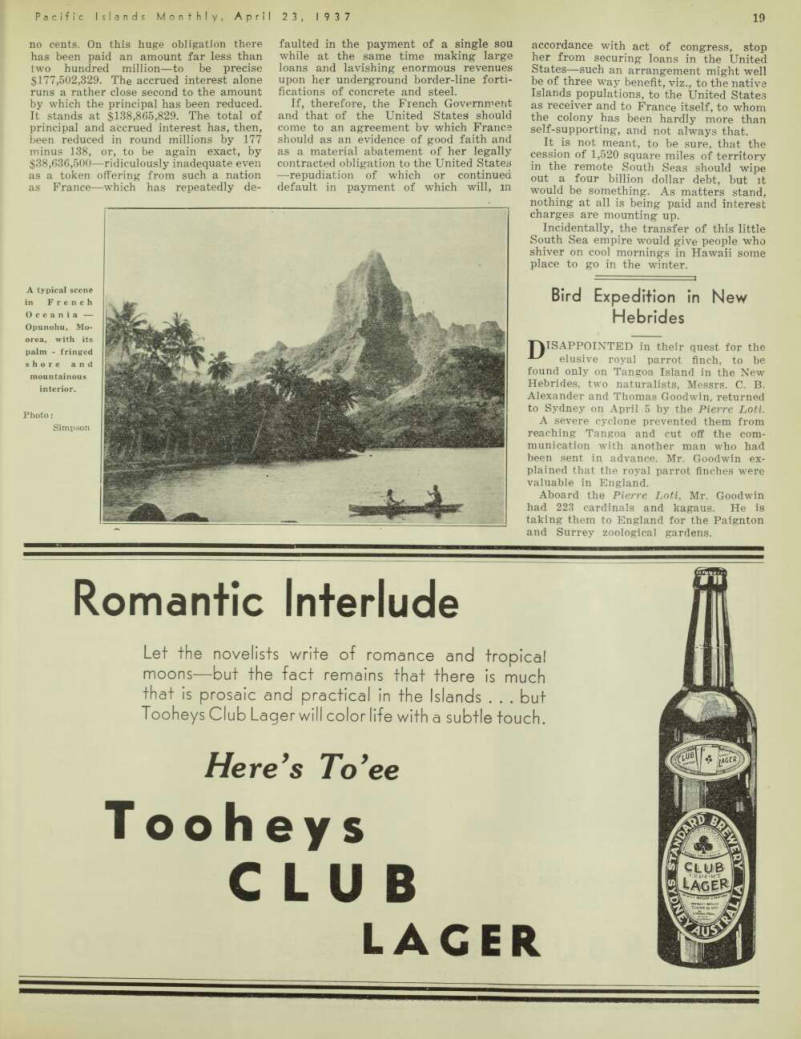
A typical scene in French Oceania Opunohu, Mo- Orea, with its palm - fringed shore and mountainous interior.
Photo: Simpson