Hurricane In Tonga
p. 10 · Read in the full issue
One Night of Terror
From a Special Correspondent
\ Nukualofa, Mar. 16.
or three rather prolonged periods * of oppressive heat during January and early February indicated that some thing out of the ordinary might be ex pected.
On Sunday, February 21, heavy wind from the N.W. reminded us of the hurri cane season. Towards evening, the squalls increased in violence and blew up to a strong gale, increasing to a whole
gale, by the time the wind shifted during the night to the S.W.
The storm centre passed fairly close to the south of Tongatabu. Considerable damage was done to native foods in general, and bananas in particular, and of course the coconut palms suffered.
Monday was calmer, and w e felt that we had had what was coming to us for the hurricane season of 1937. We were, as usual, erring on the side of optimism.
On Wednesday, February 24, a strong wind from S.S.E., with heavy squalls of rain, increased in violence towards even ing, and the one red flag of warning at the wireless station was augmented by a second, meaning “Hurricane approach ing.” Heavy rain squalls continued, the
wind increasing in violence as night fell and until long after midnight.
A moon, a couple of days from full, gave sufficient light to show coconut palms performing more like whips than trees, the heavier trees and lighter foli age being lashed unmercifully.
Sleep was out of the question, what with the noise of the wind, the hissing of the rain in the trees and the rat-a-tat as of machine-gun fire, as it fell with force on the galvanized roofs. Water found its way in through the most
innocent-looking cracks.
Towards 2 a.m., the wind had slowly veered to about N.E., increasing in velo city, and with vicious gusts and pouring rain driven by the wind.
At the height of the storm, from 2 a.m. to 3.30 a.m., it is estimated that the wind velocity was 85 m.p.h.
The centre of the storm passed very close to the north of Tongatabu on a W.S.W. course. 7.18 inches of rain fell.
The leaves of the coconut trees stood out at right angles from the trunks in one direction only—that of the wind.
As morning approached, the force of the hurricane gradually abated and dawn broke with some ameloriation.
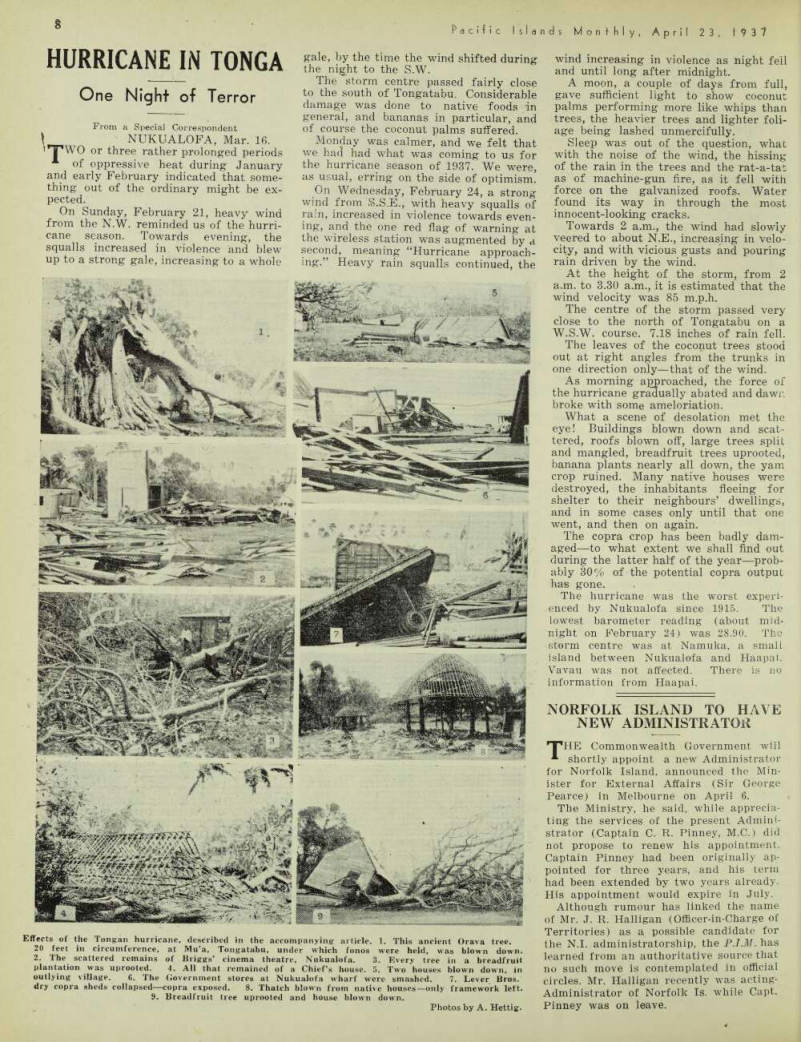
What a scene of desolation met the eye! Buildings blown down and scat tered, roofs blown off, large trees split and mangled, breadfruit trees uprooted, banana plants nearly all down, the yam crop ruined. Many native houses were destroyed, the inhabitants fleeing for shelter to their neighbours’ dwellings, and in some cases only until that one went, and then on again.
The copra crop has been badly dam aged—to what extent we shall find out during the latter half of the year—prob ably 30% of the potential copra output has gone.
The hurricane was the worst experi enced by Nukualofa since 1915. The lowest barometer reading (about mid night on February 24) was 28.90. The storm centre was at Namuka, a small island between Nukualofa and Haapai.
Vavau was not affected. There is no information from Haapai.
Effects of the Tongan hurricane, described in the accompanying article. 1. This ancient Orava tree, 20 feet in circumference, at Mu’a, Tongatabu, under which fonos were held, was blown down. 2. The scattered remains of Briggs’ cinema theatre, Nukualofa. 3. Every tree in a breadfruit plantation was uprooted. 4. All that remained of a Chief’s house. 5. Two houses blown down, in outlying village. 6. The Government stores at Nukualofa wharf were smashed. 7. Lever Bros, dry copra sheds collapsed— copra exposed. 8. Thatch blown from native houses—only framework left. 9. Breadfruit tree uprooted and house blown down.
Photos by A. Hettig.