P.-A. Airways Clipper Spans Central
pp. 7-8 · Read in the full issue
Pacific, North To South
Survey Flight From 'Frisco To New Zealand and Return Was Technical Triumph
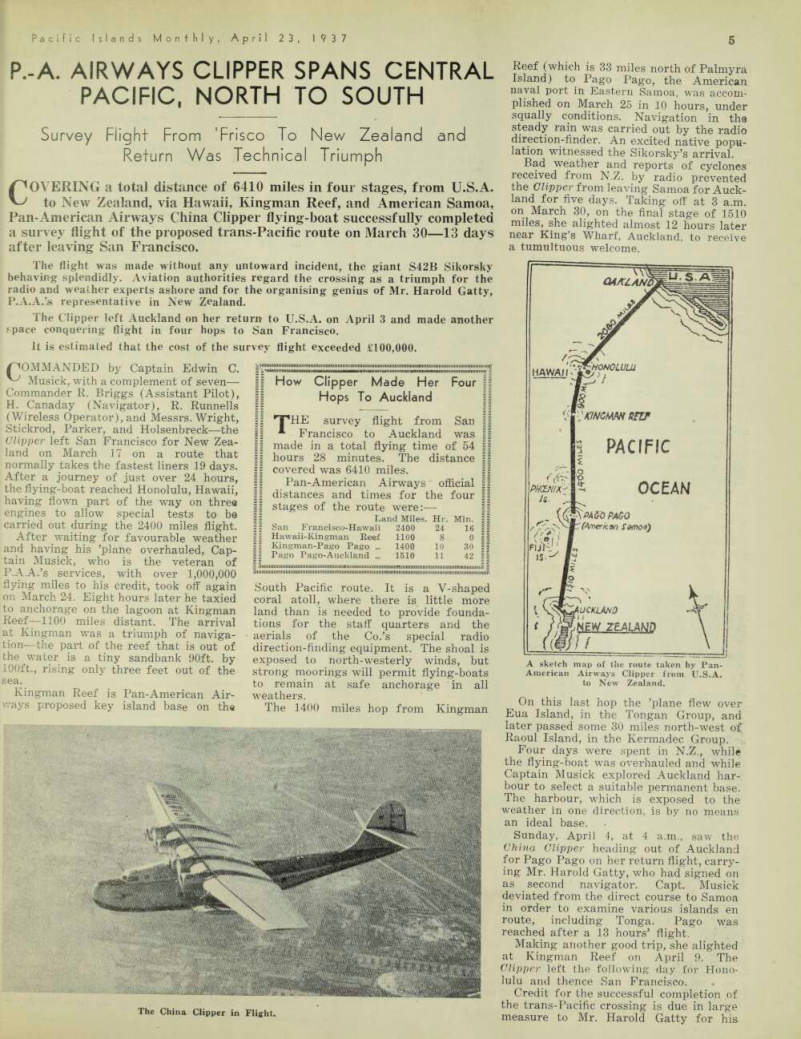
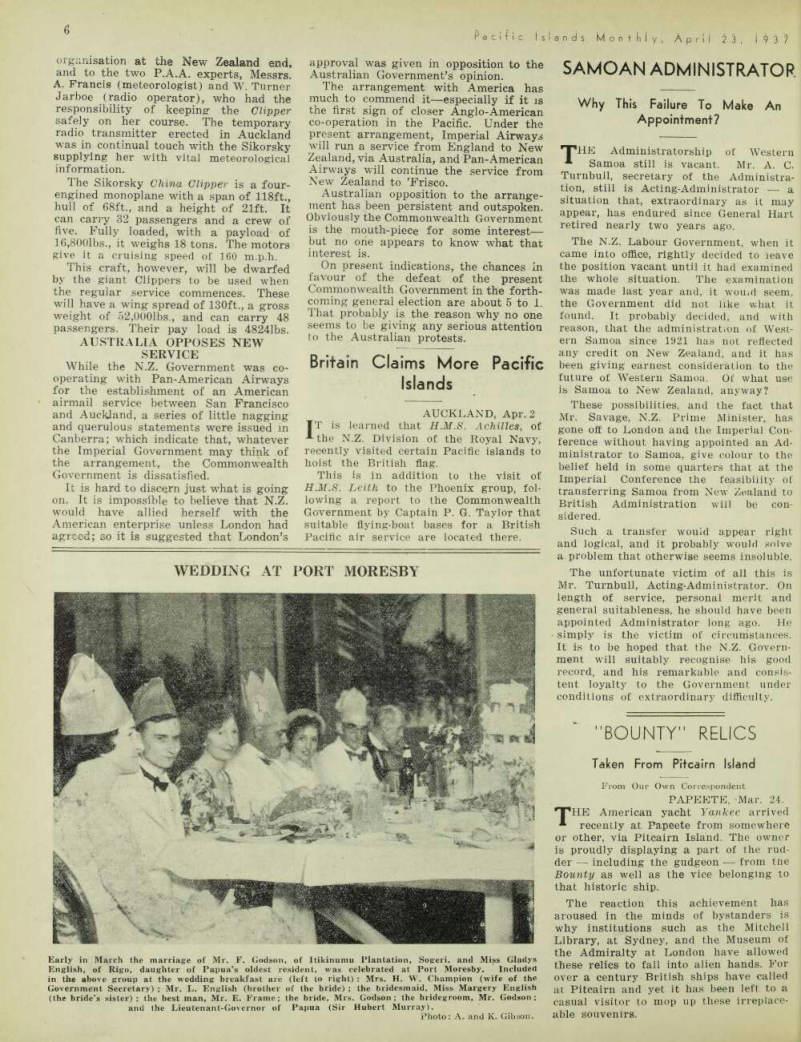
COVERING a total distance of 6410 miles in four stages, from U.S.A. to New Zealand, via Hawaii, Kingman Reef, and American Samoa, Pan-American Airways China Clipper flying-boat successfully completed a survey flight of the proposed trans-Pacific route on March 30—13 days after leaving San Francisco.
The flight was made without any untoward incident, the giant 5428 Sikorsky behaving splendidly. Aviation authorities regard the crossing as a triumph for the radio and weather experts ashore and for the organising genius of Mr. Harold Gatty, P.A.A.!s representative in New Zealand.
The Clipper left Auckland on her return to U.S.A. on April 3 and made another space conquering flight in four hops to San Francisco.
It is estimated that the cost of the survey flight exceeded £lOO,OOO.
/COMMANDED by Captain Edwin C.
Musick, with a complement of seven — Commander R. Briggs (Assistant Pilot), H. Canaday (Navigator), R. Runnells (Wireless Operator), and Messrs. Wright, Stickrod, Parker, and Holsenbreck—the Clipper left San Francisco for New Zea land on March 17 on a route that normally takes the fastest liners 19 days.
After a journey of just over 24 hours, the flying-boat reached Honolulu, Hawaii, having flown part of the way on three engines to allow special tests to be carried out during the 2400 miles flight.
After waiting for favourable weather and having his ’plane overhauled, Cap tain Musick, who is the veteran of P.A.A.’s services, with over 1,000,000 flying miles to his credit, took off again on March 24. Eight hours later he taxied to anchorage on the lagoon at Kingman Reef—lloo miles distant. The arrival at Kingman was a triumph of naviga tion—the part of the reef that is out of the water is a tiny sandbank 90ft. by 100 ft., rising only three feet out of the sea.
Kingman Reef is Pan-American Air ways proposed key island base on the
South Pacific route. It is a V-shaped coral atoll, where there is little more land than is needed to provide founda tions for the staff quarters and the aerials of the Co.’s special radio direction-finding equipment. The shoal is exposed to north-westerly winds, but strong moorings will permit flying-boats to remain at safe anchorage in all weathers.
The 1400 miles hop from Kingman
Reef (which is 33 miles north of Palmyra Island) to Pago Pago, the American naval port in Eastern Samoa, was accom plished on March 25 in 10 hours, under squally conditions. Navigation in the steady rain was carried out by the radio direction-finder. An excited native popu lation witnessed the Sikorsky's arrival.
Bad weather and reports of cyclones received from N.Z. by radio prevented the Clipper from leaving Samoa for Auck land for five days. Taking off at 3 a.m. on March 30, on the final stage of 1510 miles, she alighted almost 12 hours later near King’s Wharf, Auckland, to receive a tumultuous welcome.
On this last hop the ’plane flew over Eua Island, in the Tongan Group, and later passed some 30 miles north-west of Raoul Island, in the Kermadec Group.
Four days were spent in N.Z., while the flying-boat was overhauled and while Captain Musick explored Auckland har bour to select a suitable permanent base.
The harbour, which is exposed to the weather in one direction, is by no means an ideal base.
Sunday, April 4, at 4 a.m., saw the China Glipper heading out of Auckland for Pago Pago on her return flight, carry ing Mr. Harold Gatty, who had signed on as second navigator. Capt. Musick deviated from the direct course to Samoa in order to examine various islands en route, including Tonga. Pago was reached after a 13 hours’ flight.
Making another good trip, she alighted at Kingman Reef on April 9. The Clipper left the following day for Hono lulu and thence San Francisco, Credit for the successful completion of the trans-Pacific crossing is due in large measure to Mr. Harold Gatty for his
The China Clipper in Flight.
A sketch map of the route taken by Pan- American Airways Clipper from U.S.A. to New Zealand.
organisation at the New Zealand end, and to the two P.A.A. experts, Messrs.
A. Francis (meteorologist) and W. Turner Jarboe (radio operator), who had the responsibility of keeping the Clipper safely on her course. The temporary radio transmitter erected in Auckland was in continual touch with the Sikorsky supplying her with vital meteorological information.
The Sikorsky China Clipper is a four engined monoplane with a span of 118 ft., hull of 68ft., and a height of 21ft. It can carry 32 passengers and a crew of five. Fully loaded, with a payload of 16,8001b5., it weighs 18 tons. The motors give it a cruising speed of 160 m.p.h.
This craft, however, will be dwarfed by the giant Clippers to be used when the regular service commences. These will have a wing spread of 130 ft., a gross weight of 52,0001b5., and can carry 48 passengers. Their pay load is 48241b5.
Australia Opposes New
Service
While the N.Z. Government was co operating with Pan-American Airways for the establishment of an American airmail service between San Francisco and Auckland, a series of little nagging and querulous statements were issued in Canberra; which indicate that, whatever the Imperial Government may think of the arrangement, the Commonwealth Government is dissatisfied.
It is hard to discern just what is going on. It is impossible to believe that N.Z. would have allied herself with the American enterprise unless London had agreed; so it is suggested that London’s
approval was given in opposition to the Australian Government’s opinion.
The arrangement with America has much to commend it—especially if it is the first sign of closer Anglo-American co-operation in the Pacific. Under the present arrangement, Imperial Airways will run a service from England to New Zealand, via Australia, and Pan-American Airways will continue the service from New Zealand to ’Frisco.
Australian opposition to the arrange ment has been persistent and outspoken.
Obviously the Commonwealth Government is the mouth-piece for some interest— but no one appears to know what that interest is.
On present indications, the chances In favour of the defeat of the present Commonwealth Government in the forth coming general election are about 5 to 1.
That probably is the reason why no one seems to be giving any serious attention to the Australian protests.