Dutch New Guinea As It Is To-Day
pp. 27-32 · Read in the full issue

THE following article was written for the “Pacific Islands Monthly,” in January lust, hy Mr. William H. Potts, a young Englishman, mho left Sydney late last year with the American, Dwight Long, in the ketch “Idle Hour”. They parted company in Papua, and Mr. Potts subsequently wandered through the Trobriands, New Guinea and Dutch New Guinea.
IN modern times, when wireless has al most annihilated distance, there still remains a land which is a closed book to much of the outside world Dutch New Guinea.
It is not on account of its size, how ever, that it has been overlooked, for it has an area of 120,000 square miles and more; but it has provided its own barriers to man’s invasion, with its un
compromising landscape of impenetrable jungle and snow-capped mountains.
It is now more than 80 years since Dutch authority was established, when negotiations were finally completed with the Sultan of Ternate for the transfer of his suzerainty of north and west New Guinea to the Netherlands flag. He still has certain rights and powers, but ’ his actions are subject to the approval of
the Government. A similar position ex ists in respect of the Sultan of Tidore, whose suzerainty extends over the south
ern part. At the moment the latter is in his minority and a Regency is in control.
The early history of the country was clouded with the unhappy activities of slave raiding by the Sultans, but this, of course, was abolished when the Dutch East Indies Government took control. In spite of the long period of their admini stration, there is a negligible amount of commercial development, and during the last three or four years only has there been any real stimulus, and that mostly by foreign companies.
TT is quite understandable, however, A with the infinitely rich and produc tive Indies fully occupying their atten tion, that the Dutch have given New
Guinea scant consideration. Only now, after political pressure has been brought to bear on them to do something with it, are they giving some encouragement to its development and serious attempts are being made to discover gold and oil, whilst concessions have been given to a Japanese company to grow cotton.
The natives have been brought under control only in the coastal districts, with one or two exceptions, and cannibalism and headhunting are still rife in the interior. At the present time there is a small Government expedition in the country behind Port Humboldt (or Hol landia, as it is now called) which lies at the eastern extremity of the north coast, near the border of the Mandated Territory. One white man, a German of long experience in the territory, is in charge, and the purpose is to settle and bring under control the wild natives in those parts.
His method provides an interesting contrast with that of the Papuan Gov ernment, who usually send into unex plored territory one magistrate, accom
panied by a patrol officer, a few native armed constables and 30 or 40 carriers.
They make a journey lasting three months or more, travelling as best they can, track or no track, making friends where possible with the natives and re turning to civilisation with ample infor mation but no decisive control established.
By comparison, the Dutch method is slow, but there is a more permanent result. As progress is made from village
to village, a good track is cut and made, whilst messengers are sent on to the districts ahead to inform the natives that a white man will be arriving in a few days. Thus the element of surprise is prevented and fighting avoided.
The geographical aspect has not been ignored and, since 1910, several large and well equipped expeditions have visited the interior. Maps are available which show very few of those blank spaces marked “Unexplored,” a familiar feature of the those of the neighbouring British territories. One of the more extensive journeys cost the Government a quarter of a million pounds, and at the moment of writing (Dec., 1936) news has just been received that Mr. Colijn, the son of the Netherlands Prime Minister, is returning from a successful ascent of Carstenz Summit, one of the highest peaks in Dutch New Guinea, whose cap
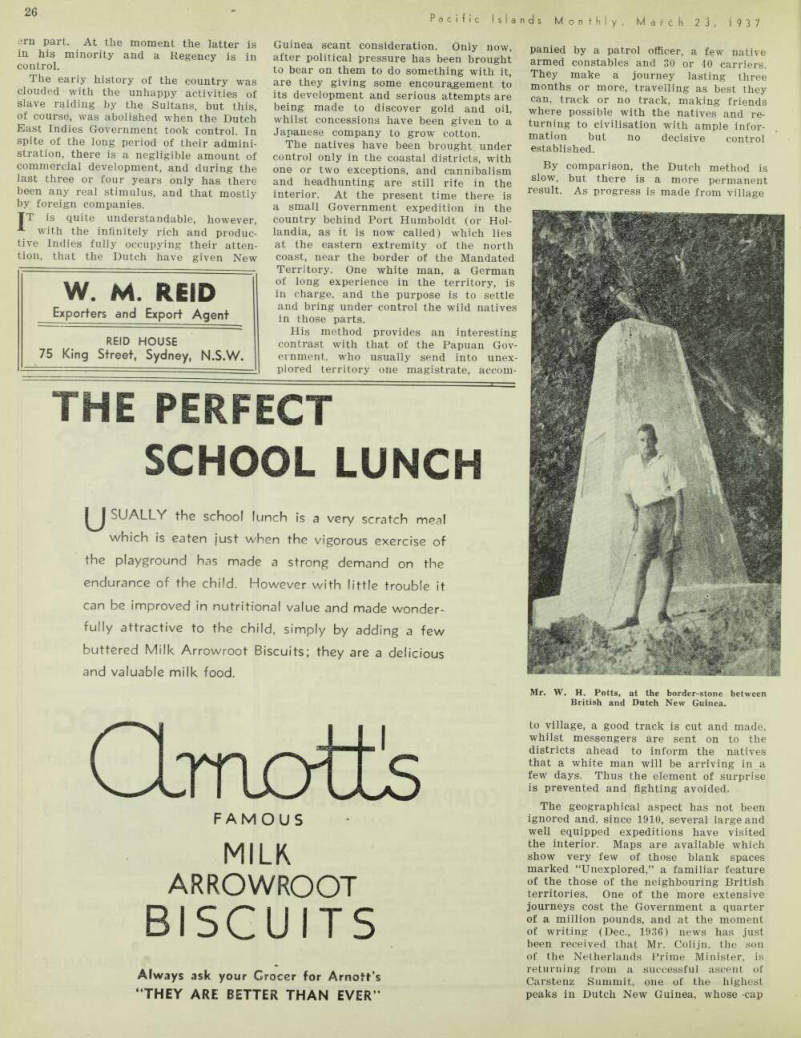
Mr. W. H. Potts, at the border-stone between British and Dutch New Guinea.
of eternal snow rises more than 16,000 feet above sea level.
Armed protection is afforded in the Dutch territory by soldiers drawn from many parts of the Indies. They are weJ trained at Batavia and equipped with sabres and modern magazine carbines.
A.l Government officials are accompanied by them on their patrolling duties and, altogether, they number about 800 in New Guinea.
District government is exercised by Controleurs who have magisterial pow ers over Europeans and natives alike.
At intervals they patrol the areas in their charge and some of the more ardu ous duties, such as native tax collecting, etc., are deputed to assistants from Am boina and Ternate. The Controleurs are responsible to the Assistant Resident at Manokwari, who in his turn is subject to the Resident at Amboina, which is the administrative centre for the Moluccas and New Guinea.
HTHERE are less than 10 settlements in * all Dutch New Guinea, and one usu ally finds about half a dozen Europeans, some natives of the Indies, Chipese stores, and a few soldiers. There is a monthly service of steamers, but there are no hotels or banks. The occasional traveller may find accommodation at the pasangrahan, which is a superior rest house.
One of the most difficult problems awaiting the settler is that of native labour, far more difficult indeed than in the two British territories, where more has been done to assist him, whilst giv ing the native fair terms. There are two classes of labourers, the free and the indentured. As the name implies, the former may terminate his employment when ever he wishes; there is no con tract. The latter, however, appears before the district Controleur and agrees to work for a specific time, up to three years, at a fixed rate of pay. If he deserts, he may be imprisoned for a short time, and returned' to his employer.
Both kinds are housed and fed, and these regulations are applied, broadly speaking, in all three territories of New Guinea, with the added and formidable difficulty that under the Dutch Govern ment, indentured labourers to be em ployed in the northern part must origi nate from the southern one and vice versa.
Transport costs are so high that this is impossible in practice, and to-day only free labour is used, which itself is far from satisfactory as the natives invari ably wish to return home within six months, leaving the employer to find new workers and pay more travelling ex penses.
Another difficulty is created by the re gulation forbidding professional recruit ing, thus compelling the employer, or one of his employees, to find his own labour ers, whereas in the British side a re cruiter will bring them to him at a fee varying from £5 to £l2 per head, accord ing to district. Recently several hundred coolies were brought from the Indies to Dutch New Guinea in connection with
oil prospecting work, but again, the ex pense of this method of obtaining labour would be prohibitive to the average em ployer. hears much to-day of the activities " of the Japanese in the Western Pacific, and New Guinea has not escaped their attention. Prevented from settling in Papua and jthe Mandated Territory, they have been Successful in obtaining concessions from the Dutch, though not on the scale they had wished.
Nanyio Kohatsu Kaisha is the opera ting company, with a capital of 20,000,000 yen, and during the last - three years they have cleared an area of 7QO acres
of jungle at Nabire, in Geelvink Bay, on the north coast, and experimented with cotton growing. Every variety has been tried and American cotton has proved the most satisfactory. But up to the present more attention has been given to experiment than actual produc tion for export; a very necessary course,
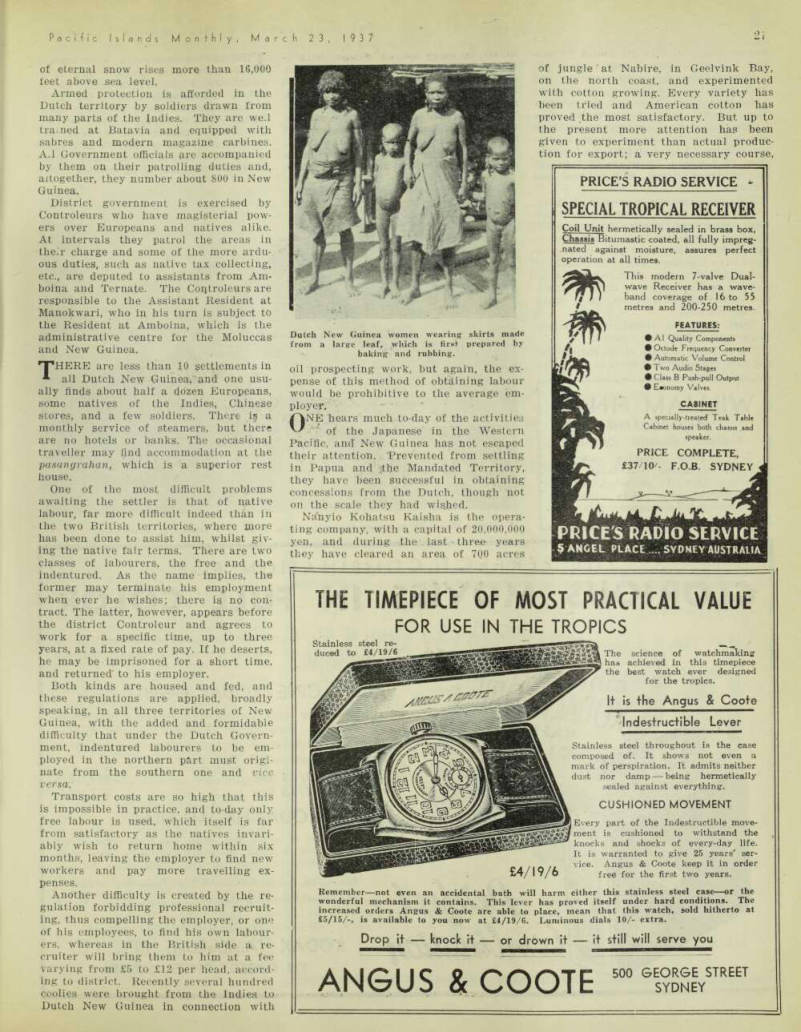
Dutch New Guinea women wearing skirts made from a large leaf, which is first prepared by baking and rubbing.
as the available data on cotton produc tion in New Guinea is negligible.
Further clearing is in progress and they hope to have about 1,400 acres in production during the next few months.
The colossal task of converting New Guinea forest to open agricultural land has called for an army of native labour ers, numbering 1,200 at times and mostly from Biak Island. There are 17 Japanese in residence, some with wives and families.
They have another concession at Momi, within a few hours’ steamer run of Na bire, where they have cut a rough track, 25 miles long, which leads into the moun tains. There they have built houses for the native labourers who collect dammar and bring it to the coast, whence it is shipped to Japan. A few acres of kapok are cultivated, in addition, on a small coastal clearing.
There are no individual Japanese settlers in Dutch New Guinea.
The spiritual welfare of the natives has not been neglected and there is a mission
school in every settled village, with a teacher from the Indies who imnarts elementary education in addition to religious instruction. A small subsidy is granted by the Government.
Dutch Protestant missions operate in the northern half of the territory, and Catholic ones in the southern division, Unlike those in the British territories, they do not engage in any form of trade,
THE natives themselves have learned J, , , .
neighbour™ in the^Stish'°part
cotfon and "nLriof tobacco are found in manv districts alone: the north ma^t On the Island of Japen in Geelvink Bay they collect dammar and cut teak, and on arrival of the steamer it is a quite remarkable event to see the heavy trunks of timber dragged by an excited crowd
Starting life again in Dutch New Guinea—the home of a colonist at Manokwari,
of natives from the beach on to huge rafts, which are then slowly paddled to the boat. A large quantity of these native productions are purchased by Chinese merchants, who travel on the steamer for that purpose.
The incentive to this activity on the part of the natives may be looked for in the imposition of an annual tax of three guilders and thirty-six cents, which is equivalent to about ten Australian shil lings at the present rate of exchange. It is payable by all male natives in con trolled areas, except those who are infirm or too young to work.
SOME years have passed since the large trade in the export of bird of para dise plumes was stopped by the Govern ment. Another great development is afoot, namely, oil production. It is too early yet to say what the future may hold in that respect, but very large con cessions have been granted to Nederland sche Nieuw Guinea Petroleum Maatschap pij, an offspring of the Shell and Stan dard Oil Companies. Large bases have been established in the McClure Gulf, at Babo, and at the western extremity, near Sorong.
Most of the area involved lies in the flat country, and aeroplanes h?,ve been used, from which a complete photographic survey has been made during the last few months and the most promising ground will now be prospected in the usual manner. Already a quarter of a million pounds has been expended in what is probably the most difficult country in the world for any kind of prospecting.
IT will be recalled that only during the last 15 years an immensely rich de posit of gold has been discovered in the Mandated Territory of New Guinea, and many hold the opinion that a large quan tity may be found on the Dutch side. / The opportunities which arose in the former country for the individual pros pector will not be available in Dutch New Guinea, however, as all the ground likely to bear gold has been leased to one company, Nederlandsche Nieuw Goud Maats., which is sponsored by the Oro ville and Billiton Companies and the firm of Erdman and Sielken, Prospecting is in progress but, so far, without substan tial result.
OF less ambitious character financially, but none the less interesting, are the Communist camp at Tanahmerah. 250 miles up the Digoel River, on the south coast; and the colonisation of a number of unemployed men from the Indies on land at Manokwari and Sabron.
The Tanahmerah camp was established by the Government some years ago, and about 1,200 malcontents from the Indies were taken there, housed and given all the necessary agricultural implements and land to enable them to realise that earthly paradise about which they had talked so much. The only stipulation was that they should remain there and a garrison of soldiers was sent to ensure that they did so. Like other similar attempts, however, it has failed and the
Communists are not even self-supporting.
The Government is obliged to send a boatload of food at regular intervals.
Occasionally one or two escape, but they are usually devoured by the cannibals who roam between the Digoel and Fly Rivers.
THE scheme of unemployed colonisa tion is of more particular interest as it represents the attempt of a Govern ment, harassed by its supporters, to deal with the problem of unemployment.
Drawn from the ranks of unemployed native and half-caste clerks, shop assis tants, etc., from Java and Sumatra, the
first detachment of colonisers, many with wives and children, sailed for New Guinea in 1928 and an association was formed, Stichting Immigratie Koloni satie Nieuw Guinea, to conduct the enter prise at Manokwari and dispose of the agricultural produce, giving each colon -Ist living necessaries to the value of the credit of his output. It has not yet proved a profitable undertaking and much of the deficit is made good by charitable public subscription in the Indies, The scheme makes it possible, however, for a penniless man to obtain a small
financial assistance from the Govern ment, spread over three years and de creasing annually, build a simple house and clear two and a half acres of jungle.
But even the most industrious man in the colony has only eight acres in pro duction and makes a bare existence; though, as he said, it was better than selling pencils in the streets of Surabaya.
Up to the present day there has been only a trifling export production, in spite of the fact that there are 200 working colonists, but this is partly accounted for by the colony consuming much of its own produce.
There are only about 30 colonists at Sabron, which is near Hollandia, and this section there is a different as sociation. The district is somewhat un healthy and financial assistance is not available, but a newcomer may earn a little by working for the association for a part' of his time. Nevertheless the results have been very disappointing there.
At both centres, the principal items grown are cassava, maize, cocoa, rice, and cotton.
It may be gathered, therefore, that this creditable attempt is not likely to have much effect on the number of un employed in the Indies and a few colon ists have abandoned their holdings and returned. Very few of them are of an
agricultural or labouring class and, nat urally, they find the work of extending their production very arduous, whilst shortage of money prevents them -from employing sufficient native labour to ac complish the task, sd for the time being it seems to be case of stalemate.
AS to the future of Dutch New Guinea, one might perhaps turn to Papua and the Mandated Territory, where de-
velopment has been in progress for a much longer period. Apart from gold, the only large exports from there have been copra, with rubber in addition from the former. They have been produced and exported under infinitely more fav ourable conditions than could be found in the Dutch Territory, and even if lab our regulations were eased a little in favour of the employer (and there is good authority for saying that the Dutch Government is unwilling to do this) there still remains the obstacle of ex ceedingly high freight charges by the steamship line which has the monopoly of the inter-Indies business. On the British side, ships call at the main ports and take copra direct to Europe, but the exports from Dutch New Guinea will have to be increased many times before such as opportunity arises there.
It is rather to the valuable products, oil and gold, that one must look to give the country the li£e blood which it needs-
Natives loading logs of teak on to a steamer at Japen Island, Dutch New Guinea.