Quick Moves In Trans-Pacific
pp. 9-10 · Read in the full issue
Air-Mail Argument
Experimental Flight by P.A. Airways Follows Agreement with N.Z.
A MONTH ago, the prospect of the establishment of a Central Pacific air-mail service, Honolulu to Auckland, by Pan-American Airways, seemed remote There was a complete hold-up by the New Zealand Government. The latter had insisted that the projected British Trans- Pacific service should be accorded the same facilities in Hawaii as Pan-American Airways were to receive in New Zeaj an( j Important international considerations became involved. The Americans apparently would not give the undertaking, New Zealand therefore would not grant facilities in Auckland.
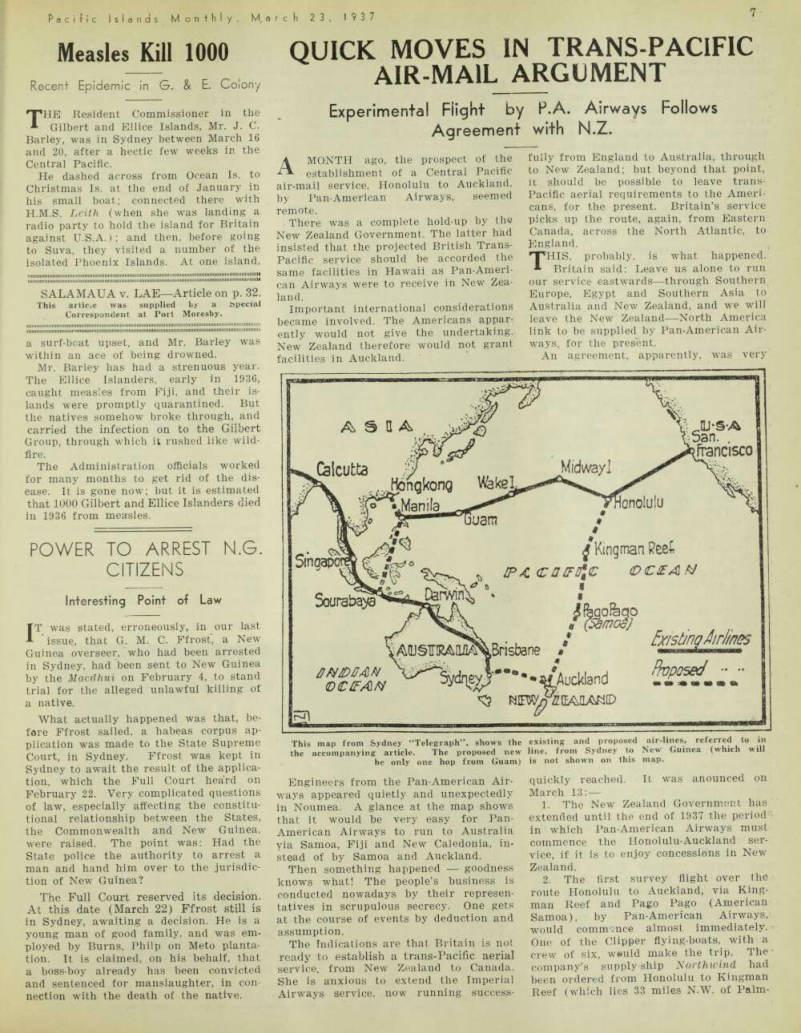
Engineers from the Pan-American Airways appeared quietly and unexpectedly in Noumea. A glance at the map shows that it would be very easy for Pan- American Airways to run to Australia yia Samoa, Fiji and New Caledonia, instead of by Samoa and Auckland.
Then something happened goodness knows what! The people’s business is conducted nowadays by their representatives in scrupulous secrecy. One gets at the course of events by deduction and assumption.
The Indications are that Britain is not ready to establish a trans-Pacific aerial service, from New Zealand to Canada.
She is anxious to extend the Imperial Airways service, now running success-
fully from England to Australia, through to New Zealand; but beyond that point, it should be possible to leave trans- Pacific aerial requirements to the Amen cans, for the present. Britain’s service picks up the route, again, from Eastern Canada, across the North Atlantic, to England.
'THIS, probably, is what happened, 1 Britain said: Leave us alone to run our service eastwards—through Southern Europe, Egypt and Southern Asia to Australia and New Zealand, and we will leave the New Zealand—North America link to be supplied by Pan-American Air ways, for the present, An agreement, apparently, was very
quickly reached. It was anounced on March 13: 1. The New Zealand Government has extended until the end of 1937 the period in which Pan-American Airways must commence the Honolulu-Auckland ser vice, if it is to enjoy concessions in New Zealand, 2. The first survey flight over the route Honolulu to Auckland, via King man Reef and Pago Pago (American Samoa), by Pan-American Airways, would commence almost immediately.
One of the Clipper flying-boats, with a crew of six, would make the trip. Ihe company’s supply-ship Northwind had been ordered from Honolulu to Kingman Reef (which lies 33 miles N.W. of Palm
This map from Sydney “Telegraph”, shows the existing and proposed air-lines, referred to in the accompanying article. The proposed new line, from Sydney to New Guinea (which will be only one hop from Guam) is not shown on this map.
yra, is 9J miles by 5 miles, and is simply a half-submerged coral reef enclosing an area of sheltered water). 3. The air-mail service between Aus tralia and New Zealand, representing the extension to New Zealand of the Imperial Airways service, will be controlled by a commission or board, on which the Gov ernments of Britain, Australia, and New Zealand will be represented.
On March 17, the original China Clipper, commanded by Captain Edwin Musick, took off from San Francisco on the first stage of the survey flight to New Zealand. The giant Sikorsky flying boat is due in Auckland on March 25.
TTHESE announcements seemed to make * the position quite clear. But there was a protest from Canberra, which said that “a trans-Pacific air service is one of contemplated major extensions of the Empire air routes”; that Australian traffic would be conserved for this ser vice; and that it knew nothing of any new agreement between New Zealand and Pan-American Airways. Which suggested that Canberra was either well behind the times, as usual; «r that the N.Z. Govern ment had taken action of a very impor tant character entirely on its own ac count.
When the curious history of these early preparations for a trans-Pacific service, north to south comes to be writ ten, a tribute will be paid to the work of Harold Gatty, champion airman and Australasian representative of Pan-Amer ican Airways. He has spent most of the past two years in New Zealand negoti ating very patiently and skilfully for the removal of scores of difficulties created by Governments and bureaucra cies. There are many practical difficul ties in the track of the proposed new service the provision of moorings, spares, workshops and accommodation; the need for regular weather data; the problem of radio stations, etc. — but Mr.
Gatty probably will say that they are as nothing in comparison with the obstacles created by Governments.
'THE rapid development of the Pan- American North Pacific service (’Frisco Hawaii —Guam —Manila —China) has given a new importance to the proposed Sydney—New Guinea service (see article on page 74).
The Dutch East Indies Airline have just completed an arrangement to run regular planes between Sourabaya and Manila, where they will connect with the Pan-American service. From Sourabaya, passengers and mails can connect with the Anglo-Australian service.
But the Sydney—New Guinea service may provide Australia with a quicker route. A plane, flying north from New Guinea, could easily reach Guam in one hop, and connect there with the Pan- American service. In other words, a modern plane could fly southwards from Guam to Sydney, via New Guinea, in two days.
Mr. R. A. Derrick, of the Methodist Mission’s Technical Institution at Davui levu, Fiji, left Sydney in February.