Products
p. 58 · Read in the full issue
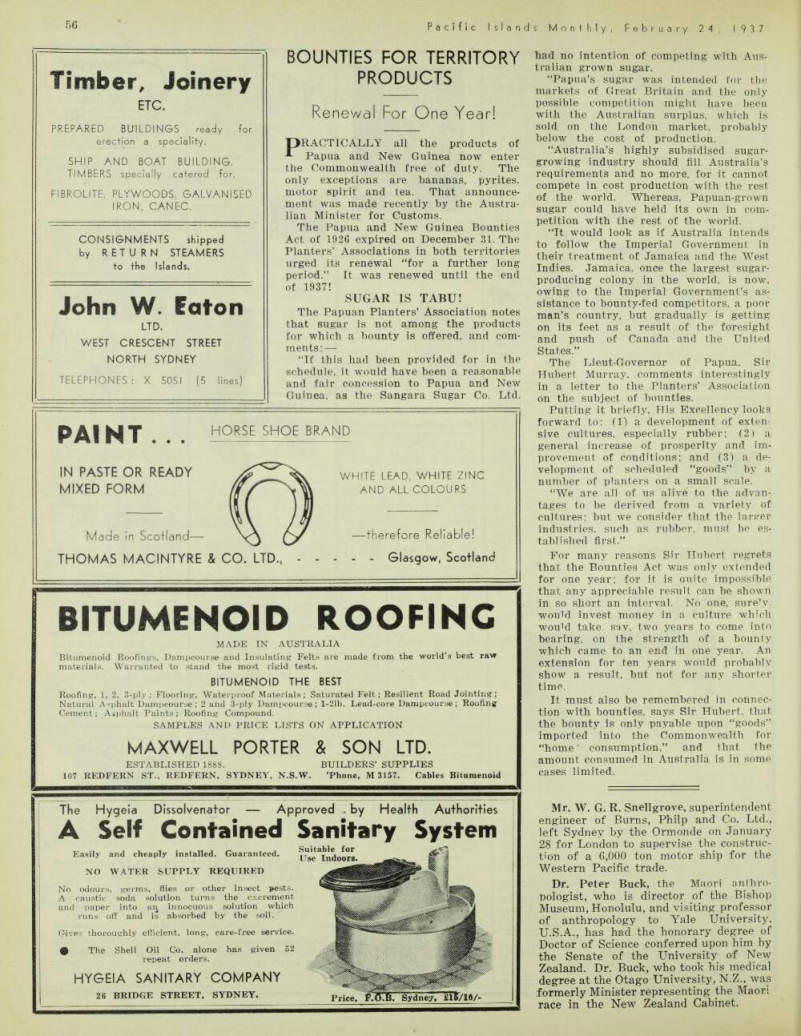
Bounties For Territory
Renewal For One Year!
PRACTICALLY all the products of Papua and New Guinea now enter the Commonwealth free of duty. The only exceptions are bananas, pyrites, motor spirit and tea. That announce ment was made recently by the Austra lian Minister for Customs.
The Papua and New Guinea Bounties Act of 1926 expired on December 31. The Planters’ Associations in both territories urged its renewal “for a further long period.” It was renewed until the end of 1937!
Sugar Is Tabu!
The Papuan Planters’ Association notes that sugar is not among the products for which a bounty is offered, and com ments: — “If this had been provided for in the schedule, it would have been a reasonable and fair concession to Papua and New Guinea, as the Sangara Sugar Co. Ltd.
had no intention of competing with Aus tralian grown sugar.
“Papua’s sugar was intended for the markets of Great Britain and the only possible competition might have been with the Australian surplus, which is sold on the London market, probably below the cost of production.
“Australia’s highly subsidised sugar growing industry should fill Australia’s requirements and no more, for it cannot compete in cost production with the rest of the world. Whereas, Papuan-grown sugar could have held its own in com petition with the rest of the world.
“It would look as if Australia intends to follow the Imperial Government in their treatment of Jamaica and the West Indies. Jamaica, once the largest sugar producing colony in the world, is now, owing to the Imperial Government’s as sistance to bounty-fed competitors, a poor man’s country, but gradually is getting on its feet as a result of the foresight and push of Canada and the United States.”
The Lieut-Governor of Papua, Sir Hubert Murray, comments interestingly in a letter to the Planters’ Association on the subject of bounties.
Putting it briefly, His Excellency looks forward to: (1) a development of exten sive cultures, especially rubber; (2) a general increase of prosperity and im provement of conditions: and (3) a de velopment of scheduled “goods” by a number of planters on a small scale.
“We are all of us alive to the advan tages to be derived from a variety of cultures: but w r e consider that the larger industries, such as rubber, must be es tablished first.”
For many reasons Sir Hubert regrets that the Bounties Act was only extended for one year; for it is quite impossible that any appreciable result can be shown in so short an interval. No one, sure’y would invest money in a culture which wou’d take, say, two years to come into bearing, on the strength of a bounty which came to an end in one year. An extension for ten years would probably show a result, but not for any shorter time.
It must also be remembered in connec tion with bounties, says Sir Hubert, that the bounty is only payable upon “goods” imported into the Commonwealth for “home ‘ consumption,” and that the amount consumed in Australia is in some cases limited.
Mr. W. G. R. Snellgrove, superintendent engineer of Burns, Philp and Co. Ltd., left Sydney by the Ormonde on January 28 for London to supervise the construc tion of a 6,000 ton motor ship for the Western Pacific trade.
Dr, Peter Buck, the Maori anthro pologist, who is director of the Bishop
Museum, Honolulu, and visiting professor
of anthropology to Yale University, U.S.A., has had the honorary degree of Doctor of Science conferred upon him by the Senate of the University of New Zealand. Dr. Buck, who took his medical degree at the Otago University, N.Z., was formerly Minister representing the Maori race in the New Zealand Cabinet.