Praise For The W.R.C. Line
p. 40 · Read in the full issue
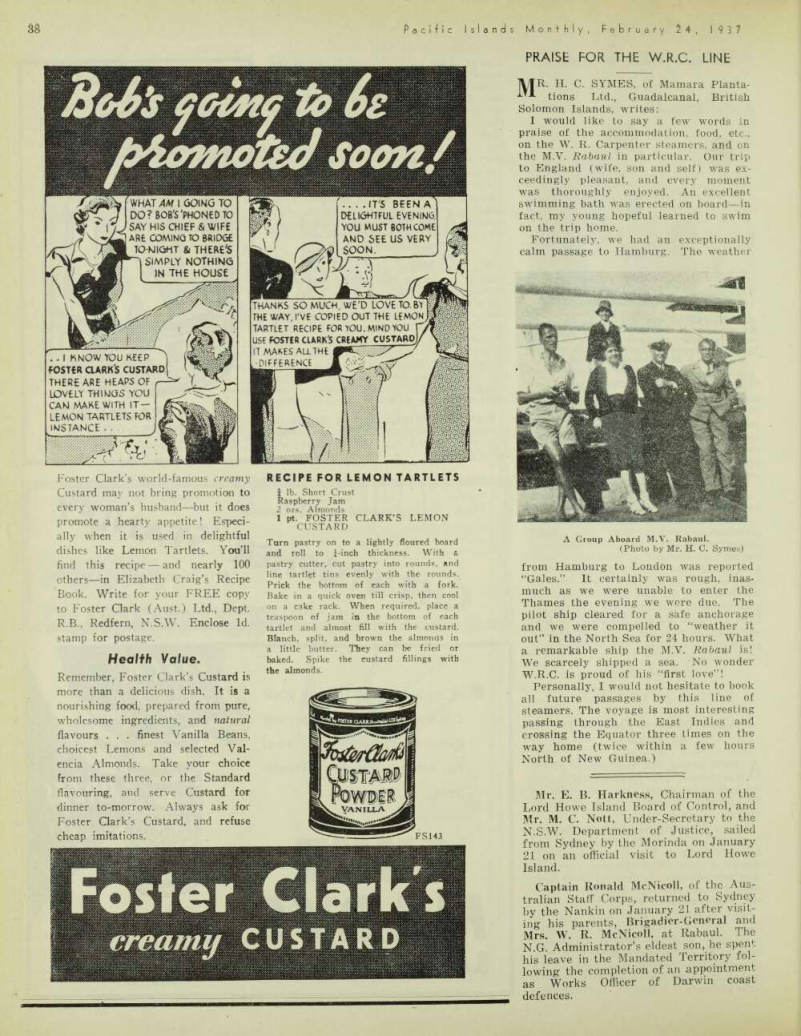
TV/fR. H. C. SYMES, of Mamara Planta •L*-*- tions Ltd., Guadalcanal, British Solomon Islands, writes; I would like to say a few words in praise of the accommodation, food, etc., on the W. R. Carpenter steamers, and on the M.V. Rabaul in particular. Our trip to England (wife, son and self) was ex ceedingly pleasant, and every moment was thoroughly enjoyed. An excellent swimming bath was erected on board—in fact, my young hopeful learned to swim on the trip home.
Fortunately, we had an exceptionally calm passage to Hamburg. The weather
from Hamburg to London was reported “Gales.” It certainly was rough, inas much as we were unable to enter the Thames the evening we were due. The pilot ship cleared for a safe anchorage and we were compelled to “weather it out” in the North Sea for 24 hours. What a remarkable ship the M.V. Rabaul is!
We scarcely shipped a sea. No wonder W.R.C. is proud of his “first love”!
Personally, I would not hesitate to book all future passages by this line of steamers. The voyage is most interesting passing through the East Indies and crossing the Equator three times on the way home (twice within a few hours North of New Guinea.) Dir. E. B. Harkness, Chairman of the Lord Howe Island Board of Control, and Mr. M. C. Nott, Under-Secretary to the N.S.W. Department of Justice, sailed from Sydney by the Morinda on January 21 on an official visit to Lord Howe Island.
Captain Ronald McNicoll, of the Aus tralian Staff Corps, returned to Sydney by the Nankin on January 21 after visit ing his parents, Brigadier-General and Mrs. W. R. McNicoll, at Rabaul. The N.G. Administrator’s eldest son, he spent his leave in the Mandated Territory fol lowing the completion of an appointment as Works Officer of Darwin coast defences.
A Group Aboard M.V. Rabaul. (Photo by Mr. H. C. Symes)