Dutch And Australian New Guinea
pp. 19-21 · Read in the full issue
Interesting Comparison of Development and Resources
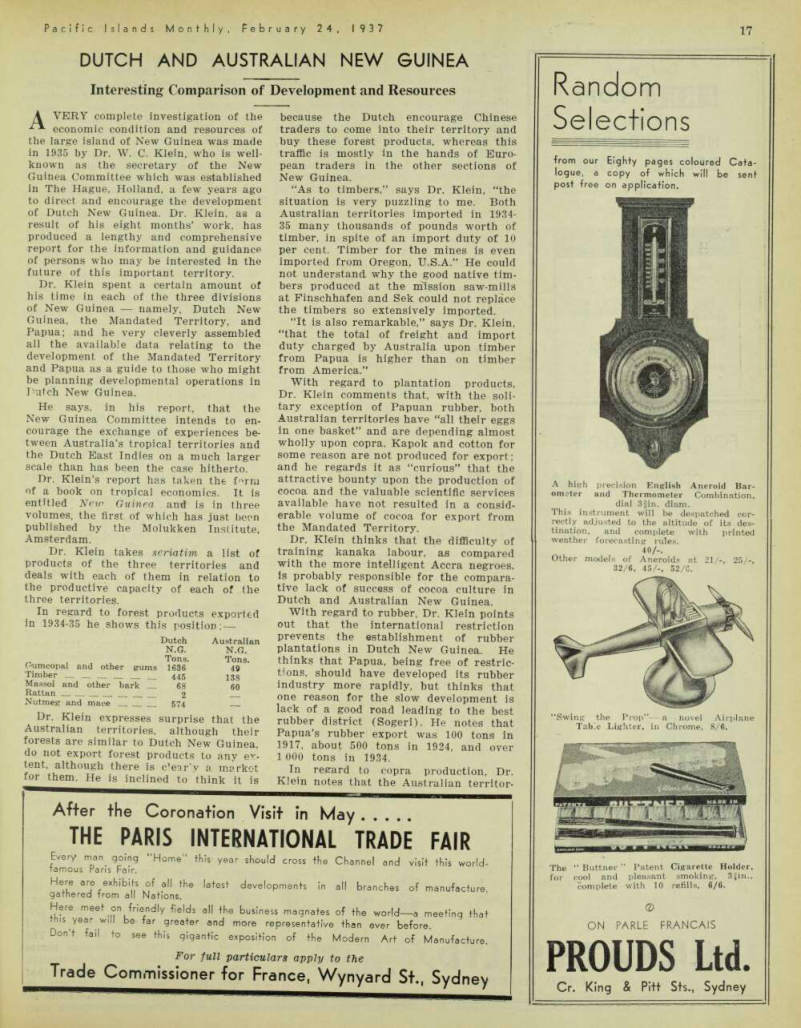
A VERY complete investigation of the economic condition and resources of the large island of New Guinea was made in 1935 by Dr. W. C. Klein, who is well known as the secretary of the New Guinea Committee which was established in The Hague, Holland, a few years ago to direct and encourage the development of Dutch New Guinea. Dr. Klein, as a result of his eight months’ work, has produced a lengthy and comprehensive report for the information and guidance of persons who may be interested in the future of this important territory.
Dr. Klein spent a certain amount of his time in each of the three divisions of New Guinea namely, Dutch New Guinea, the Mandated Territory, and Papua; and he very cleverly assembled all the available data relating to the development of the Mandated Territory and Papua as a guide to those who might be planning developmental operations in Dutch New Guinea.
He says, in his report, that the New Guinea Committee intends to en courage the exchange of experiences be tween Australia’s tropical territories and the Dutch East Indies on a much larger scale than has been the case hitherto.
Dr. Klein’s report has taken the f"rm of a book on tropical economics. It is entitled New Guinea and is in three volumes, the first of which has just been published by the Molukken Institute, Amsterdam.
Dr. Klein takes seriatim a list of products of the three territories and deals with each of them in relation to the productive capacity of each of the three territories.
In regard to forest products exported in 1934-35 he shows this position;
Dr. Klein expresses surprise that the Australian territories, although their forests are similar to Dutch New Guinea, do not export forest products to any ex tent, although there is c’ear'y a market for them. He is inclined to think it is
because the Dutch encourage Chinese traders to come into their territory and buy these forest products, whereas this traffic is mostly in the hands of Euro pean traders in the other sections of New Guinea, “As to timbers,” says Dr. Klein, “the situation is very puzzling to me. Both Australian territories imported in 1934- 35 many thousands of pounds worth of timber, in spite of an import duty of 10 per cent. Timber for the mines is even imported from Oregon, U.S.A.” He could not understand why the good native tim bers produced at the mission saw-mills at Finschhafen and Sek could not replace the timbers so extensively imported.
“It is also remarkable,” says Dr, Klein, “that the total of freight and import duty charged by Australia upon timber from Papua is higher than on timber from America.”
With regard to plantation products.
Dr. Klein comments that, with the soli tary exception of Papuan rubber, both Australian territories have “all their eggs in one basket” and are depending almost wholly upon copra. Kapok and cotton for some reason are not produced for export; and he regards it as “curious” that the attractive bounty upon the production of cocoa and the valuable scientific services available have not resulted in a consid erable volume of cocoa for export from the Mandated Territory.
Dr. Klein thinks that the difficulty of training kanaka labour, as compared with the more intelligent Accra negroes, is probably responsible for the compara tive lack of success of cocoa culture in Dutch and Australian New Guinea.
With regard to rubber, Dr. Klein points out that the international restriction prevents the establishment of rubber plantations in Dutch New Guinea. He thinks that Papua, being free of restric tions, should have developed its rubber industry more rapidly, but thinks that one reason for the slow development is lack of a good road leading to the best rubber district (Sogeri). He notes that Papua’s rubber export was 100 tons in 1917, about 500 tons in 1924, and over 1 000 tons in 1934.
In regard to copra production, Dr.
Klein notes that the Australian territor
Dutch Australian N.G.
N.G.
Tons.
Tons.
Gumcopal and other gums 1636 49 Timber 445 138 Massoi and other bark 68 60 Rattan 2 Nutmeg and mace 574
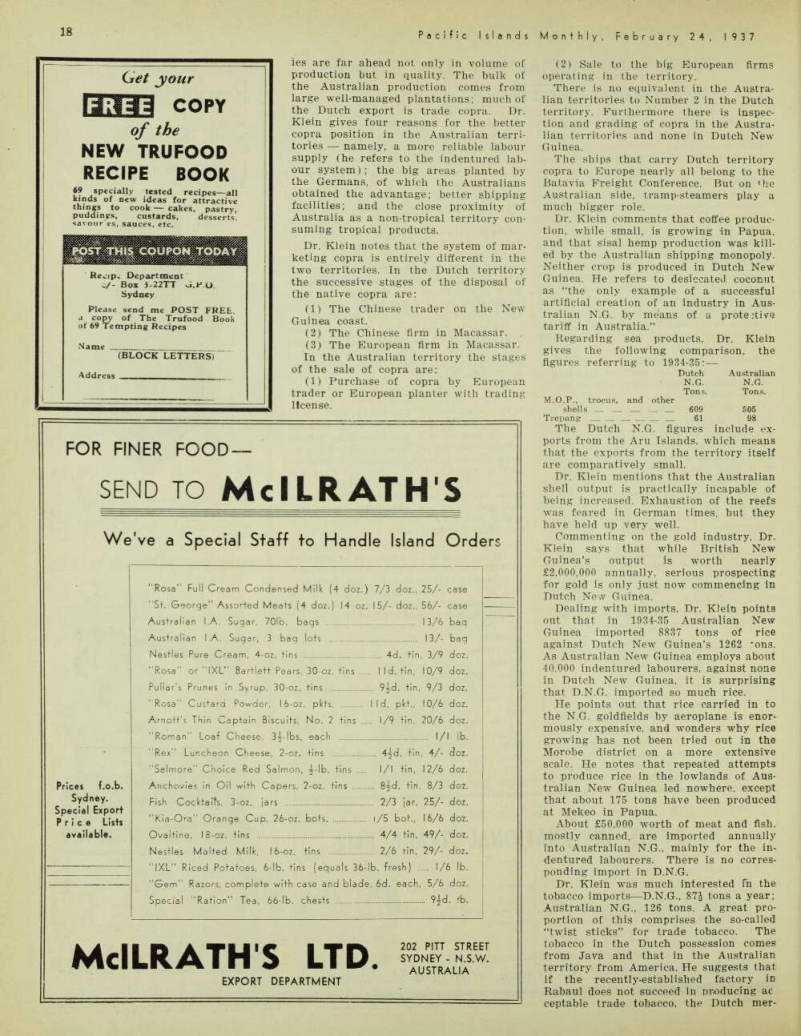
ies are far ahead not only in volume of production but in quality. The bulk of the Australian production comes from large well-managed plantations; much of the Dutch export is trade copra. Dr.
Klein gives four reasons for the better copra position in the Australian terri tories namely, a more reliable labour supply (he refers to the indentured lab our system); the big areas planted by the Germans, of which the Australians obtained the advantage; better shipping facilities; and the close proximity of Australia as a non-tropical territory con suming tropical products.
Dr. Klein notes that the system of mar keting copra is entirely different in the two territories. In the Dutch territory the successive stages of the disposal of the native copra are; (1) The Chinese trader on the New Guinea coast. (2) The Chinese firm in Macassar. (3) The European firm in Macassar.
In the Australian territory the stages of the sale of copra are; (1) Purchase of copra by European trader or European planter with trading license.
(2) Sale to the big European firms operating in the territory.
There is no equivalent in the Austra lian territories to Number 2 in the Dutch territory. Furthermore there is inspec tion and grading of copra in the Austra lian territories and none in Dutch New Guinea.
The ships that carry Dutch territory copra to Europe nearly all belong to the Batavia Freight Conference. But on Die Australian side, tramp-steamers play a much bigger role.
Dr. Klein comments that coffee produc tion, while small, is growing in Papua, and that sisal hemp production was kill ed by the Australian shipping monopoly.
Neither crop is produced in Dutch New Guinea. He refers to desiccated coconut as “the only example of a successful artificial creation of an industry in Aus tralian N.G. by means of a protective tariff in Australia.”
Regarding sea products, Dr. Klein gives the following comparison, the figures referring to 1934-35: —
The Dutch N.G. figures include ex ports from the Aru Islands, which means that the exports from the territory itself are comparatively small.
Dr. Klein mentions that the Australian shell output is practically incapable of being increased. Exhaustion of the reefs was feared in German times, but they have held up very well.
Commenting on the gold industry, Dr.
Klein says that while British New Guinea’s output is worth nearly £2,000,000 annually, serious prospecting for gold is only just now commencing in Dutch New Guinea.
Dealing with imports, Dr. Klein points out that in 1934-35 Australian New Guinea imported 8837 tons of rice against Dutch New Guinea’s 1262 "ons.
As Australian New Guinea employs about 40,000 indentured labourers, against none in Dutch New Guinea, it is surprising that D.N.G. imported so much rice.
He points out that rice carried in to the N.G. goldfields by aeroplane is enor mously expensive, and wonders why rice growing has not been tried out in the Morobe district on a more extensive scale. He notes that repeated attempts to produce rice in the lowlands of Aus tralian New Guinea led nowhere, except that about 175 tons have been produced at Mekeo in Papua.
About £50,000 worth of meat and fish, mostly canned, are imported annually into Australian N.G., mainly for the in dentured labourers. There is no corres ponding import in D.N.G.
Dr. Klein was much interested fn the tobacco imports—D.N.G., 87J tons a year; Australian N.G., 126 tons. A great pro portion of this comprises the so-called “twist sticks” for trade tobacco. The tobacco in the Dutch possession comes from Java and that in the Australian territory from America. He suggests that if the recently-established factory in Rabaul does not succeed in producing ac ceptable trade tobacco, the Dutch mer
Dutch Australian N.G.
N.G.
Tons.
Tons.
M.O.P., trocus, and other shells .„ ..._ 609 505 Trepang ... 61 98
chants in the East Indies should go after this trade. He mentions that the D.N.G. native smokes much more tobacco than his neighbour in ' Australian territory.
Dr. Klein, dealing with textile imports, notes that more textiles are bought per head in Dutch New Guinea than in Aus tralian New Guinea. He says this is due to the fact that in Australian N.G. the majority of natives under Government control are not allowed to wear clothing above the waist.
Dealing generally with imports, Dr.
Klein notes an increase in quantity in Japanese textiles in Australian New Guinea —probably as a result of the intro duction of new Japanese lines of ship ping—but he thinks that this develop ment is not so noticeable in the case of ironware and machinery. “I find the kanaka, like the more intelligent nat ives of the Molukkas, Fiji, Samoa, etc., dislikes Japanese tools and knives. I saw Japanese nails and roofing iron in Dutch New Guinea, but in Australian New Guinea they are lacking entirely.”
Taking the total volume of trade in the respective territories, Dr. Klein says that in the period of about 30 years, between 1905 and the present time, the total vol ume of Dutch trade increased about 70 per cent, whereas in the Australian terri tories the increase has been about 1,000 per cent. The increase in the case of the Mandated Territory was 1,600 per cent, but in Papua it was about 300 per cent.
“Much more significant is the export surplus,” concludes Dr. Klein. “On our side it was big and positive in 1905, and still bigger but negative in 1934. The other two territories show the more nor
mal change from a negative to a positive surplus. If the Dutch had put money in Dutch N.G. in the past instead of drawing benefits from it, we might have had the same normal course of affairs, as is shown by the Australian territories.
“Fortunately from the comparison of the years 1934 and 1935 the reader can learn for the Dutch part that we now put every year increasing amounts of money into this country. If we had the statistics for 1936 available this would come out still more’ clearly, as in that year Gov ernment and oil and gold companies all started to spend big sums on this terri tory, the former to equip some five new European and some 25 new native Gov ernment stations, the latter to bring in aeroplanes, drilling machinery, etc., to explore the mineral wealth.
“It would not surprise the writer if the total volume of trade in the next 10 years approached that of the Australian part. This of course depends much on the result of the oil and gold explora tions, as forests and agriculture alone, even if strongly pursued, could not make the difference.”
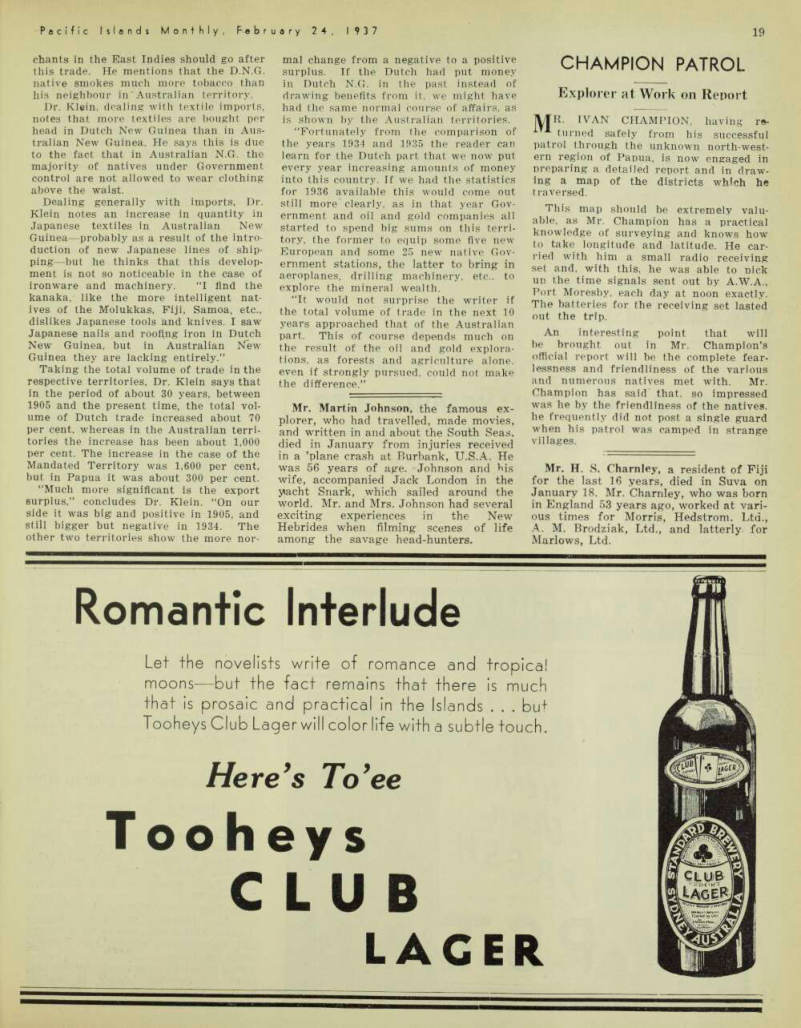
Mr. Martin Johnson, the famous ex
plorer, who had travelled, made movies,
and written in and about the South Seas, died in January from injuries received in a ’plane crash at Burbank, U.S.A. He was 56 years of age. Johnson and his wife, accompanied Jack London in the yacht Snark, which sailed around the world. Mr. and Mrs. Johnson had several exciting experiences in the New Hebrides when filming scenes of life among the savage head-hunters.