Impressions of the Trobriands: Hospitable People, With Many Strange Customs
pp. 41-47 · Read in the full issue
Made In Australia advt
Impressions Of The Trobriands
Hospitable People, With Many Strange Customs By W. H. POTTS was only a temporary stopping place for me, where a boat might might be found which was going to the Trobriand Islands.
Lying about 15o’miles north of Samarai, this picturesque group has many interesting customs and legends, which are unlike any others on the mainland of Papua, and are still observed with almost the same particularity as in the pre-government and mission period.
After a few days, a boat was scheduled to make her six-weekly visit there and early one morning, before anyone else was astir, we cast off and sailed quietly away through China Straits.
We anchored in I>obu Passage on the first night and set off again at daybreak, passing the mountain, Koyatabu on Pergusson Island, which towered thousands of feet above us on our port side. As the sun rose higher, the Amphlett group came into view, that cluster of steep little islands where an extensive native pottery manufacture is still practised.
After some hours’ sailing through coral strewn waters, a long, low island appeared, tinged with the faint blue haze of distance. Absolutely flat, without even a solitary relieving hill, it stretched for many miles athwart our course, with several smaller outlying islands at its north-western extremity. These constituted the Trobriand Group, real coral islands, of which the principal one is Kiriwina. Though only 30 miles long and 12 miles wide at its broadest part, it supports a native population of about gOOO.
As we drew closer, the mid-western shore appeared as one large crescentshaped bay, whilst its shallow waters were enclosed by coral reefs which gave shelter to a lagoon of that emerald green shade, so familiar and pleasing to every traveller in coral seas.
THAT evening, an anchorage was found at a small island called Muwo. which lies off the south point of the crescent.
Here is a coconut plantation which is operated by a well-known identity of New Guinea, Mr. E. Auerbach, who, as far back as 1911, made a notable gold-prospecting journey with Jim Preston and Shark-eye Park up the Markham River in what was then German New Guinea, eventually reaching the Watut River, when the first indications of gold came to light in those remote places.
Fish in abundance are found at Muwo, and all night long phosphorescent shapes gleamed in the dark waters, whilst occasionally a huge glowing form would encircle the boat, telling us that we were indeed among the sharks, After taking on copra here, we sailed on Bau which is on Kiriwina and is the p or £ f or Losuia, the Government station—jf a clearing in the forest with a copra-store shed can be called a port. The water off Losuia is only deep enough to rece ive boats up to ten or fifteen tons, and most of the cargo is transhipped to more suitable craft at Bau . „ , Jrobnand native is a keen fellow f 9 r !' rad€ ;’ and when 1-he news of our arrlJai had been spread, many canoes put from the shore and soon our decks w 9 re swarming with a chattering horde, o climbed all over the cargo peered tf® engine-room and poked their heads through the port holes. With them they brought fish, fowls, eggs, yams, Potatoes, pumpkins and pawpaws, y ° u were more aesthetically mclmed, they would offer you unique carvin&s °f A n ® workmanship. Smaller pieces were mostly of ebony, whilst the larger ones were of a native brown wood, of a v . ery P le asmg tint. Pigs, dogs and bowls seemed to be their favourite subjects; and some weeks later, when I visprincipal carving village, I was *° see them at work on massive tables, Their canoes are similar to the Papuan outrigger type, having the customary hollowed-out tree-trunk, which varies in length from six to twenty feet.
When the time came to continue our cks . cleared , of . t i ies .® • p€ ° ple ’ Wlth basket of fruit carvings and they scrambled ° the many cano-es which lay arouna us- (Continued overleaf) 39 Pacific Islands Monthly, January 22, 1 937 MILK
Best, Therefore Cheapest
Copyright A257c COON we were passing along the coast, around the northern end of Kiriwina en route to the island of Kitava, which lies to the east of the Trobriand Group.
As the boat punched her way into the rising wind, it was noticed that a solid wall of coral, capped by fairly thick timber, barred all entry to the interior of Kiriwina and stood out even to the water’s edge; at rare intervals a small stretch of sand appeared where a break in the rock had occurred.
After some hours, we dropped anchor in the small straits between Nurutu and Kitava Islands. Here was water of a deep shade of transparent blue, unlike any other in these seas. Silvery sand bounded the narrow coastal flat, whilst masses of coral towered above all, forming- a high inland plateau.
The natives on this island closely resemble those on the main one. They have similar customs and dances, live in the same type of house and cultivate extensive gardens. There is, however, only one white man living there and he has reigned supreme for a quarter of a century, with his house on top of the hill and his coconut trees stretching for several miles along the coast. If you want to buy some yams from the natives, or carvings, or any kind of trade, then you go to him and he will arrange it for you; nothing can be done except through him, so well do the natives trust and regard him.
The boat’s visit was the first for three mfonths; and soon we saw hfs spare figure striding through the lines of palm trees; his dinghy put off and was soon bumping alongside. With a battered old felt hat, red handkerchief around his neck and his knife thrust inside his stocking in true Scottish fashion, this timehonoured inhabitant of the South Seas fook hold of a stay and came abroad.
Next morning, the copra was loaded, and regretfully I went on board as the anchor was heaved up. Laughing girls swam playfully around, others called out good-bye from the beach while my kind host waved the same old hat.
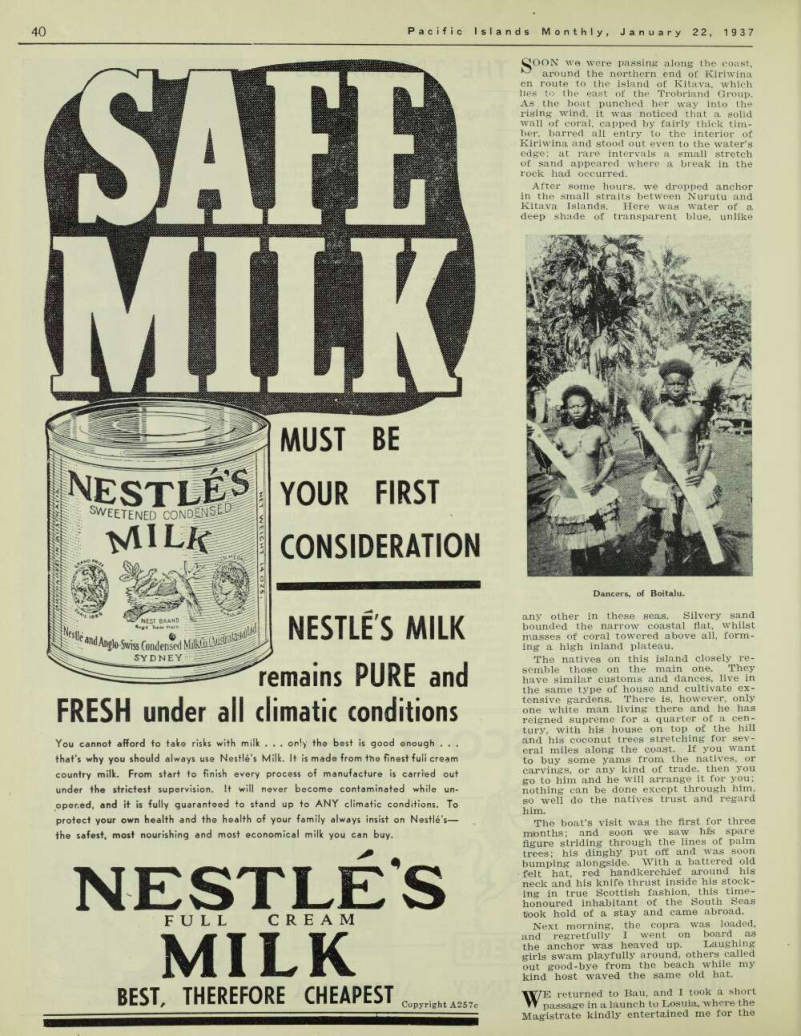
WE returned to Bau, and I took a short passage in a launch to Losuia, Where the Magistrate kindly entertained me for the Dancers, of Boitalu. 40 Pacific Islands Monthly, January 22, 1937 Ltd.
WATERLOO New Hebrides: Vila, code Address: Gilberts: Tarawa.
"Bumsouth. Norfolk Is. Niue. Wallis Is. Futuna Is. night. On the following morning, a cookboy was engaged, who also served as interpreter, as neither Motuan nor Suau are understood on the island. Carriers were readily obtained, though they were definitely not of the stamina of the Papuan mainland boys, three being required. where two would have sufficed on the mainland. By entering Kiriwina by way of Dosuia, which lies on the northern side of the crescent shaped bay, it is possible to avoid the coral wall and at the same time visit the majority of villages without crossing it.
To thje traveller accustomed to the difficult and inferior native tracks in Papua, perhaps the most striking point about this island is its network of easy paths, which are scarcely graded at all as the interior is almost flat. Lines of coconut palms skirt these miniature roads all over Kiriwina, whilst the presence of a village is denoted, even from a distance, by tall massive trees, under whose shade the thirsty visitor may consume copious draughts of cool coconut milk at his ease. For these islands are hot. Dense scrub deters the cooling wind and only when the large garden clearings are reached can the breeze be felt.
My first destination was the village of Boitalu, which lay at about one and a half hour’s walk from Losuia. Here is a place which is unique in the island, for its inhabitants are despised by all the other villages.
“Do they not eat bush pig and snake?
Do they not eat even the crocodile?” exclaimed the cook-boy, Noeli, in terms of indignation.
This, apparently, just “isn’t done” and accordingly social ostracism is the result.
No other villagers may partake of the food of Boitalu, excepting coconuts, nor may they join in their dances.
The food question threatened some difficulty for Noeli, as he had been given one stick of trade tobacco to purchase his first three days’ food as required from the villages we visited, and he had omitted to mention the Boitalu tabu until arrival. Fortunately, his wife thought of it, and sent some food after him by another boy, so the situation was saved.
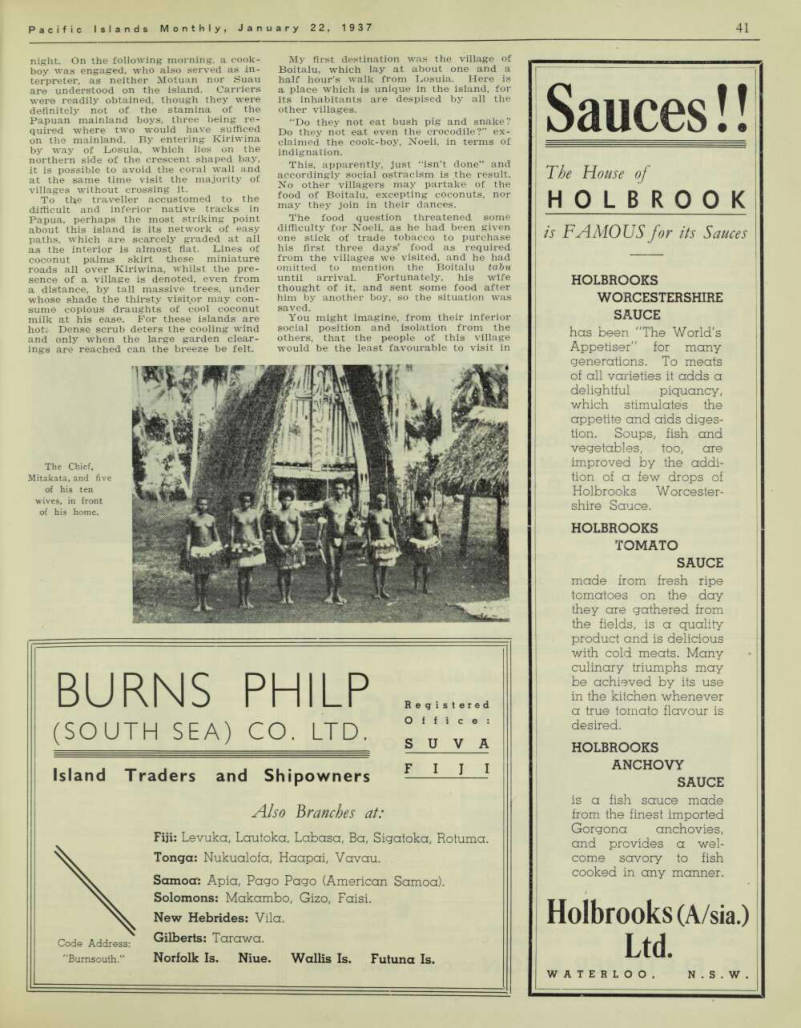
You might imagine, from their inferior social position and isolation from the others, that the people of this village would be the least favourable to visit in The Chief, Mitakata, and five of his ten wives, in front of his home. 41 Let us know your requirements. We will be pleased are Widely Used Throughout the Pacific Islands. the island. Actually, the contrary is the case, for they are the most hospitable and obliging of all the natives. They will ask you to watch their dances and nothing gives them greater pleasure than your acceptance. They will fetch water ofegS’ ayTe^a y we S With amoUnt g ‘ THEY always like a smoke, however A small th© service they perform for you, and by trading with them it is possible to avoid all us© of tinned meat.
Ther© are set prices all over the Trobriands, which are carefully observed by the white residents. For instance, one stick of tobacco (costing about threepence) will purchase four eggs, or two pineapples, or thirty pounds of potatoes, yams, etc., or enough fish for two days. A good fowl will cost you three sticks, and a bush pig may also be had for that price.
Whenever they receive tobacco they will always ask insistently for “pwairp” —or so it sounds. Actually, it is a piece of newspaper they want in which to roll their cigarettes, as a change from the eternal pandanus leaf All the Kiriwlna villages resemble each other in the well populated northern area, and quite the most noticeable thing on entering one is the yam houses. Each family has its own garden, and at the end of each harvest the yams are carefully stored in an airy structure which is rai sed two or three feet off the ground and is usually about twelve feet high, three feet wide and ten long. Lengths °f tree trunks, about four inches in diameter, form the floor and walls, which are so built up that ample ventilation is provided, which is essential if the yams are to last until next harvest, The living houses are all set on the ground, with the roof slightly curved in one long sweep and combining roof and wall in one. The whole structure is a framework of thin sticks, thatched with pandanus leaves and without any opening except the doorway. There is one family in each house and a narrow platform is fixed at the entrance, on which the native may sit and chew betel-nut, if he is so minded.
That the benefits of a structure raised from the ground are known to them is obvious from their yam houses, and enquiry as to their reason for not building their own houses similarly, revealed at once their fear and belief in magic.
They are convinced that if they raise the level of their floors, the witch doctor will make a little fire underneath them while they sleep, from the effect of which they will die within three months.
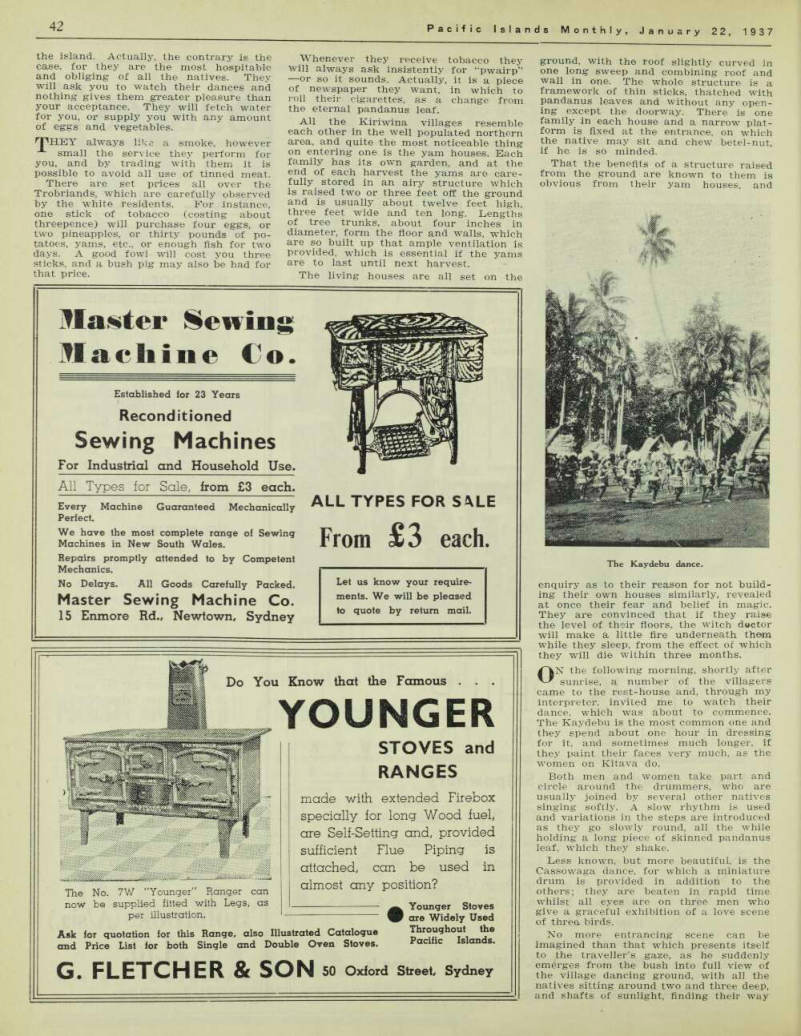
ON the following morning, shortly after sunrise, a number of the villagers came to the rest-house and, through my interpreter, invited me to watch their dance, which was about to commence.
The Kaydebu is the most common one and they spend about one hour in dressing for it, and sometimes much longer, if they paint their faces very much, as the women on Kitava do.
Both men and women take part and circle around the drummers, who are usually joined by several other natives singing softly. A slow rhythm is used and variations in the steps are introduced as they go slowly round, all the while holding a long piece of skinned pandanus leaf, which they shake.
Less known, but more beautiful, is the Cassowaga dance, for which a miniature drum is provided in addition to the others; they are beaten in rapid time whilst all eyes are on three men who give a graceful exhibition of a love scene of threa birds.
No more entrancing scene can be imagined than that which presents itself to the traveller’s gaze, as he suddenly emerges from the bush into full view of the village dancing ground, with all the natives sitting around two and three deep, and shafts of sunlight, finding their way The Kaydebu dance.
For all Island requirements.
Cable Address: "NEWLANDBED,' Sydney through the fronds of the palm trees, flashing on the bright headgear of the dancers, in vivid contrast to their dark bodies, like spotlights on a theatre stage.
At the end of the harvest, there is dancing in almost every village and at that time it is continued for longer periods, sometimes all through the night, with feasting.
IN Boitalu are carved all those attractive articles of furniture, which are found in almost every Papuan home and never fail to draw the admiration of newcomers to the territory; many even find their way to Australia and England.
The accompanying illustration of a table in a half-finished state shows a typical example of the more massive productions.
In this particular case the supporting pieces will take the form of men, but quite often they are carved to the image of animals resembling large lizards; the whol6 piece is cut from the solid trunk of a tree and may be finished in four or five days by an experienced hand.
Another design which is equally popular embodies a large bowl instead of a table top, whilst there are infinite varieties of both styles. In addition, there are numerous single pieces representing various animals, and there is a curious example in the possession of a trader of a carving, about eighteen inches long, which was first shaped like a goat owned by him. The goat died before its “sittings” were completed, and the native forgot what it looked like: but, unwilling to discard a half-finished article, he decided to convert it to a pig, and the result would certainly puzzle a naturalist, if it were alive.
The tools most commonly used to-day are small adzes and penknives; whilst intricate work, such as one finds on native hair combs are executed with a dog’s tooth, firmly tied into the split end of a small stick.
There are here perhaps the most comely young women of the island, though they quickly deteriorate after marriage, which takes place when they are between fourteen and sixteen years old, as a rule. The men of this island are inferior to those found on the Papuan mainland coasts and their features are softer; their height rarely exceeds 5 feet 6 inches. It is more than sixty years since tribal fighting took place on the island, but in earlier times it was prevalent. To-day the skulls and bones of the vanquished remain in the caves, which abound in the coral wall, together with some ancient forms of pottery, doubtless the one-time property of the victims.
There are also traces of an earlier race, beyond the ken of the present natives, and hug'e stone slabs, up to twelve feet high, have recently been discovered in a position to suggest either a large tomb or house. The existence of a race using stone buildings was unsuspected in Kiriwina until this discovery.
When walking from village to village it is found that the surrounding bush is rarely more than a few feet high, for the population is so large that almost the whole interior has been under cultivation. When a harvest is finished, the garden is left for five years before it is used again, thus permitting the scrub to grow. A new area is selected, the bush cut down and burnt, then the yams, taro, sweet potatoes, sugar cane, etc. are set by the men.
Each individual’s garden is marked off A Boitalu boy, carving a table.
E. Wright & Co. Ltd.
Office and Works: 148-152 Cleveland Street, Sydney. N.S.W.
Telegraphic Address: "Wrightmake,'' Chippendale Address Ropeyard, 163 CLARENCE STREET, SYDNEY N.S.W. from its neighbour by a boundary of sticks or stones and later is kept free of weeds by women. In the southern part of the island this latter performance takes place during January and February, when all the gardens are weeded at the same time; and woe betide any man, white or black, who intrudes there while they are at work, for he will be pursued and, if he is caught, he will be treated in a manner unfit for public description—but not actually injured.
On one occasion, a former resident magistrate was chased but fortunately he escaped. The last record of a case of this pursuit took place about three years ago, when a native narrowly missed this unique ceremony. It is so well-known, however, that no intelligent boy will ever venture near.
A FEW more miles in a north-easterly direction from Boitalu, lies the village of Omerakana, where Mitakata reigns, the paramount chief of Kiriwina. When he is sitting outside his house, every native in sight must walk, bent double and the greatest respect is shown to him in all ways. He has ten wives (whereas all other men have only one) and each of them has her own living and yam houses.
Mitakata’s house is much larger than the average, and over the entrance there are numerous designs in blue and red on a background of white. These are also found on his two massive yam houses, which stand high above all others.
Whenever these coloured designs are found, they denote the dwelling of a chief.
In addition to Mitakata, there are several other chiefs in different villages, but of lesser importance. tie receives an allowance of several pounds of tobacco monthly from the government, and also a substantial contribution of yams from his subjects, so that he need never work. At one time it was the custom for all the men in the chief’s village to appear before him each morning and receive any special instructions he might give, but to-day this practice has ceased. Succession to this high rank is always through the maternal relations.
Hence, the present chief’s sons will not take his place. At the moment, the heir is his maternal uncle.
This inversion of our own custom is due to the natives’ ignorance of fatherhood. They believe that on the death of one of them, the spirit will go to the little island of Tuma, on the north-west coast of Kiriwina, and at certain times of the year these spirits travel back across the water and are re-born.
THERE is a most interesting ceremony in connection with this belief, called Milamala. Shortly after the end of each annual harvest, all the spirits of Tuma come back to their respective villages for a few hours; food is put out for them on small platforms and the villagers dance and sing all night. But the spirits must not linger after daybreak and, at that time, the whole village attempts to chase them away back to Tuma, with as much noise as possible.
The coastal villages provide the most remarkable scenes when three or four hundred natives gather on the water’s edge, looking out to sea, and waving their The chief, Mitakata, in front of his yam house. also Spotted Gum Timbers—Prices Right A C Frvpr 110 Miller St., v*. rryer Pyrmont> N .s.w.
Herbert Del Cott Pty. Ltd.
Cables "Voltage" 116 QUEEN STREET. MELBOURNE 'Phone: Central 10488 farewells, some with tears streaming down their faces, as they remember their lost ones. “Kaion” they cry, “Kaion” (goodbye, good-bye). The word is pronounced “kaioon”; and, when uttered in their plaintive way, one feels that it is indeed a sad departure.
An increasing acquaintance with these attractive people shows an outstanding devotion to their gardens and, so early do they leave their villages to go to them, that when carriers are required, it is necessary to send for them at daybreak.
There is an additional occupation, which is confined to the villages on the shores of the lagoon on the west coast; that is diving for pearls. A small lapi oyster is common in these waters and produces a pearl which, though slightly inferior compared with that from better-known areas, is none-the-less a valuable product of the island and, during the last twentyfive years, approximately £300,000 worth has been bought by traders from the natives. The latter have absolute right in the best areas and no white man or half-caste may dive for pearls, but must content himself with buying them from the natives. To do this he must obtain a buyer’s licence from the government at a cost of £5O per annum.
The oyster itself is inferior to the common edible one when uncooked, but if it is put into the fire and roasted in its shell it is delicious.
One evening, I tried a bush pig, also cooked in the native way, but it was not very tasty. This latter method is performed by digging a hole in the ground a few inches deep and about a yard across (for smaller pigs), lighting a wood fire in it and placing pieces of rock or coral on top of it. When the fire has burnt itself out, the pig is placed on the hot stones, covered with large leaves, then smothered with soil and left for some hours. Yams, etc. are often cooked in this manner but of course require only a short time.
Although the Trobriands are selfsupporting, as far as food is concerned, they are obliged to import earthenware, for a considerable amount of cooking is done in large clay pots, which they buy from the Amphlett Islands, in exchange for yams and other produce which is lacking there.
PERHAPS the most remarkable of all their customs is that known as Kula, which is practised not only in the Trobriands but in almost all the islands of Eastern Papua. With this is bound up a tremendous trade route which never varies, yet is separate from Kula, which itself is a reminder of those not very distant days when natives visiting another island for trading purposes did so at a considerable risk. If, however, they could each find partners in that island, then they would be safe for future expeditions, and assured of food and lodging for the duration of their stay.
So was the Kula evolved and it embraced the following islands; Trobriands, Marshall, Bennett, Woodlark, Laughlin, Misima, Panayati, Tubetube, Wari, Sariba, Sidea, Basilisk, Rogea, Ncrmanby, Fergusson and Amphletts. This is not an exhaustive list but is the main route followed and is roughly circular.
The ceremony is conducted by the exchange of armshells ( mvoali ) and red spondylus discs ( soulava ) between the partners on adjoining islands on the route. These tokens are never held for more than a few months, and never become private property, but are handed on year after year, completely travelling round the Kula route, with the distinction that the mwali always travel in an anticlockwise direction whilst the soulava go in the reverse direction.
When setting out on Kula expeditions, canoes are used which are much larger than the usual coasting type, for sometimes fifty miles or more of open sea have to be covered, and usually many articles of trade are carried at the same time. There may be ten or more of these large canoes in a group, and it is a fine sight to see them arriving under sail, with often a dozen occupants, and loaded high with goods for barter.