"Clear Out!": How Samoa, in Panic Over Epidemic, Treated Five Apia Residents
pp. 9-10 · Read in the full issue
Nadi, after nine years’ service at the former institution.
“Clear Out!”
How Samoa, In Panic Over Epidemic, Treated Five Apia Residents TN New Zealand’s long record of stupid 1 and muddling mismanagement in Samoa, the case of the Matua’s Christmas passengers probably will stand unique.
The Matua arrived in Apia on Christmas Eve. She carried a number of roundtrippers, and five persons booked for Apia.
The latter were: Miss Betty Dawson, daughter of Dr.
Dawson—a school-girl, on a visit to her parents from New Zealand.
Miss Mabel Yandell, an Apia resident, returning home after a holiday visit to Australia.
Mr. W. Links, an executive of Messrs Burns Philp (S.S.) Ltd., Apia, returning home from leave spent in Australia.
Messrs. G. Stoeckicht and A. Matthes, two German residents of Samoa, returning to Apia after a visit to Germany.
These five people learned by radio, when half way to Apia, that there might be difficulties regarding quarantine in Apia, owing to the outbreak of infantile paralysis in New Zealand. But they had been allowed ashore freely in Nukualofa and Barotonga, so they did not worry over much.
Miss Yandell and Mr. Links did not worry at all. They had gone from Sydney to Auckland in the Aioatea, and transferred immediately to the waiting Matua, which sailed a few hours later. They had spent an hour or two in Auckland streets but they felt that their connection with New Zealand was nil.
They calculated without Samoa’s famous Old Granny Government.
The decision of the authorities, announced in Apia, was that no one could land from the Matua. The round-trippers growled, but submitted. The five Apia people protested, and pleaded that at least they be allowed to go ashore, in quarantine: but officialdom simply did nothing.
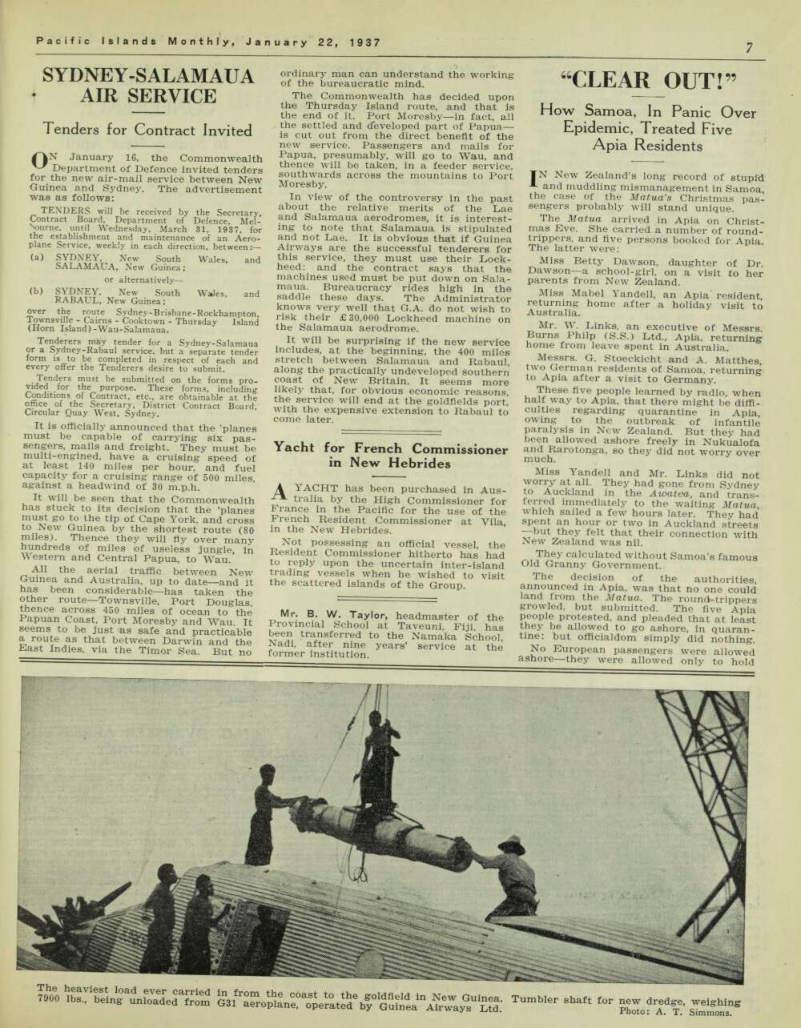
No European passengers were allowed ashore—they were allowed only to hold 7900 lbs., being Tumbler shaft for 7 Pacific Islands Monthly, January 22, 1937 distant converse with their friends, who circled around the ship in boats —but there was no restriction upon the Samoan cargo-workers from the shore. Over 100 Samoans, on two occasions, came aboard, mingled with the crew, and worked the cargo, which also was allowed ashore without restriction.
The Apia five, armed with piles of Christmas presents, watched the Apia shore hungrily during Christmas Eve and the whole of Christmas Day. Their friends came near, and shouted and gesticulated.
Mr. Links, using glasses, had the doubtful pleasure of watching a Christmas party in progress at his own house.
Finally, it dawned upon the hapless five that the Administration meant it —they were to be chased away from their home.
Then, through Mr. Links, they appealed most urgently to the Acting-Administrator. They asked: Where were they to go? When might they come back? How were they to live in the meantime? Why could they not land and be placed in quarantine—especially in view of the fact that hundreds of natives had been allowed aboard the ship?
Officialdom simply shrugged its shoulders and said it did not know.
A few minutes before the Matua sailed for Suva the Captain was officially informed that the passengers must remain away for a month and then they could not return by any vessel which had called at a N.Z. port.
Messrs. Stoeckicht and Matthes left the Matua at Suva, and are still there, awaiting some way of getting home. Miss Dawson returned to Auckland.
Mr. Links and Miss Yandell returned to Sydney, in order to catch a copra-steamer, the Tolken, which is due in Samoa some time in March.
Round-trippers on the Matua, on their return to New Zealand, told the newspapers there that the proceedings aboard the vessel at Apia were a priceless farce.
They said that the Samoan officials at first made the ship’s company wear masks; but no masks were worn by the