L.M.S. Pioneers: Their Work at the Octagonal Church in Tahiti
PACIFIC PUBLICATIONS LTD., Union House, 247 George St., Sydney L.M.S. PIONEERS Their Work at the Octagonal Church in Tahiti By Our Papeete Correspondent.
THE scholarly researches by Mr. W.
W. Bolton, M.A. (Cantab.), into the early history of Protestant missions in Oceania have brought to light very many interesting facts, and have performed the priceless service of saving from oblivion the last resting-places of the faithful pioneers who brought the gospel to the Islands.
In November, 1936, a handsome tablet in the Tahitian language (of which the above is a translation) —presented by Mr. Bolton on behalf of the London Missionary Society—was installed and dedicated with solejnn ceremonies in the Octagonal Church at Papetoai, in the island of Moorea.
The graves of the two missionaries and those of the wives of Messrs. Henry, Davies, and Hayward, of the mission, were identified by Mr. Bolton —after long research among widely scattered sources —from the obscurity of over a century of neglect.
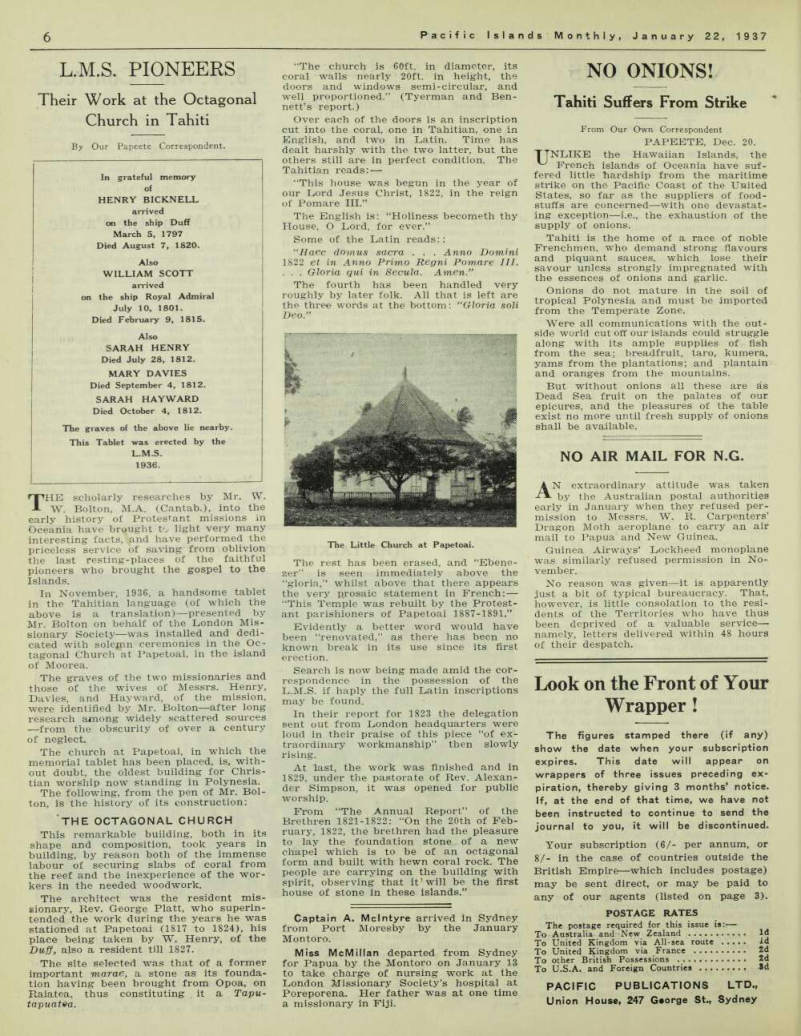
The church at Papetoai, in which the memorial tablet has been placed, is, without doubt, the oldest building for Christian worship now standing in Polynesia.
The following, from the pen of Mr. Bolton, is the history of its construction:
The Octagonal Church
This remarkable building, both in its shape and composition, took years in building, by reason both of the immense labour of securing slabs of coral from the reef and the inexperience of the workers in the needed woodwork.
The architect was the resident missionary, Rev. George Platt, who superintended the work during the years he was stationed at Papetoai (1817 to 1824), his place being taken by W. Henry, of the Duff, also a resident till 1827.
The site selected was that of a former important marae, a stone as its foundation having been brought from Opoa, on Raiatea, thus constituting it a Taputapuatea.
“The church is 60ft. in diameter, its coral walls nearly 20ft. in height, the doors and windows semi-circular, and well proportioned.” (Tyerman and Bennett’s report.) Over each of the doors is an inscription cut into the coral, one in Tahitian, one in English, and two in Latin. Time has dealt harshly with the two latter, but the others still are in perfect condition. The Tahitian reads: “This house was begun in the year of our Lord Jesus Christ, 1822, in the reign of Pomare HI.”
The English is: “Holiness becometh thy House, O Lord, for ever.”
Some of the Latin reads:: “Haec domus sacra . . . Anno Domini 1822 et in Anno Primo Regni Pomare 111. . . . Gloria qui in Secula. Amen The fourth has been handled very roughly by later folk. All that is left are the three words at the bottom; "Gloria soli Deo"
The rest has been erased, and “Ebenezer” is seen immediately above the “gloria,” whilst above that there appears the very prosaic statement in French: “This Temple was rebuilt by the Protestant parishioners of Papetoai 1887-1891.”
Evidently a better word would have been “renovated,” as there has been no known break in its use since its first erection.
Search is now being made amid the correspondence in the possession of the L.M.S. if haply the full Latin inscriptions may be found.
In their report for 1823 the delegation sent out from London headquarters were loud in their praise of this piece “of extraordinary workmanship” then slowly rising.
At last, the work was finished and in 1829, under the pastorate of Rev. Alexander Simpson, it was opened for public worship.
From “The Annual Report” of the Brethren 1821-1822; “On the 20th of February, 1822, the brethren had the pleasure to lay the foundation stone of a new chapel which is to be of an octagonal form and built with hewn coral rock. The