Capt. Dow’S Last
pp. 52-54 · Read in the full issue
Voyage
The Extraordinary Cruise of the “Chance”
By Julian Hillas
READERS of the P.I.M. will probably recall seeing, some months ago, an announcement of the finding of a small yacht off one of the northern Solomons, her single occupant dead in his bunk. The story, meagrely supported by facts, roused considerable speculation as to the identity and intentions of the solitary navigator.
Inquiries in several quarters have now elicited the fact that Captain John Dow was certainly the eldest of that hardy company of adventurers who have taken, since the War, to roaming the Seven Seas in small boats. It also appears likely that his ketch, the Chance, could have laid claim to a similar distinction.
In 1932, Captain Dow was 71 years of age. A widower, with two sons killed in France, it seemed as though his last days were fully insured by a comfortable bank balance of 30,000 dollars, accumulated through fifty years at sea. And then, in the financial chaos of that American summer, the bank closed its doors. Of the little fortune, there remained but 150 dollars.
He spent the following winter in New York, subsisting largely on the hospitality of friends. The prospect of a second under these conditions galled the Cap tain’s spirit.
Captain Dow had an idea. His health was still excellent. Poking around the waterfront, his eye had fallen upon a dis used ship’s lifeboat. From enquiries, he learned that it had long ago been con demned; and well could he believe this, from the worm-eaten state of her tim bers. The manager of the shipyard was an old friend.
The boat changed owners and, with bor rowed tools, the Captain set to work on her. From amidships forward he decked her in. Under his capable hands the dere lict gradually emerged as the two-masted ketch Chance.
Finished, she represented his last dreams—dreams of warm Southern lands where the bounty of Nature and the kind ness of Man were as unfailing as the rise and fall of the tropical tides. He would sail thither and end his days in those congenial latitudes. In vain his friends pointed out the hazards attached to such a voyage in such a vessel as the Chance.
Better, the Captain argued, to be lost at sea in the attempt, than spend another winter in New York. Finally, they gave up trying to dissuade him.
In the summer of 1933 he started, accompanied by Captain John H. Meyers, another old sea-dog beam-ended by the Depression.
On their voyage down the Atlantic coast they encountered such weather that Meyers was unwilling to share further adventures, and returned north from one of the ports at which they touched.
A second experiment in passengers was even less satisfactory. Bound from the American mainland to Haiti, and within a couple of days’ sail of the latter, his new companion mysteriously sickened and died.
Dow was in an awkward predicament.
If he reached port alone, the authorities might view the position seriously, and at 72 he had no wish to be charged with the
murder of an almost complete stranger.
At the same time, there were distinctly more pleasant prospects than spending several days with a corpse. The weather was already uncomfortably hot.
The Captain prayed for a good breeze, got it, and thirty-six hours later sailed into port, where he turned his defunct passenger over for a post-mortem.
From Haiti, Dow sailed alone and,
single-handed, took his boat through the Panama Canal at a cost—based on her tonnage—of 2 dollars!
He was now down to his last dime and, when a passing tramp steamer, obliged to disembark her third officer at Panama, sought a substitute, Captain Dow signed on for the round trip to New York.
But back in Panama a fresh misfortune faced the veteran wanderer. The Chance,
moored among the small native craft of the port, had been stripped of every port able fitting, including her canvas. Recog nising the latter decorating one of his neighbours, the Captain was lucky enough to regain his sails, but of the remainder of the gear not a trace could be found; and to make good his losses Dow was forced to spend practically every cent of the money he had just earned.
From Panama to the Galapagos was the next stage, again single-handed. The Captain had decided to travel alone in future.
At the Galapagos, he caught and salted a large number of fish. To vary this diet, he turned his attention to the wild goats which roamed the island; but without traps or firearms their capture presented a tough problem. After several nights spent in the lower branches of a tree, he succeeded in securing two of these animals by means of a lasso.
To the Marquesas, Dow made an uneventful run, with fair winds and a following shoal of fish, which supplied him regularly with breakfast.
After a short stay at Hiva-Oa, he set out for Manihiki, in the Northern Cooks.
By this time, the Chance had almost reverted to the state in which her owner had first seen her, and it was only pro verbial luck that brought her safely over the next lap. She made water at an alarming rate.
During the last day or two, Dow was in the habit of pumping her dry and then snatching such rest as he could. In an hour or so the water reached his feet, which he had purposely left dangling out of the bunk, and he would get up and pump again for dear life.
At Manihiki, the natives hauled the
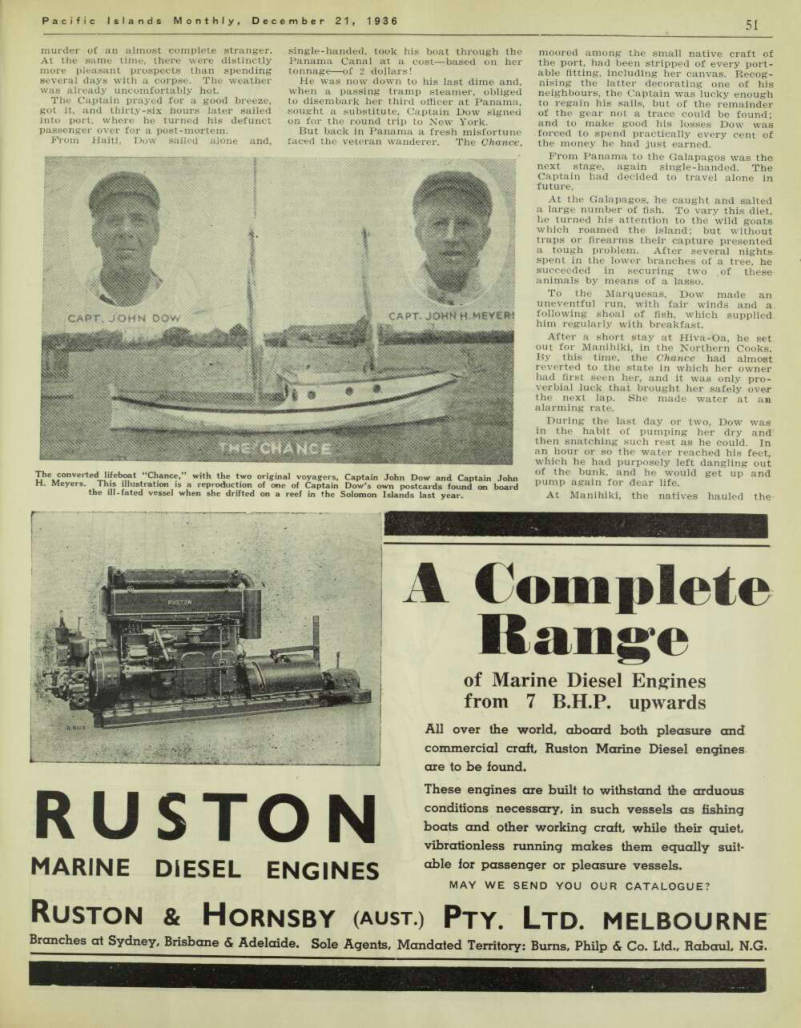
The conycrted lifeboat "Chance,” with the two original voyagers, Captain John Dow and Captain John H. Meyers. This illustration is a reproduction of one of Captain Dow’s own postcards found on board the ill-fated vessel when she drifted on a reef in the Solomon Islands last year.
Chance across the reef and up onto the beach, where he was able to plug the worst leaks and give a much-needed coat of paint, provided—in addition to the necessary provisions to carry him on to Samoa —by Mr. A. H. Brown, at that time the only white man resident on the island.
In Manihiki, the Captain found the lotus whose scent he had savoured in far-off New York. His 73 years fell away like so much wrapping. Here he danced hula hulas, and, with the connivance of his new friends, bathed himself in the
warm glow of a tropical romance. At the end of three weeks, he pulled out for Pago Pago where, to his surprise, the officer commanding the American Naval Station proved to be a former shipmate.
The Chance, now absolutely on her last sea-legs, was taken in hand by the Navy and given such an overhaul that her owner scarcely recognised the old boat in which he had made so memorable a voyage.
Leaving Samoa, he set a course for Manila, a destination he never reached.
On January 25, 1936, the Chance was towed into Tulagi, after having drifted' onto one of the reefs at Ysabel, where her erratic behaviour had attracted the notice of natives ashore. Paddling out, they found her single occupant dead in the cabin.
Captain Dow had made his last port, as he would himself have wished—a master mariner in command of his own vessel, small as she might be. In quest of adven ture he had met the greatest adventure of all, and his gallant old spirit passed on to merge itself with the sand and surf of some mysterious islet lit by “that light which never was on land or sea.”
Mr. F. V. Saunders, a planter, of Kavieng, arrived in Sydney from New Guinea by the November Montoro.