Chinese Labour Question Still Agitates
pp. 48-49 · Read in the full issue
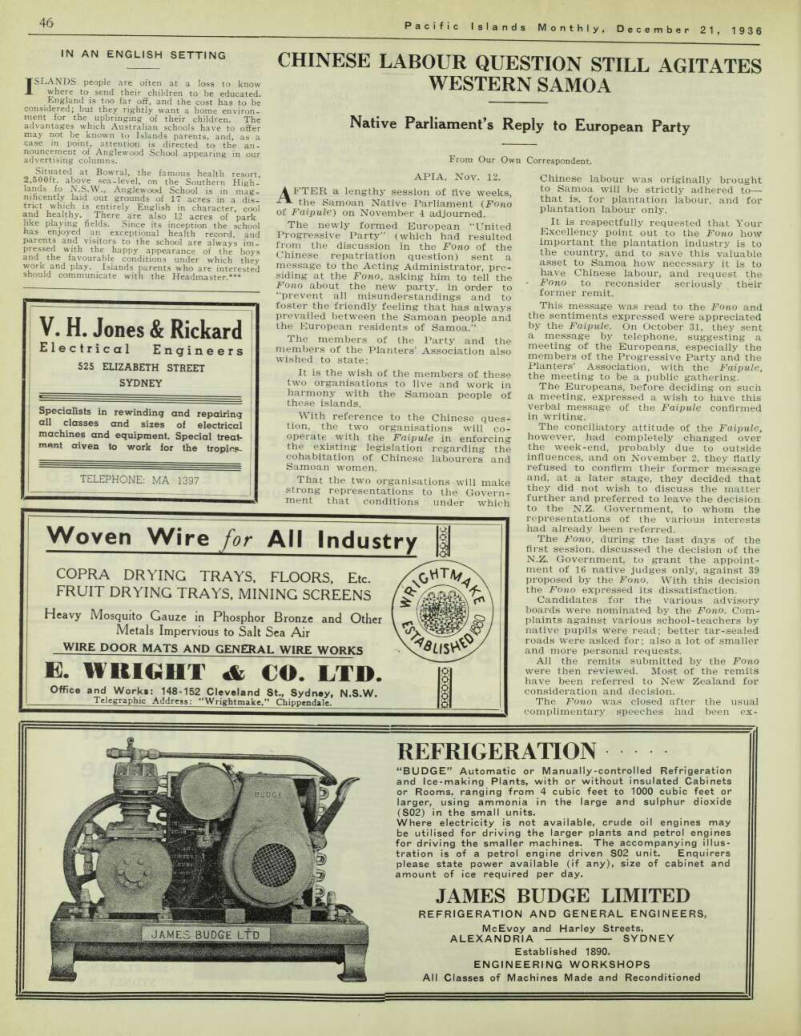
Western Samoa
Native Parliaments Reply to European Party
From Our Own Correspondent.
Apia, Nov. 12.
A FTER a lengthy session of five weeks, the Samoan Native Parliament ( Fono of Faipule ) on November 4 adjourned.
The newly formed European “United Progressive Party” (which had resulted from the discussion in the Fono of the Chinese repatriation question) sent a message to the Acting Administrator, pre siding at the Fono, asking him to tell the Fono about the new party, in order to “prevent all misunderstandings and to foster the friendly feeling that has always prevailed between the Samoan people and the European residents of Samoa.”
The members of the Party and the members of the Planters’ Association also wished to state: It is the wish of the members of these two organisations to live and work in harmony with the Samoan people of these islands.
With reference to the Chinese ques tion, the two organisations will co operate with the Faipule in enforcing the existing legislation regarding the cohabitation of Chinese labourers and Samoan women.
That the two organisations will make strong representations to the Govern ment that conditions under which
Chinese labour was originally brought to Samoa will be strictly adhered to— that is, for plantation labour, and for plantation labour only.
It is respectfully requested that Your Excellency point out to the Fono how important the plantation industry is to the country, and to save this valuable asset to Samoa how necessary it is to have Chinese labour, and request the - Fono to reconsider seriously their former remit.
This message was read to the Fono and the sentiments expressed were appreciated by the Faipule. On October 31, they sent a message by telephone, suggesting a meeting of the Europeans, especially the members of the Progressive Party and the Planters’ Association, with the Faipule, the meeting to be a public gathering.
The Europeans, before deciding on such a meeting, expressed a wish to have this verbal message of the Faipule confirmed in writing.
The conciliatory attitude of the Faipule, however, had completely changed over the week-end, probably due to outside influences, and on November 2, they flatly refused to confirm their former message and, at a later stage, they decided that they did not wish to discuss the matter further and preferred to leave the decision to the N.Z. Government, to whom the representations of the various interests had already been referred.
The Fono, during tbe last days of the first session, discussed the decision of the N.Z. Government, to grant the appoint ment of 16 native judges only, against 39 proposed by the Fono. With this decision the Fono expressed its dissatisfaction.
Candidates for the various advisory boards were nominated by the Fono. Com plaints against various school-teachers by native pupils were read; better tar-sealed roads were asked for; also a lot of smaller and more personal requests.
All the remits submitted by the Fono were then reviewed. Most of the remits have been referred to New Zealand for consideration and decision.
The Fono was closed after the usual complimentary speeches had been ex
changed between the Samoan representa tives and the Acting Administrator.
N.Z. Government And Chinese
Repatriation
In a letter to the United Progressive Party, the Acting Administrator stated that the Minister for External Affairs had advised him that the repatriation of the Chinese was a matter of policy with the N.Z. Government, and that there appeared to be no point in the Party discussing the matter with the Faipule.
During the visit of the Goodwill Mis sion in July last, the Hon. Mr. Langstone stated to the planters that the mis sionaries were of opinion that the Samoan natives could be trained for plantation work, and thus replace the Chinese plan tation labourers.
The local newspaper has published a report of a Commission of Inquiry into the labour problems of the Pacific Islands, set up in 1922 by the Methodist Church of New Zealand. The report deals with the system of Chinese indentured labour in Samoa, and gives the considered opinions of the heads of the Methodist and the London Mission Societies in Samoa, who agree that the importation of labour is necessary in the interest of the country and of the Samoans themselves, and that under proper safeguards, no objection can be raised against Chinese plantation labour. The London Mission Society’s District Committee, composed of Samoans, comes to the same decision, stating that they do not consider that the introduction of Chinese constitutes any serious moral danger to the Samoan people.
The Commission further states that the N.Z. Government had expressed itself to the effect that the “sacred trust of civili sation” involves the maintenance of the Government and other plantations—their reversion to jungle would seal the fate of the Samoan race. This maintenance of plantations cannot be accomplished with out imported indentured labour.