New Guinea
pp. 28-29 · Read in the full issue
Riding on a Bullet to New Guinea Some Impressions of a Trip by G.A.’s Lockheed
ON Thursday, November 12, at 5 a.m., we rose straight into the sunrise over Sydney in Guinea Airways’ new two engined Lockheed monoplane, and darted away northwards at 200 miles per hour.
At 10 a.m. the following day I walked off the aerodrome at Wau, in Central New Guinea, 2150 miles from Sydney.
Had the pilot been prepared to take risks with the afternoon clouds over the New Guinea mountains, we could have done the trip in one day—a journey, nor mally, that takes ten days by mail steamer.
I found the prospect of this means of travel terrifying. A ’plane, travelling at 3J miles per minute, could hit the earth with a prodigious bump. And, from the North Queensland coast to Papua, there were 450 miles over water. As I walked across Mascot aerodrome that morning my knees were secretly shaking.
But, in fifteen minutes, all fear was gone. One can feel, in this type of machine, such a reserve of power, and such stability, that a consciousness of safety grows on one. There is no “flop ping about” —the machine flies straight and stiff, like a bullet. When there are mountains ahead, it just rises up, at any old angle, and flies over them —there is no circling around making height.
In 30 minutes from Sydney we were over Newcastle, 100 miles away. At 7.45 we were breakfasting in Brisbane; at 10.15 we had morning tea in Rockhamp ton; we lunched in Townsville at 1 p.m.; and at 3.45 p.m. I was making a photo graph of the postmaster at Port Douglas, 1400 miles north of Sydney, reading a copy of that morning’s Sydney Morning Herald.
Yet, in the air, we did not seem to realise the breath-taking speed of this means of travel. We conversed easily in the cabin, watched the East Coast scenery, read and slept.
With a good map it is easy to identify all the features of the coastline, over which one rushes at 3i miles per minute.
Except that the distances which seem so impressive on the map are as nothing from the Lockheed.
I predict that this particular run, Syd ney to North Queensland, along the coast line, being filled with colour and variety, will become one of the most popular in this part of the world.
The Lockheed sat all night on the level, hard beach at Port Douglas; and, at dawn, she rose smoothly and easily into a glow ing sky, ran 100 miles up the coast to Cape Hattery, and then headed out over the sea.
Four hundred and fifty miles before we should see land again! I looked out at the engines—they were purring happily.
At the pilot—he was yawning—both he and I had cursed this 3.30 a.m. rising. At my fellow-passengers—they were com posing themselves for sleep. So I went to sleep, too!
So much for that “terrifying” crossing over the open sea to Papua.
Two hours later, we saw the blue mountains of Papua. On past Bootless Inlet; and there was the apparently ever lasting old Pruth sitting up on the reef near Port Moresby.
At 8.15 a.m. the Lockheed roared and dipped over Port Moresby, and then ran out on to the aerodrome. Half an hour later the Port folk were reading the pre vious day’s Sydney and Brisbane news papers.
Shortly after 10 a.m., the people in Wau were doing the same. The Lockheed went up over the backbone of New Guinea, and along past the western shoulder of Mount Lawson, 10,000 feet up, like an arrow shot from a bow.
It was a unique experience to sit in the cockpit of that Lockheed machine with Pilot “Tommy” O’Dea. I had heard of “finger-tip control” as applied to motor cars; but here I saw it in an aeroplane.
One touch was sufficient to alter course or elevation; yet, even without that touch the ’plane flew straightly as if guided between steel rails.
The dashboard carried an amazing array of tell-tale instruments, and it was fascinating to watch how quickly they registered the slightest variation of height, speed, course, elevation, engine temperature, revolutions, fuel reserve, etc.
It seemed to me that a pilot, in a machine like that, would know everything, except what his wife was doing.
I have seen Ohater and O’Dea, both great pilots, at the controls of that Lock
heed, and I can understand something of the pleasure that an airman gets in handling so superb a machine.
On a Saturday evening I went down from Wau to Lae in the cockpit of the Lockheed with Eric Chater. The machine left the ground at Wau with the well known “Chater tilt”: and within four
minutes we were roaring over the eastern mountains. The Lockheed seemed to go straight up and to laugh at the mountain tops. For the first time I recognised the exaltation of the real airman, soaring high over the mountain peaks, in a good machine on a perfect day.
Guinea Airways’ sober general manager
became a boy again. “Let’s go to Sala maua and give Tommy O’Dea the ‘rasp berry!’” he said.
Course was altered slightly, and in a few more minutes the Lockheed went bel lowing down over Salamana. I saw, once again, the long isthmus, the water-logged aerodrome, and the wooded promontory.
The “raspberry” consisted of a couple of steep turns over the O’Dea residence, in the course of which I apparently stood on my own ear. Then the Lockheed flattened out over the sea—eighteen miles to Lae.
Our time from Wau to Lae aerodrome, about 70 miles, including the “raspberry” at Salamaua, was exactly 20 minutes!
R.W.R.
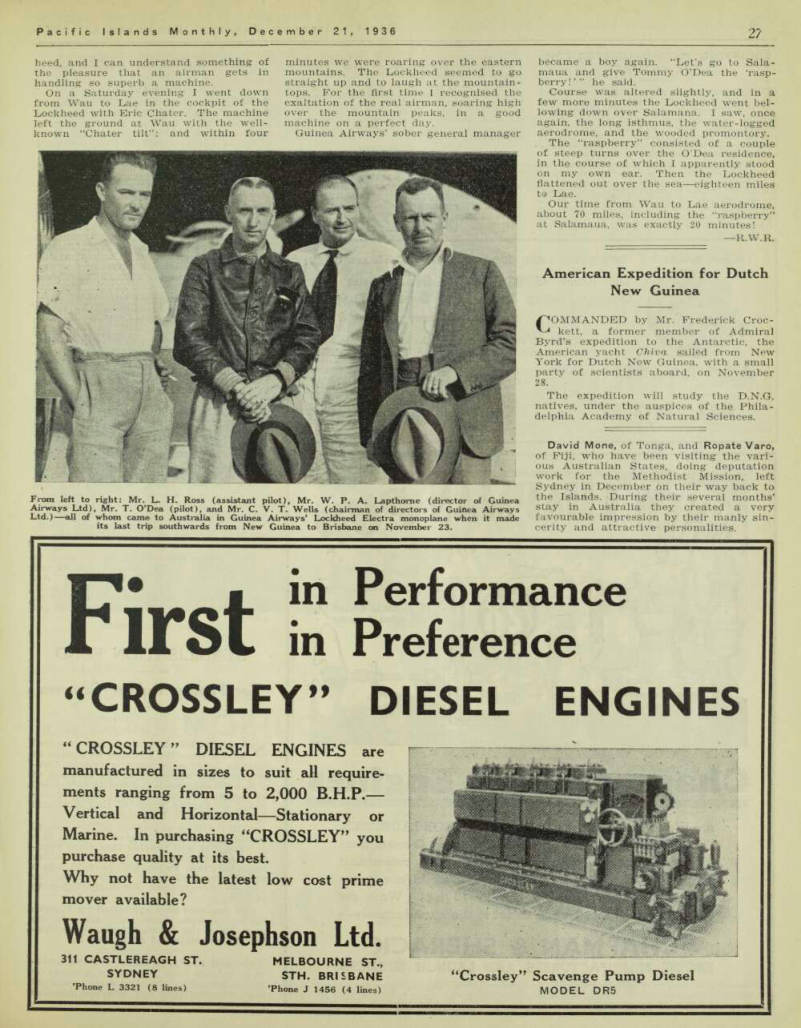
From left to right: Mr. L. H. Ross (assistant pilot), Mr. W. P. A. Lapthrne (director of Guinea Airways Ltd), Mr. T. O’Dea (pilot), and Mr. C. V. T. Wells (chairman of directors of Guinea Airways Ltd.)—all of whom came to Australia in Guinea Airways’ Lockheed Electra monoplane when it made its last trip southwards from New Guinea to Brisbane on November 23.