Prince Taufa’ahau
p. 12 · Read in the full issue
Honoured Kava Ceremony in Sydney
ORIOR to his departure for Tonga, in A December, Crown Prince George Taufa’ahau was the guest of the Poly nesian Club of Sydney at a gathering in his honour. Kava was made with the appropriate Samoan ritual by the chief tainess Lefagaoalii (Mrs. Alfred Page) and presented to the Prince (who, on his return to Sydney, will enter the Uni versity as a law student). Others to whom the ancient drink was given were: Captain Gerhard Heyen. formerly of Buta ritari, who spoke on the Gilbert Islands: Mr. R. W. Robson, editor of the Pacific Islands Monthly; and Messrs. L. J. Moran (president) and Eric Ramsden, executive members of the club.
The president (Mr. Moran) briefly wel comed the Prince, and wished him a happy stay in Tonga during his holidays.
In his reply, Prince Taufa’ahau empha sised the importance of preserving what is best in the traditions of the Polynesian people. “I am proud of my ancestry, and I am sure,” he said to club members, “that you are proud of yours, too.” For that reason it was essential that Polynesians resident in Sydney should meet and ex change ideas. “I am particularly happv to be here,” the Crown Prince concluded, “because this club represents an ideal!”
The Prince promised to convey the club’s greetings to Queen Salote (who holds the post of patroness), and he also agreed to nomination as a member.
Captain Heyen, in the course of one of the most interesting addresses club members have heard since its foundation, traced the history of the Gilbert Islands from native traditions, through the early whaling phase, touched upon the first mis sionary associations, “blackbirding opera tions,” and finally their proclamation as a British colony (after a period as a Pro tectorate) in 1915. The inhabitants he described as “honest and likeable,” and the language, though the roots were of Malay origin, was similar to the Poly nesian tongues.
The president accepted with thanks several weapons from the Gilbert Group which Captain Heyen presented to the club.
With Prince Taufa’ahau were Mr. and Mrs. B. Lamacraft (the father of the latter was at one time British Consul in Tonga), Mr. Harold Rabone (whose grand father was one of the pioneer Wesleyan missionaries in the kingdom), Mrs. Heyen, and Miss Dora Busby (great-niece of Mr.
James Busby, one time British Resident at the Bay of Islands, N.Z.), Also present were Mr. and Mrs. Walter Petch, and members of their family. Mr.
Fetch was at one time schoolmaster on Pitcairn Island, and Mrs. Petch is a de scendant of Fletcher Christian, of Bounty fame.
Abgut 160 people attended the gathering, which will be the last of the year. The club has met with so much success that members now have their own clubroom in Jamieson Street, Sydney. Visitors from the Islands who desire to attend club meetings are requested to communicate with the president, care of the Pacific Islands Monthly, Union House, Sydney.
Mr. H. Alday, of the New Guinea Pub lic Service, returned to Rabaul in De cember by the Malaita. He is a member of the District Services and Native Affairs’ Department.
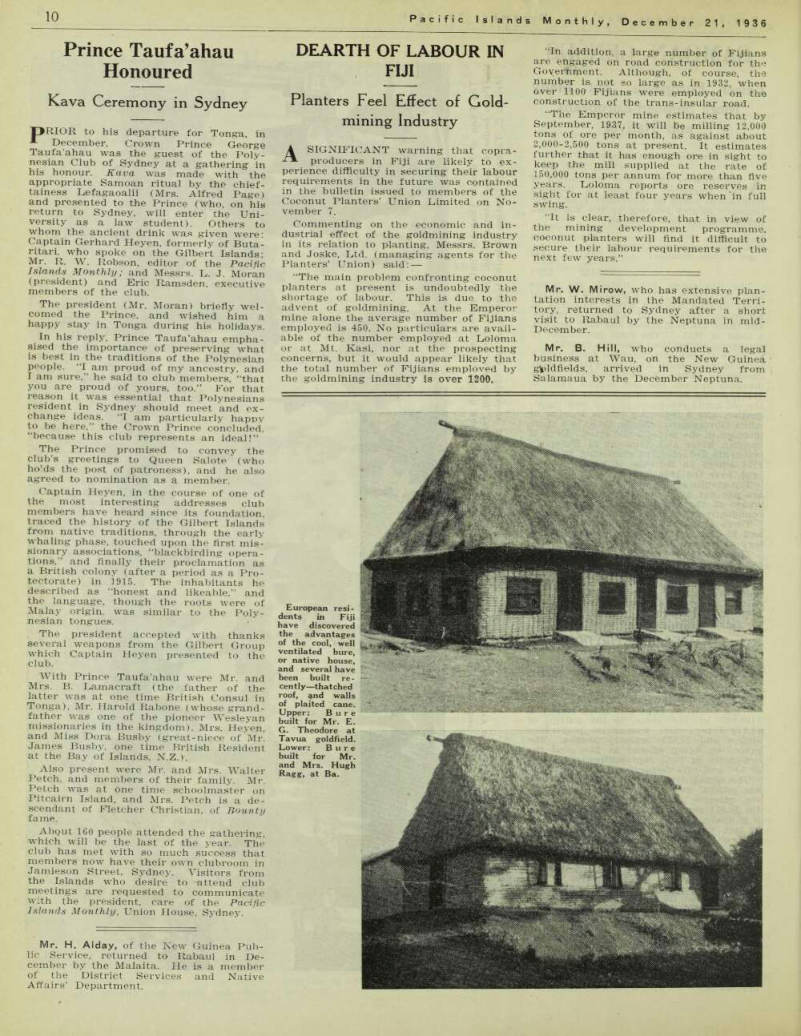
European resi dents in Fiji have discovered the advantages of the cool, well ventilated bure, or native house, and several have been built re cently—thatched roof, walls of plaited cane.
Upper: Bure built for Mr. E.
G. Theodore at Tavua goldfield.
Lower: Bure built for Mr. and Mrs. Hugh Ragg, at Ba.