The Search For Oil In Papua
pp. 49-50 · Read in the full issue
Development with an Imperial Significance
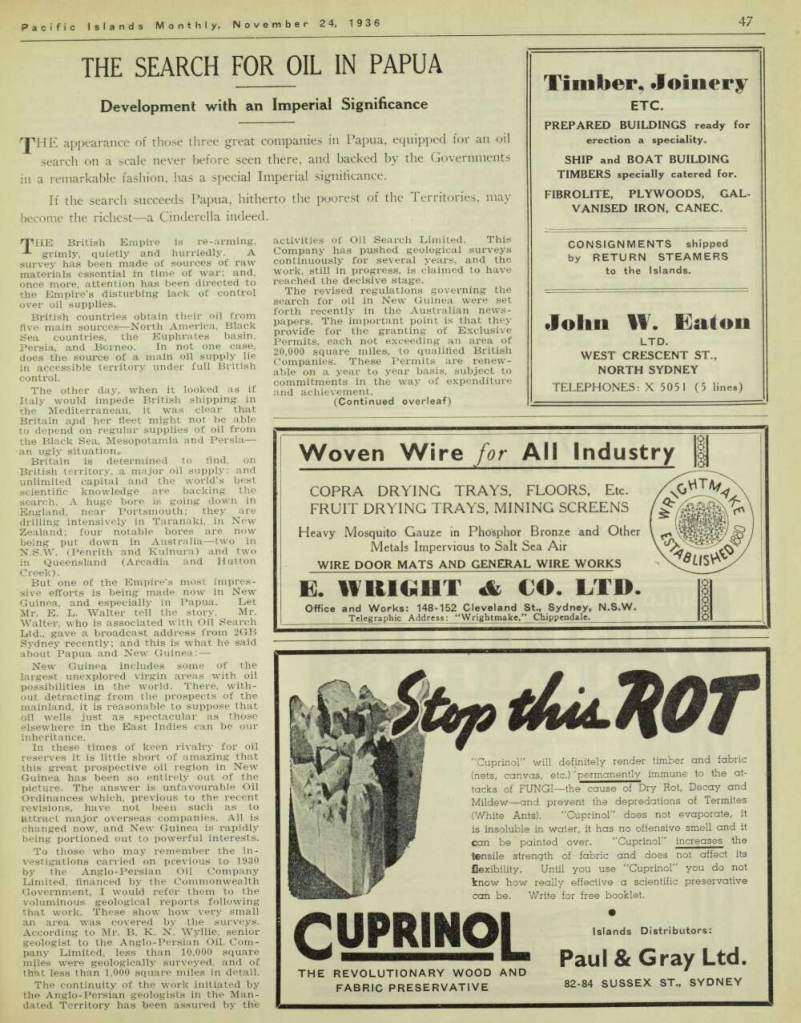
appearance of those three great companies in Papua, equipped for an oil search on a scale never before seen there, and backed by the Governments in a remarkable fashion, has a special Imperial significance.
If the search succeeds Papua, hitherto the poorest of the Territories, may become the richest —a Cinderella indeed.
rpHE British Empire is re-arming, grimly, quietly and hurriedly. A survey has been made of sources of raw materials essential in time of war; and, once more, attention has been directed to the Empire’s disturbing lack of control over oil supplies.
British countries obtain their oil from five main sources —North America, Black Sea countries, the Euphrates basin, Persia, and Borneo. In not one case, does the source of a main oil supply lie in accessible territoi'y under full British control.
The other day, when it looked as if Italy would impede British shipping in the Mediterranean, it was clear that Britain ajxd her fleet might not be able to depend on regular supplies of oil from the Black Sea, Mesopotamia and Persia— an ugly situation, Britain is determined to find, on British territory, a major oil supply: and unlimited capital and the world’s fyest scientific knowledge are backing the search. A huge bore is. going down in England, near Portsmouth; they are drilling intensively in Taranaki, in New Zealand; four notable bores are now being put down in Australia —two in N.S.W. (Penrith and Kulnura) and two in Queensland (Arcadia and Hutton Creek).
But one of the Empire's most impres sive efforts is being made now in New Guinea, and especially in Papua. Let Mr. E. L. Walter tell the story. Mr.
Walter, who is associated with Oil Search Ltd., gave a broadcast address from 2GB Sydney recently; and this is what he said about Papua and New Guinea: — New Guinea includes some of the largest unexplored virgin areas with oil possibilities in the world. There, with out detracting from the prospects of the mainland, it is reasonable to suppose that oil wells just as spectacular as those elsewhere in the East Indies can be our inheritance.
In these times of keen rivalry for oil reserves it is little short of amazing that this great prospective oil region in New Guinea has been so entirely out of the picture. The answer is unfavourable Oil Ordinances which, previous to the recent revisions, have not been such as to attract major overseas companies. All is changed now, and New Guinea is rapidly being portioned out to powerful interests.
To those who may remember the in vestigations carried on previous to 1930 by the Anglo-Persian Oil Company Limited, financed by the Commonwealth Government, I would refer them to the voluminous geological reports following that work. These show how very small an area was covered by the surveys.
According to Mr. B. K. N. Wyllie, senior geologist to the Anglo-Persian Oil. Com pany Limited, less than 10,000 square mpes were geologically surveyed, and of that less than 1,000 square miles in detail.
The continuity of the work initiated by the Anglo-Persian geologists in the Man dated Territory has been assured by the
activities of Oil Search Limited. This Company has pushed geological surveys continuously for several years, and the work, still in progress, is claimed to have reached the decisive stage.
The revised regulations governing the search for oil in New Guinea were set forth recently in the Australian news papers. The important point is that they provide for the granting of Exclusive Permits, each not exceeding an area of 20,000 square miles, to qualified British Companies. These Permits are renew able on a year to year basis, subject to commitments in the way of expenditure and achievement. (Continued overleaf)
Sir George Pearce, when notifying the granting of Exclusive Permits covering an aggregate area of 52,000 square miles in Papua, stated that —“The conditions of a Permit make it necessary for the permittee to conduct a thorough and energetic search, and it was hoped that the seach would lead to the discovery of petroleum in payable quantities in the Territories.” This is a hope with every promise of fulfilment, providing the search is thorough and energetic.
The Permits issued to date in Papua which cover an area of 52,000 square miles, have been allocated as follows; One of 20,000 square miles in the Western and Delta Divisions of the Territory, goes to Papua Oil Development Ltd.; a similar area, in the same district, to Island Ex plorations Company Pty. Ltd. and a third in the Gulf and Delta Divisions to Oriomo Oil Limited. This latter Permit covering 12,000 square miles will be worked by Oil Search Limited.
The stage, now set for the thorough and energetic search essential to success, emphasises the regard in which the oil prospects of Papua are held. Nothing can be more impressive to the public than to know that the activities of Papua Oil Development Co. Ltd. are to be conducted under the auspices of the Shell Company, and the activities of Island Explorations Co. are under the auspices of the Vacuum Oil Company. These powerful companies,
through manifesting such keen interest in the acquisition of Permits in Papua, give a lead to the people of Australia that must be followed.
Fully as much interest also is dis played in the acquisition of Permits in the Mandated Territory. The outcome, soon to be announced by the Minister, is awaited with interest. Oil Search Limited will, presumably, be generously dealt with, considering the advanced stage of the geological explorations of that com pany in the Sepik District south of the Torricelli Mountains, which have been so diligently pushed during the past several years.
The New Guinea Gazette, No. 433, dated January 15, 1936, takes in an addi tional area of 2,200 square miles there previously “uncontrolled,” with a popu lation exceeding 20,000. It is only proper to state that this has been made possible through the activities of Oil Search Limited’s survey parties, which have contributed greatly to the establishment of friendly relations with the native in habitants.