Kemarkable Irrigation System
pp. 41-42 · Read in the full issue
Pre-European Papuan
Engineers
By Mollie Lett
M. x ,, r AN \ years ago, before European occu pation. the Wamira people, in the Wedau district, along the N.E. Coast of Papua, designed and constructed an irriga ti°n scheme to serve their rich garden lands, which were separated by a wide open gorge from a stream 1 h miles distant.
The system, which is the only known example of native engineering in the ter ritory, has been a continual source of interest and speculation to settlers since its discovery, on account of its origin, engineering skill, and clever adaptation.
According to one authority it represents a well designed and highly creditable piece of engineering,” and “stands as a monument to the skill and perseverance of a primitive race.” icre S en upon s jss hiiarS natives rely during the dry periods of the According to legend, the origin of the
scheme dates from the time of a great drought and famine when, in desperate need, an old man of the tribe named Gaire, goaded by the taunts of a neighbouring tribe, called the head men of Wamira to gether. to find some means whereby their parched lands could obtain water from the stream on the other side of the gorge.
There were many difficulties. The gully was deep and wide, and no suitable timber stood near its banks. Trees had to be felled and hauled long distances But the work was completed at last and with “shouts of laughter and joy” the Wamira people watched the water run across from bank to bank and enter a channel to their rich garden lands; and their troubles were over.
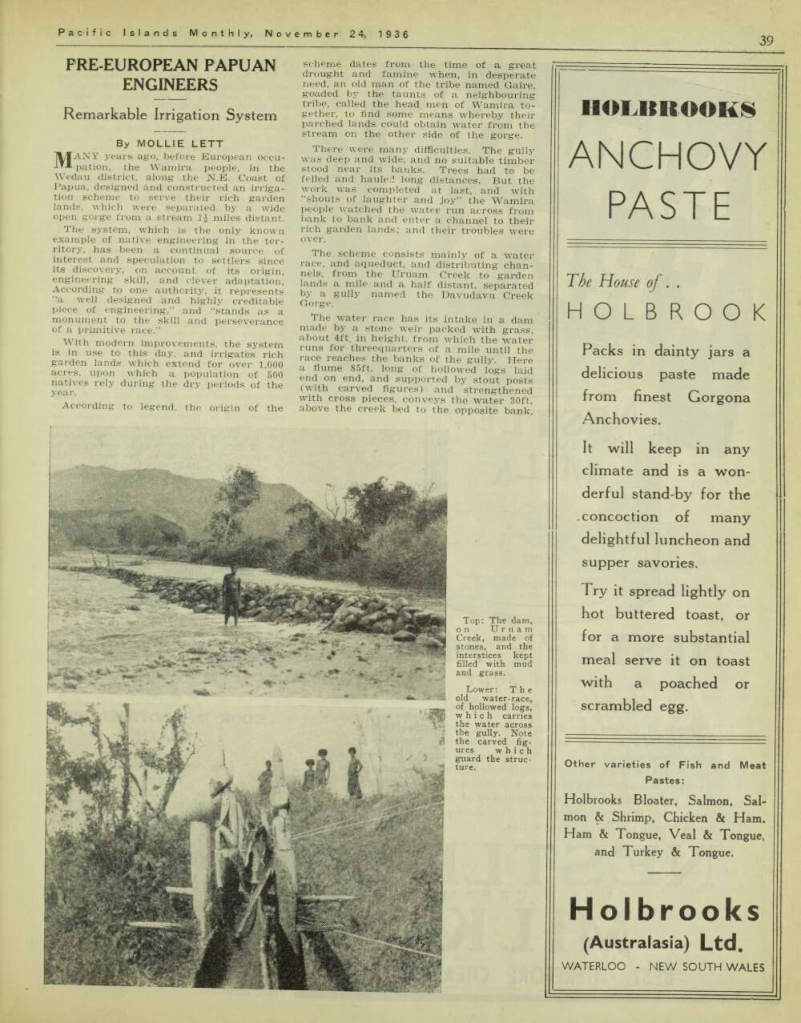
The scheme consists mainly of a water race, and aqueduct, and distributing chan nels. from the Uruam Creek to garden i an ds a mile and a half distant, separated by a gully named the Davudavu Creek Gorge lhe water race has its intake in a dam made by a stone weir packed with grass, V s (with carved figTrLT'aTd with cross pieces, conveys the water 30ft. above the creek bed to the opposite bank,
Top: The dam, on Uruam Creek, made of stones, and the interstices kept filled with mud and grass.
Lower: The old water-race, of hollowed logs, which carries the water across the gully. Note the carved fig ures which gruard the struc ture.
where the race continues to the gardens.
The distributing channels intersect and surround the whole area of 1,000 acres, and are said to be six miles in length. 960 acres of this extent consist of a rich black flat, on which most of their taro is grown.
In 1926, at the request of the Wamira people, the Government substituted a syphon pipe line for the wooden flume of hollowed logs and made various improve ments —culverts and cement facings. The logs were in an advanced state of decay, and periodically bush fires caused a great deal of damage.
Great care is taken by the tribe to keep the main and distributing channels in order. Women are strictly forbidden to bathe in them and no one is permitted to drink from the flowing water. When the flow becomes scarce, the natives become greatly disturbed, and certain men of the tribe make incantations over the water to increase the flow; or to remove any spells that may have been cast by evil spirits.
The carved images on the upright posts in the gully represent two males and two females and were placed there by the tribe over 50 years ago as a decoration in honour of Gaire’s notable achievement.
According to native explanation, the grade of the channel was regulated by the water flowing from the dam and by digging first from the intake. When the water ceased to flow, they merely dug deeper, or vice versa; and, by these means, the existing main race was graded evenly to a fall of 30ft. per mile, which, according to a report, “appears to be the correct rate of grade for ‘critical velocity’ in this class of soil and the heavy growth of grass in the channel bed.”
Apart from the legend which assigns the origin of the irrigation system to the ingenuity of the old Wamira man, there have been many suggestions as to its source. That it may have been derived from some early Chinese immigration is one suggestion. Long before New Guinea was annexed, Chinese, engaged in beche de-mer industry, visited the south and east coast periodically in junks, sailing as far south as the Great Barrier Reef of Austra lia.
The carved images on the upright posts were placed there at a later period; the first two about 60 years ago, and the others within the knowledge of the pre sent inhabitants. Their design may have no bearing on the original structure.