Fiji
pp. 70-71 · Read in the full issue
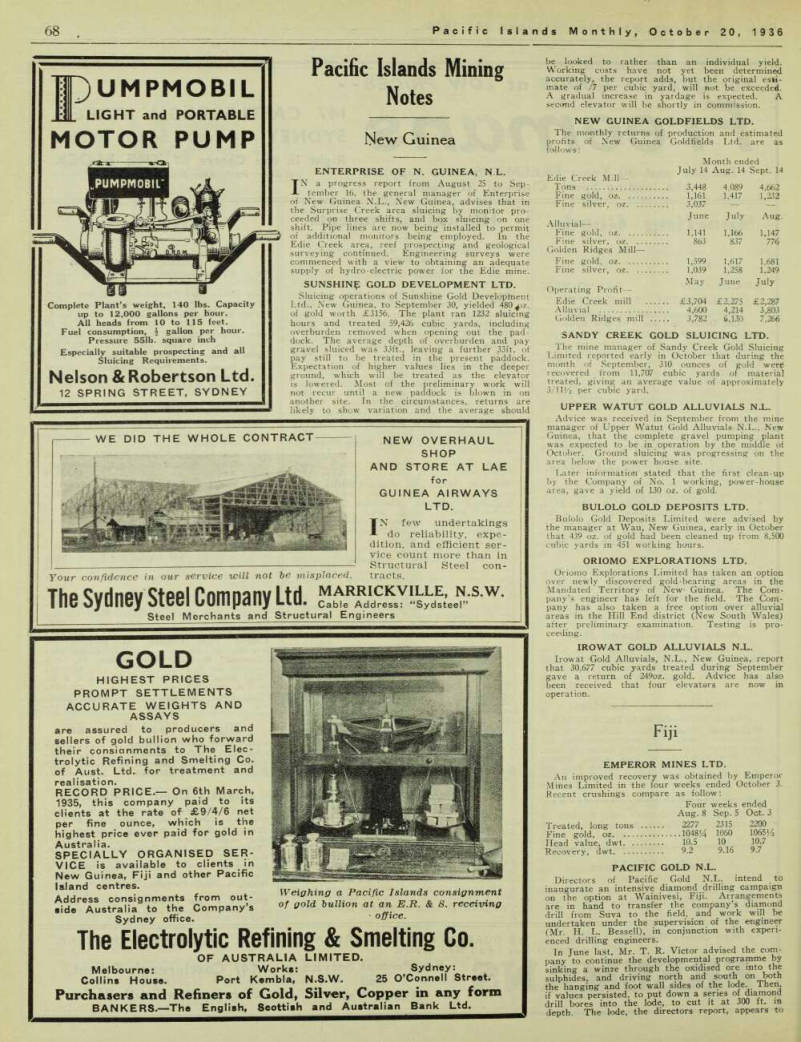
Emperor Mines Ltd.
An improved recovery was obtained by Emperor Mines Limited in the four weeks ended October 3.
Recent crushings compare as follow:
Pacific Gold N.L.
Directors of Pacific Gold N.L. intend to inaugurate an intensive diamond drilling campaign on the option at Wainivesi, Fiji. Arrangements are in hand to transfer the company’s diamond drill from Suva to the field, and work will be undertaken under the supervision of the engineer (Mr. H. L. Bessell), in conjunction with experi enced drilling engineers.
In June last, Mr. T. R. Victor advised the com pany to continue the developmental programme by sinking a winze through the oxidised ore into the sulphides, and driving north and south on both the hanging and foot wall sides of the lode. Then, if values persisted, to put down a series of diamond drill bores into the lode, to cut it at 300 ft. in depth. The lode, the directors report, appears to
Four weeks ended Aug. 8 Sep. 5 Oot. 3 Treated, long tons 2277 2315 2200 Fine gold, oz 1048J4 1060 106554 Head value, dwt 10.5 10 10.7 Recovery, dwt 9.2 9.16 9.7
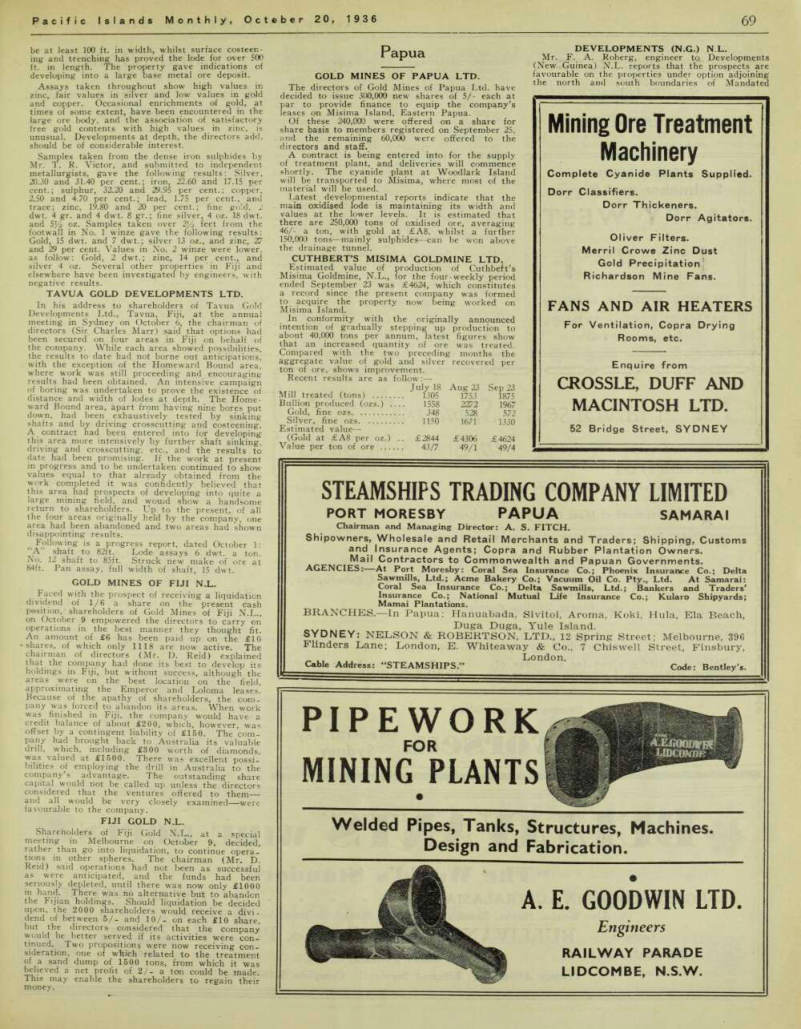
be at least 100 ft. in width, whilst surface costeen ing and trenching has proved the lode for over 500 ft. in length. The property gave indications of developing into a large base metal ore deposit.
Assays taken throughout show high values in zinc, fair values in silver and low values in gold and copper. Occasional enrichments of gold, at times of some extent, have been encountered in the large ore body, and the association of satisfactory free gold contents with high values in zinc, is unusual. Developments at depth, the directors add. should be of considerable interest.
Samples taken from the dense iron sulphides by Mr. T. R. Victor, and submitted to independent metallurgists, gave the following results: Silver, 20.30 and 31.40 per cent.; iron, 22.60 and 17.15 per cent.; sulphur, 32.20 and 29.95 per cent.; copper. 2.50 and 4.70 per cent.; lead, 1.75 per cent., and trace; zinc, 19.80 and 20 per cent.; fine gold, 2 dwt. 4 gr. and 4 dwt. 8 gr.; fine silver, 4 oz. 18 dwt. and S l /2 oz. Samples taken over 2J4 feet from the footwall in No. 1 winze gave the following results; Gold, 15 dwt. and 7 dwt.; silver 13 oz., and zinc, 27 and 29 per cent. Values in No. 2 winze were lower, as follow: Gold, 2 dwt.; zinc, 14 per cent., and silver 4 oz. Several other properties in Fiji and elsewhere have been investigated by engineers, with negative results.
Tavua Gold Developments Ltd.
In his address to shareholders of Tavua Gold Developments Ltd., Tavua, Fiji, at the annual meeting in Sydney on October 6, the chairman of directors (Sir Charles Marr) said that options had been secured on four areas in Fiji on behalf of the company. While each area showed possibilities, the results to date had not borne out anticipations, with the exception of the Homeward Bound area, where work was still proceeding and encouraging results had been obtained. An intensive campaign of boring was undertaken to prove the existence of distance and width of lodes at depth. The Home ward Bound area, apart from having nine bores put down, had been exhaustively tested by sinking shafts and by driving crosscutting and costeening.
A contract had been entered into for developing this area more intensively by further shaft sinking, driving and crosscutting, etc., and the results to date had been promising. If the work at present in progress and to be undertaken continued to show values equal to that already obtained from the work completed it was confidently believed that this area had prospects of developing into quite a large mining field, and would show a handsome return to shareholders. Up to the present, of all the four areas originally held by the company, one area had been abandoned and two areas had shown disappointing results.
Following is a progress report, dated October 1: ‘A” shaft to 82ft. Lode assays 6 dwt. a ton.
No. 12 shaft to 85ft. Struck new make of ore at 84ft. Pan assay, full width of shaft, 15 dwt.
Gold Mines Of Fiji N.L.
Faced with the prospect of receiving a liquidation dividend of 1/6 a share on the present cash position, shareholders of Gold Mines of Fiji N.L.. on October 9 empowered the directors to carry on operations in the best manner they thought fit.
An amount of £6 has been paid up on the £lO -shares, of which only 1118 are now active. The chairman of directors (Mr. D. Reid) explained that the company had done its best to develop its holdings in Fiji, but without success, although the areas were on the best location on the field, approximating the Emperor and Loloma leases.
Because of the apathy of shareholders, the com pany was forced to abandon its areas. When work was finished in Fiji, the company would have a credit balance of about £2OO, which, however, wa<offset by a contingent liability of £l5O. The com pany had brought back to Australia its valuable drill, which, including £3OO worth of diamonds, was valued at £l5OO. There was excellent possi bilities of employing the drill in Australia to the company’s advantage. The outstanding share capital would not be called up unless the directors considered that the ventures offered to them— and all would be very closely examined—were favourable to the company.
Fiji Gold N.L.
Shareholders of Fiji Gold N.L., at a special meeting in Melbourne on October 9, decided, rather than go into liquidation, to continue opera tions in other spheres. The chairman (Mr. D.
Reid) said operations had not been as successful as were anticipated, and the funds had been seriously depleted, until there was now only £lOOO in hand. There was no alternative but to abandon the Fijian holdings. Should liquidation be decided upon, the 2000 shareholders would receive a divi dend of between 5/- and 10/- on each £lO share, but the directors considered that the company would be better served if its activities were con tinued. Two propositions were now receiving con sideration, one of which related to the treatment of a sand dump of 1500 tons, from which it was believed a net profit of 2/- a ton could be made.
This may enable the shareholders to regain their money.