Men Who Knew Yesterday
pp. 43-44 · Read in the full issue
By Eric Ramsden
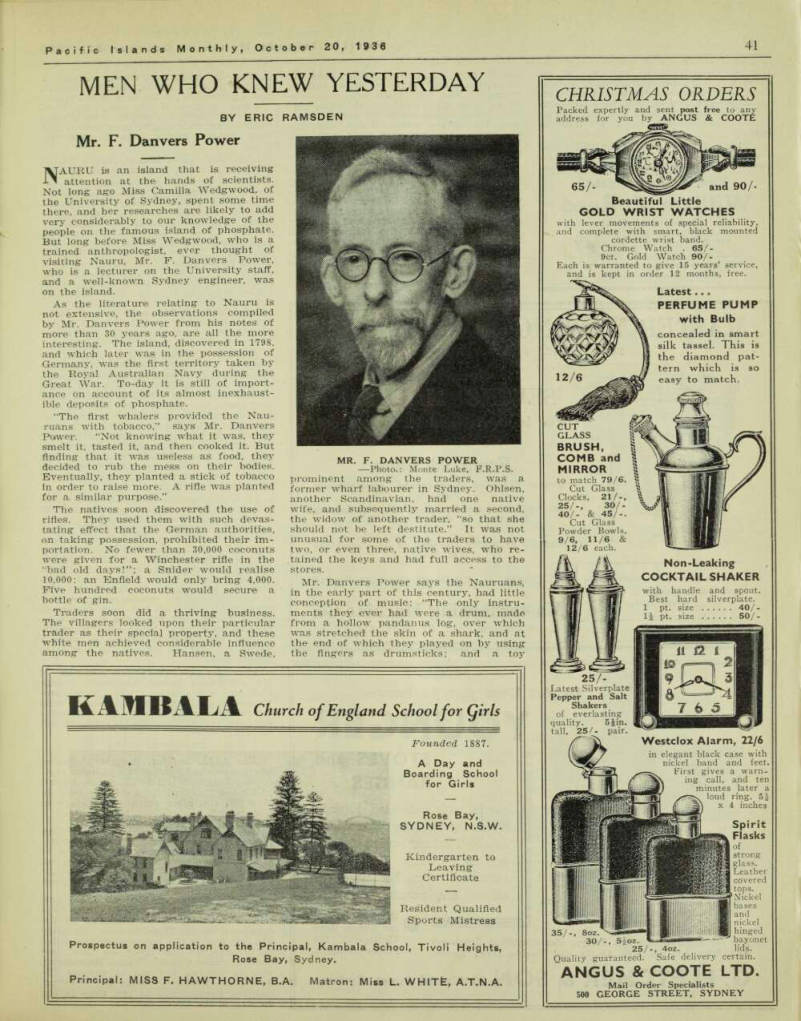
Mr. F. Danvers Power
NAURU is an island that is receiving attention at the hands of scientists.
Not long ago Miss Camilla Wedgwood, of the University of Sydney, spent some time there, and her researches are likely to add very considerably to our knowledge of the people on the famous island of phosphate.
But long before Miss Wedgwood, who is a trained anthropologist, ever thought of visiting Nauru, Mr. F. Danvers Power, who is a lecturer on the University staff, and a well-known Sydney engineer, was on the island.
As the literature relating to Nauru is not extensive, the observations compiled by Mr. Danvers Power from his notes of more than 30 years ago, are all the more interesting. The island, discovered in 1798, and which later was in the possession of Germany, was the first territory taken by the Royal Australian Navy during the Great War. To-day it is still of import ance on account of its almost inexhaust ible deposits of phosphate.
“The first whalers provided the Nau ruans with tobacco,” says Mr. Danvers Power. “Not knowing what it was, they smelt it, tasted it, and then cooked it. But finding that it was useless as food, they decided to rub the mess on their bodies.
Eventually, they planted a stick of tobacco in order to raise more. A rifle was planted for a similar purpose.”
The natives soon discovered the use of rifles. They used them with such devas tating effect that the German authorities, on taking possession, prohibited their im portation. No fewer than 30,000 coconuts were given for a Winchester rifle in the “bad old days!”; a Snider would realise 10,000; an Enfield would only bring 4,000.
Five hundred coconuts would secure a bottle of gin.
Traders soon did a thriving business.
The villagers looked upon their particular trader as their special property, and these white men achieved considerable influence among the natives. Hansen, a Swede,
prominent among the traders, was a former wharf labourer in Sydney. Ohlsen, another Scandinavian, had one native wife, and subsequently married a second, the widow of another trader, “so that she should not be left destitute.” It was not unusual for some of the traders to have two, or even three, native wives, who re tained the keys and had full access to the stores.
Mr. Danvers Power says the Nauruans, in the early part of this century, had little conception of music: “The only instru ments they ever had were a drum, made from a hollow pandanus log, over which was stretched the skin of a shark, and at the end of which they played on by using the fingers as drumsticks; and a toy
Mr. F. Danvers Power
—Photo.: Monte Luke, F.R.P.S.
trumpet made from the leaf stem of the same tree . . . On one occasion a band from a German warship played on shore to amuse the natives, but the latter were frightened and, thinking the music some kind of punishment, made off into the bush.
“What’s the matter with the white man
now?” they demanded. “Why does he make that noise? Have we done anything wrong?” The reed instrument was ob jected to as it squealed, “all the same pig”
The kettle drum made too much noise: but the natives were pleased with the big drum. One old man wanted to look inside the latter to investigate where the big noise came from.
Sports, including wrestling; fishing; the telling of legends; club throwing; dancing; and a ball game, all had a part in com munal life when Mr, Danvers Power was on the island. Small boys played a similar game to marbles with seeds and nuts. Mr.
Danvers Power saw the famous frigate bird dance performed when the partici pants, green leaves in their hands, went through all the evolutions of catching those birds and chanted of their prowess.
The Nauruans of old encased a fat man
in “armour” made from closely woven coir consisting of a corselet, trousers, helmet, and a protection for the back of the hands.
“It was the duty of this man,” Mr. Dan vers Power says, “to protect, with a stout quarterstaff, two smaller men who fought with lighter spears from beneath his arms.”
Like some Pacific islands, Nauru did not escape a period of missionary intolerance.
On one occasion a missionary, an ex steward, a German by birth but American naturalised, found a single girl in the mission compound who was expecting a child. The native asked the missionary (who was said to have had some medical experience) to assist her at its birth. But he refused to do so, declaring that he would be no party to “bringing a child of sin into the world.” Dr. Kruelle, the Ger man scientist investigating disease on the island, happened to arrive at an opportune time, and hearing of the missionary’s re fusal, used to walk a mile from the Resi dent Magistrate’s bungalow twice a day in the heat until the child was safely delivered and the mother out of danger.
The Germans instituted a rule that the resident missionary should, perforce, be come acquainted with the native language, or else leave the island within two years.
The missionary in question, after a time, addressed the natives in such a glib fashion that the authorities believed him proficient in the Nauru tongue. As a mat ter of fact, only those natives accustomed to hearing him speak could understand his oratorical flow. Some newcomers at last begged the traders to explain what he meant: they imagined the missionary to be speaking German!
At Nauru, as elsewhere, the missionaries set their faces against certain of the natives’ dances and amusements. Inci dentally, they went as far as to refuse baptism for three years to natives who attended their own dances. Men were pro hibited from smoking on the Sabbath.
Even a ban was placed against tree climb ing on the sacred day if they owed allegi ance to the mission. It was decided that it was indecent for women to show their breasts —though such had been customary for centuries —and European clothes were insisted upon. The latter edict, naturally enough, caused many deaths, as when a native got wet, he allowed the clothes to dry on him.
After the un-Christianlike behaviour of the missionary before mentioned, Roman Catholic missionaries, who were pre viously not allowed on the Island, were invited to come to Nauru. The unpopular minister, unable to retain his converts, left for other fields.
Miss J. M. Jenkins, 8.A., a Methodist Mission worker among the Chinese resi dents of Rabaul, left Brisbane on August 22 by the Macdhui for a further term in New Britain, after extended furlough in Queensland.
Ratu Mosese Dranibaka, a Fijian preacher for the Seventh Day Adventist organisation, who came to Australia to attend a Mission conference in Melbourne, died from pneumonia at the Wahroonga Sanatarium, N.S.W., at the end of August.
Captain Benton arrived at Rarotonga, Cook Group, from New Zealand, on Sep tember 5 to take over command of the trading schooner Tiare Taporo. He made his first trip in the latter when she sailed north during September on her last voyage under Captain Viggo Rasmussen, who is leaving the sea to assume the duties of Resident Agent at Penrhyn.
Captain Benton was at one time in the employ of the Union S.S. Co.