Footloose In Samoa
pp. 27-33 · Read in the full issue
(From Notes Made in Western Samoa in July, 1936, by R. W. Robson )
“¥ WANT to get away from ‘beach poli- J- tics,’ and all these sophisticated na tives,” I said to my friends in Apia. “I should like to meet the real Samoans, in their own homes.”
Two wise men conducted me to Manono.
To get there, we travelled in a bus which, with apparent ferocious intent, hit every bump along 25 miles of road to Mulifanua. Still, how could one com plain: 25 miles for 1/6 —surely the cheap est bus ride in Polynesia!
That stretch of Upolu coast is packed with beauty and interest. Crystal streams rush down from the central highlands, and supply fresh water bathing-pools under the palms, at the edge of the lagoon.
On the banks of every stream are the brown villages of the amiable, dignified Samoans.
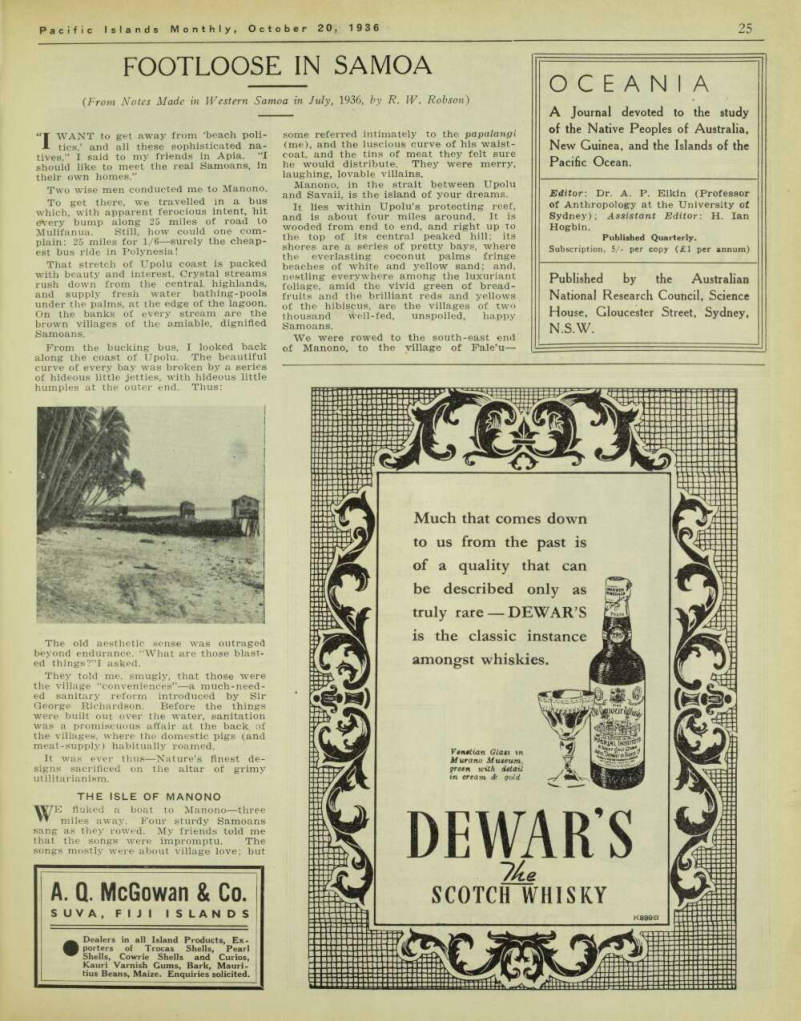
From the bucking bus, I looked back along the coast of Upolu. The beautiful curve of every bay was broken by a series of hideous little jetties, with hideous little humpies at the outer end. Thus:
The old aesthetic sense was outraged beyond endurance. “What are those blast ed things?”! asked.
They told me, smugly, that those were the village “conveniences” —a much-need ed sanitary reform introduced by Sir George Richardson. Before the things were built out over the water, sanitation was a promiscuous affair at the back of the villages, where the domestic pigs (and meat-supply) habitually roamed.
It was ever thus—Nature’s finest de signs sacrificed on the altar of grimy utilitarianism.
The Isle Of Manono
WE fluked a boat to Manono—three miles away. Four sturdy Samoans sang as they rowed. My friends told me that the songs were impromptu. The songs mostly were about village love; but
some referred intimately to the papalangi (me), and the luscious curve of his waist coat, and the tins of meat they felt sure he would distribute. They were merry, laughing, lovable villains.
Manono, in the strait between Upolu and Savaii, is the island of your dreams.
It lies within Upolu’s protecting reef, and is about four miles around. It is wooded from end to end, and right up to the top of its central peaked hill: its shores are a series of pretty bays, where the everlasting coconut palms fringe beaches of white and yellow sand; and, nestling everywhere among the luxuriant foliage, amid the vivid green of bread fruits and the brilliant reds and yellows of the hibiscus, are the villages of two thousand well-fed, unspoiled, happy Samoans.
We were rowed to the south-east end of Manono, to the village of Fale’u—
surely the loveliest corner in the South Seas.
Guided by excited children, we walked along to the fale of Leiataua Piupiu, chief of the village.. The chief, a young, hand some man of dignified bearing, met us courteously.
“We have come to be your guests for the week-end,” we said. I had been as sured that all was in order; but I could
not believe it, and waited for the “knock back.”
But the chief smiled, and said some thing to his smiling, comely wife. She laughed delightedly, and called something to her two smiling handmaidens. They shouted with glee, and in two minutes that fale was a scene of intense activity.
The everyday mats were removed, and fresh and beautiful mats were spread on
the floor. We were invited inside, and I was placed with my back to the post which denotes the honoured guest. The kava ceremony was prepared. The vil-
lage elders came in—courteous, smiling, dignified gentlemen. Out at the back, I could see a boy pursuing a panic-stricken cockerel: his fury and purposefulness in dicated preparations for our supper.
THAT was my first experience of Samoan hospitality. I met it many times afterwards; but I never shall for get that evening under the roof of the chief of Fale’u.
An attractive girl made the kava, and we drank it punctiliously—l had the honour of the first bowl. “Manu-eea” (good health to you) they said, and bowed to me, as I drank the fresh brew.
They gave us a luscious meal. There were broiled chickens, fish fresh from the lagoon, fat-bellied crabs, bread-fruit, taro, roasted bananas, a kind of oyster, arrow-root pudding, coconut-cream sauce, and the whole washed down with the milk of coconuts, drunk from the green nuts.
The chief and his family sat politely and chatted to us while we ate. Samoan eti quette, that rigid thing, demands that the host shall not eat until the guest is finished and satisfied.
One of my friends proposed to amuse the chief’s children with conjuring tricks; but, in ten minutes, his audience com prised the whole village—young and old.
No hero of Albert Hall ever scored a greater artistic triumph. Every trick -clicked.” The audience was spellbound —except one small boy, who ran away, howling dolorously, because the conjurer, after the manner of his kind, extracted a missing white ball from the juvenile ear.
We had hoped for a siva; but, during the whole period of our stay, we saw no voung girls between the ages of 14 and 20. They are kept firmly herded together, in one house, under the grim eye and per sonal care of the native pastor. The New Morality is triumphant in Manono, and in many parts of the mainland. But, in other villages, the girls siva joyously and sing in concert, as of yore.
We slept at one end of the fale, on soft mats, behind a piece of tapa hung so as to give that degree of privacy that European susceptibilities demand. The chief and his family slept at the other end. In the morning they brought us bowls of water, clean towels, and soap.
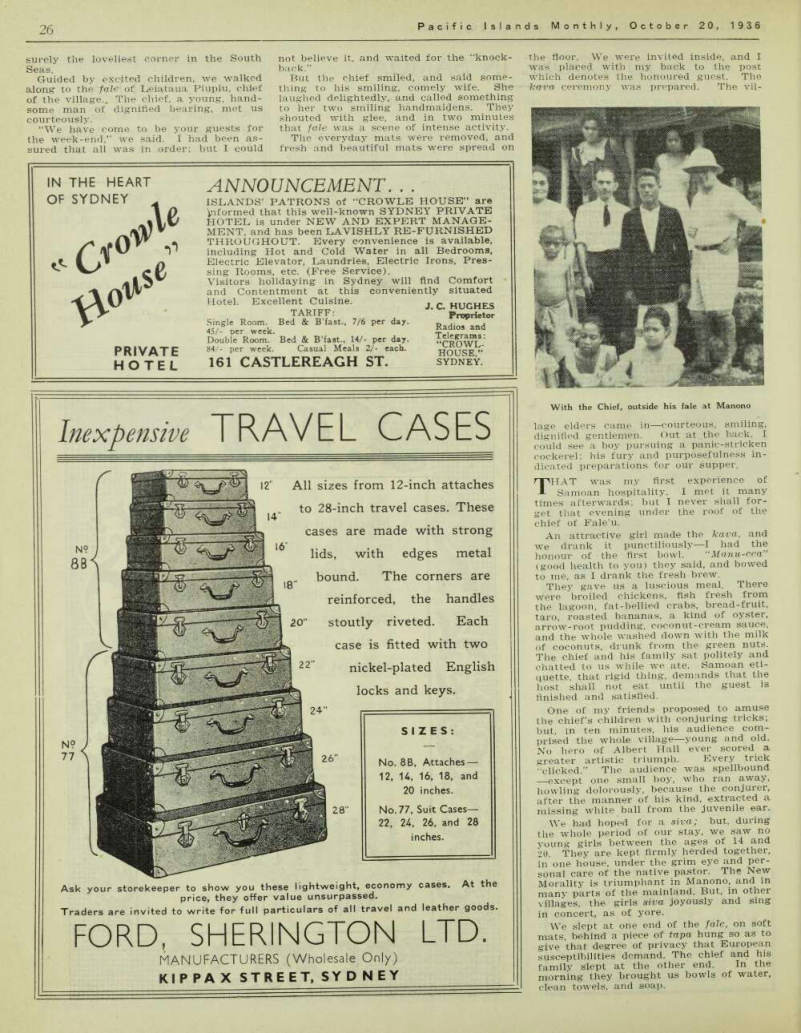
With the Chief, outside his fale at Manono
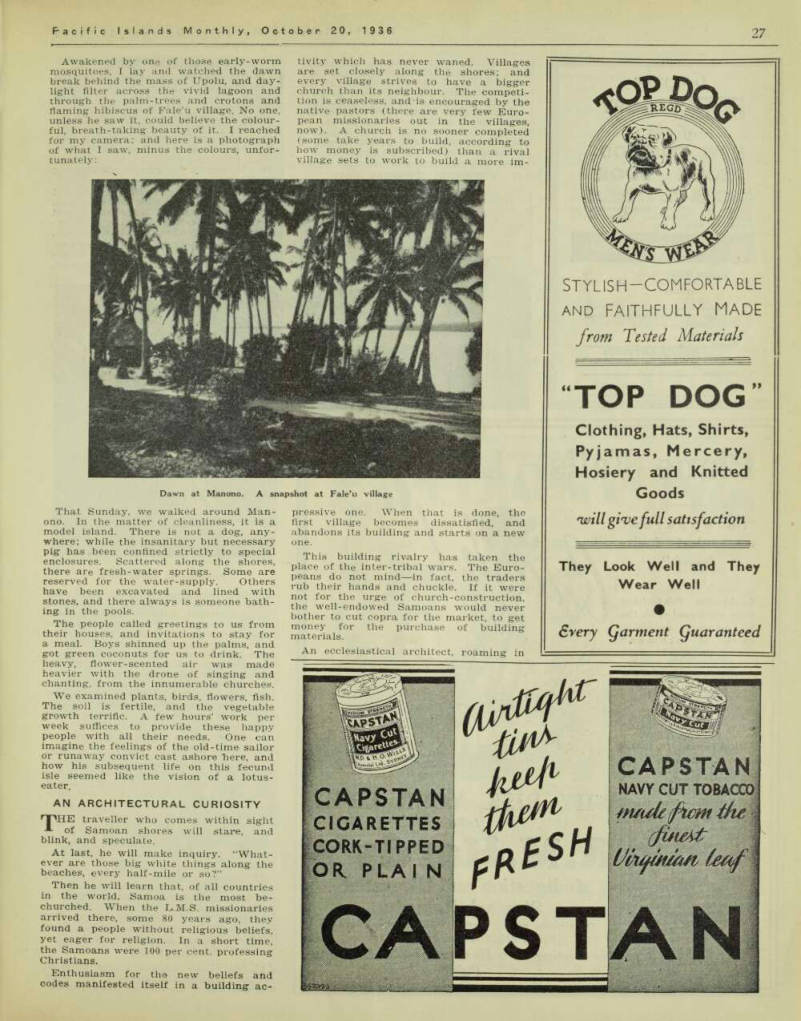
Awakened by one of those early-worm mosquitoes, I lay and watched the dawn break behind the mass of Upolu, and day light filter across the vivid lagoon and through the palm-trees and crotons and flaming hibiscus of Fale’u village. No one, unless he saw it, could believe the colour ful, breath-taking beauty of it. I reached for my camera; and here is a photograph of what I saw, minus the colours, unfor tunately:
That Sunday, we walked around Man ono. In the matter of cleanliness, it is a model island. There is not a dog, any where; while the insanitary but necessary pig has been confined strictly to special enclosures. Scattered along the shores, there are fresh-water springs. Some are reserved for the water-supply. Others have been excavated and lined with stones, and there always is someone bath ing in the pools.
The people called greetings to us from their houses, and invitations to stay for a meal. Boys shinned up the palms, and got green coconuts for us to drink. The heavy, flower-scented air was made heavier with the drone of singing and chanting, from the innumerable churches.
We examined plants, birds, flowers, fish.
The soil is fertile, and the vegetable growth terrific. A few hours’ work per week suffices to provide these happy people with all their needs. One can imagine the feelings of the old-time sailor or runaway convict cast ashore Tiere, and how his subsequent life on this fecund isle seemed like the vision of a lotus eater.
An Architectural Curiosity
T'HE traveller who comes within sight -*■ of Samoan shores will stare, and blink, and speculate.
At last, he will make inquiry. “What ever are those big white things along the beaches, every half-mile or so?”
Then he will learn that, of all countries in the world, Samoa is the most be churched. When the L.M.S. missionaries arrived there, some 80 years ago, they found a people without religious beliefs, yet eager for religion. In a short time, the Samoans were 100 per cent, professing Christians.
Enthusiasm for the new beliefs and codes manifested itself in a building ac
tivity which has never waned. Villages are set closely along the shores; and every village strives to have a bigger church than its neighbour. The competi tion is ceaseless, and is encouraged by the native pastors (there are very few Euro pean missionaries out in the villages, now). A church is no sooner completed (some take years to build, according to how money is subscribed) than a rival village sets to work to build a more im
pressive one. When that is done, the first village becomes dissatisfied, and abandons its building and starts on a new one.
TVI . , , , . .. „ J* I ®, r ™ lr / has taken the ® y ars ' +^ he * E^ r °' f*.° v. ot /i mind a fac t’ traders ™b their hands and chuckle. If it were t^ H Urgr ® 1 °J church -construction, the well-endowed Samoans would never bother to cut copra for the market, to get money for the purchase of building materials, * An ecclesiastical architect, roaming in
Dawn at Manono. A snapshot at Fale’u village
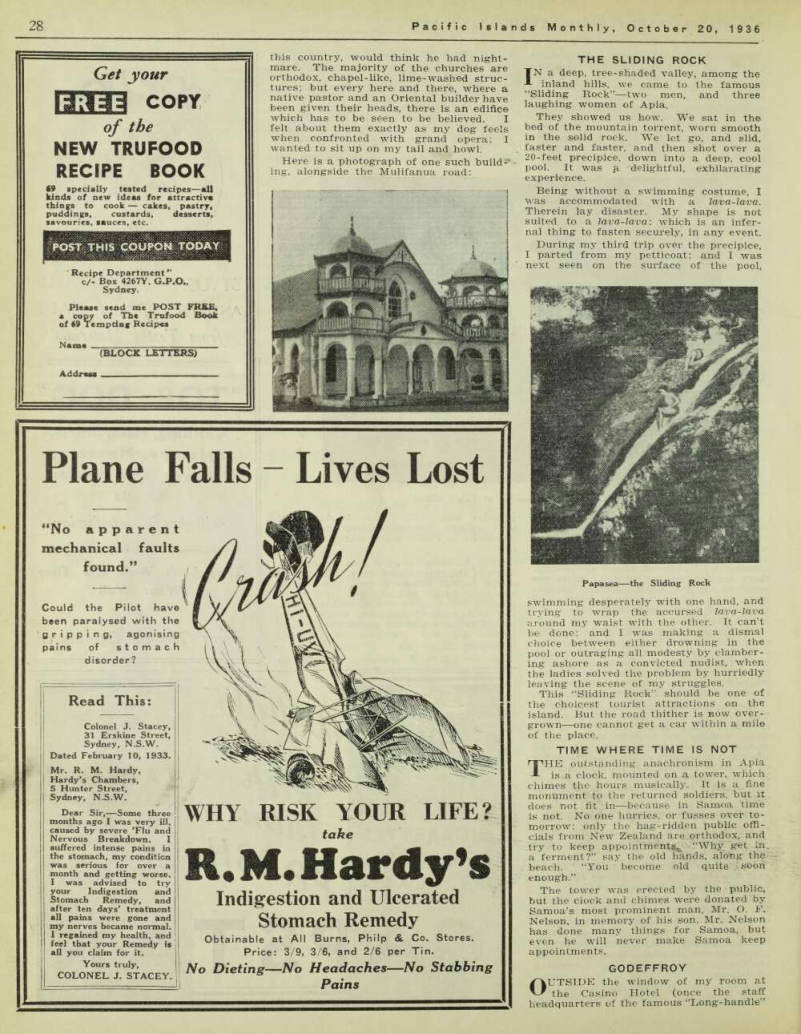
this country, would think he had night mare. The majority of the churches are orthodox, chapel-like, lime-washed struc tures; but every here and there, where a native pastor and an Oriental builder have been given their heads, there is an edifice which has to be seen to be believed. I felt about them exactly as my dog feels when confronted with grand opera: I wanted to sit up on my tail and howl.
Here is a photograph of one such build” ing, alongside the Mulifanua road:
The Sliding Rock
IN a deep, tree-shaded valley, among the inland hills, we came to the famous “Sliding Rock” —two men, and three laughing women of Apia.
They showed us how. We sat in the bed of the mountain torrent, worn smooth in the solid rock. We let go, and slid, faster and faster, and then shot over a 20-feet precipice, down into a deep, cool pool. It was a delightful, exhilarating experience.
Being without a swimming costume, I was accommodated with a lava-lava.
Therein lay disaster. My shape is not suited to a lava-lava: which is an infer nal thing to fasten securely, in any event.
During my third trip over the precipice, I parted from my petticoat; and I was next seen on the surface of the pool,
swimming desperately with one hand, and trying to wrap the accursed lava-lava around my waist with the other. It can't be done; and I was making a dismal choice between either drowning in the pool or outraging all modesty by clamber ing ashore as a convicted nudist, when the ladies solved the problem by hurriedly leaving the scene of my struggles.
This “Sliding Rock” should be one of the choicest tourist attractions on the island. But the road thither is now over grown—one cannot get a car within a mile of the place.
Time Where Time Is Not
THE outstanding anachronism in Apia is a clock, mounted on a tower, which chimes the hours musically. It is a fine monument to the returned soldiers, but it does not fit in—because in Samoa time is not. No one hurries, or fusses over to morrow: only the hag-ridden public offi cials from New Zealand are orthodox, and try to keep “Why get in a ferment?” say the old hands, along the beach. “You become old quite soon enough.”
The tower was erected by the public, but the clock and chimes were donated by Samoa’s most prominent man, Mr. O. F.
Nelson, in memory of his son. Mr. Nelson has done many things for Samoa, but even he will never make Samoa keep appointments.
Godeffroy
OUTSIDE the window of my room at the Casino Hotel (once the staff headquarters of the famous “Long-handle”
Papasea—the Sliding Rock
firm—the D.H. and P.G.) there was a cairn of rough stones, with cacti growing upon it. I investigated, and on the north side, looking out over the sea, I found two large brass plates. One carried the pic ture of a handsome strong-featured man —Johan Cesar Godeffroy; and the other, a few words, in German, to say that, on this spot, eighty years ago, the famous firm of Godeffroy and Son was first estab lished in Samoa.
I went to Watson’s History of Samoa for details: and there I learned that about 1854 August Unshelm, representing Godeffroy (a great Hamburg house) ar rived in Apia from Valparaiso, and com menced trading. He established branches in Tonga and Fiji, but was lost at sea in a hurricane in 1864. Theodor Weber, a remarkable man of dynamic energy, then took charge, and he extended the opera tions of Godeffroy all over the Central and South Pacific. The Godeffroy firm, broken by foreign speculation, collapsed in the seventies, and its organisation was taken over by the D.H. and P.G.
No one seemed to know who had erected the monument. It must have been a long time ago, for the mana of Godeffroy de parted in the seventies.
By a curious coincidence, the author of this invaluable History of Samoa occu pied the next room to mine, in the hotel.
He was temporarily in Samoa, acting as Chief Judge—a learned man, with a most intimate and cynical knowledge of the Samoans.
Polynesian Migration
IN Samoa I had the pleasure of meeting Monsignor J. Darnand, the Catholic Bishop of Samoa, and of receiving from him a copy of his book, Le Foret qui s’lllumine, in which he tells the story of mission work in that part of the Pacific.
The book was published recently by the Libraire Catholique, 10 Rue Jean Bart, Paris.
I was especially interested in two sec tions of the book— L’Origine et les Mi grations des Polynesiens and Les Vik
The inscription on Apia’s clock-tower
The plaque, showing Johan Cesar Godeffroy, set in a cairn of stones at the Casino Hotel, Apia.
ings du Pacifique. Monsignor Darnand has made a close personal study of all the evidence he could find about the early migrations and voyages of the Polyne sians; he has consulted most of the numerous books on the subject; and his conclusions, written at the end of three decades in these islands, are most valu able.
In Apia, also, I met Father Deihl, a very popular missionary, who, although a younger man, also has devoted much study and thought to the mystery of the Polynesian race. He has accumulated quite a library on the subject, and can discuss it in a fascinating way.
After talking with these men and read ing their books. One is left in no doubt
about the Polynesian migration. Partly Caucasian, partly Mongolian, with a little Ethiopian mixed in, these attractive people came from somewhere about Wes tern Asia, and crossed Southern India and
the East Indies, into the Central Pacific.
That must have happened—but I leave the details to the scientists.
I think it was Father Deihl who, in this connection, directed my attention to a book, Arabia Deserta, in which the author, G. M. Doughty, describes an Arabian coffee-drinking ceremony called Kahwa. It is at least remarkable that this ceremony is similar to that which at tends the drinking of kava throughout Polynesia.
Snapshots At The Baths
ALL through history, all over the world, artists and writers have found in spiration at the public baths; and Samoa is no exception.
Every village has its bathing pool and its communal resort, where the family wash is undertaken in leisurely fashion.
Streams, flowing from the central moun
Monsignor J. Darnand, Catholic Bishop of Western Samoa.
tains, give an endless supply of fresh water. I never entered a village, but what I did not see a dozen pretty pictures, just waiting to be photographed. Here are two of them:
This young Samoan mother was sous ing her offspring very thoroughly in the pool, when I arrived and was smilingly given permission to make a picture.
This young woman had herself just left the pool and was drying her hair, while she did the family wash—beating it upon a plank.
It may interest Pacific Islands travellers to know that all these photographs were taken with a Kodak Vdllenda camera (the No. 48 model, making pictures of half “V.P.” size), using Kodak Panatomic film.
Mr. Leo Austen, Assistant Resident Magistrate in the Trobriand Group, Papua, who has been in Australia on fur lough since July, returned to Port Moresby by the Macdhui on September 30.
Dr. W. C. Klein, of the Dutch New Guinea Committee, who was in Papua and New Guinea last year studying condi tions and administrative methods, has written a book, in Dutch, entitled “Nieuw Guinea.” It contains almost 400 pages and is published by the Molukken Insti tute.