Aerial Transport For Pacific
pp. 24-26 · Read in the full issue
Significant Manoeuvres by Various Interests
VyiTH the rapid growth of inter-con ' ’ tinental aerial transport, the strategic importance is growing of various little islands in the Pacific which for a century or two have had little or no value.
At the moment of this writing an aero plane is trying to fly from Melbourne to London in five days; and another aero plane, piloted by a woman, is on the way from London to New Zealand in another record-breaking attempt. Is it any wonder that there is new merit in islands which are big enough to provide a landing ground ?
During the month various steps have been taken to advance aerial transport in the Pacific —especially a conference in Wellington of representatives of Britain, Australia, and New Zealand.
In the circumstances, it is not surpris ing that there have been events of signific ance in connection w T ith the ownership of Pacific Islands.
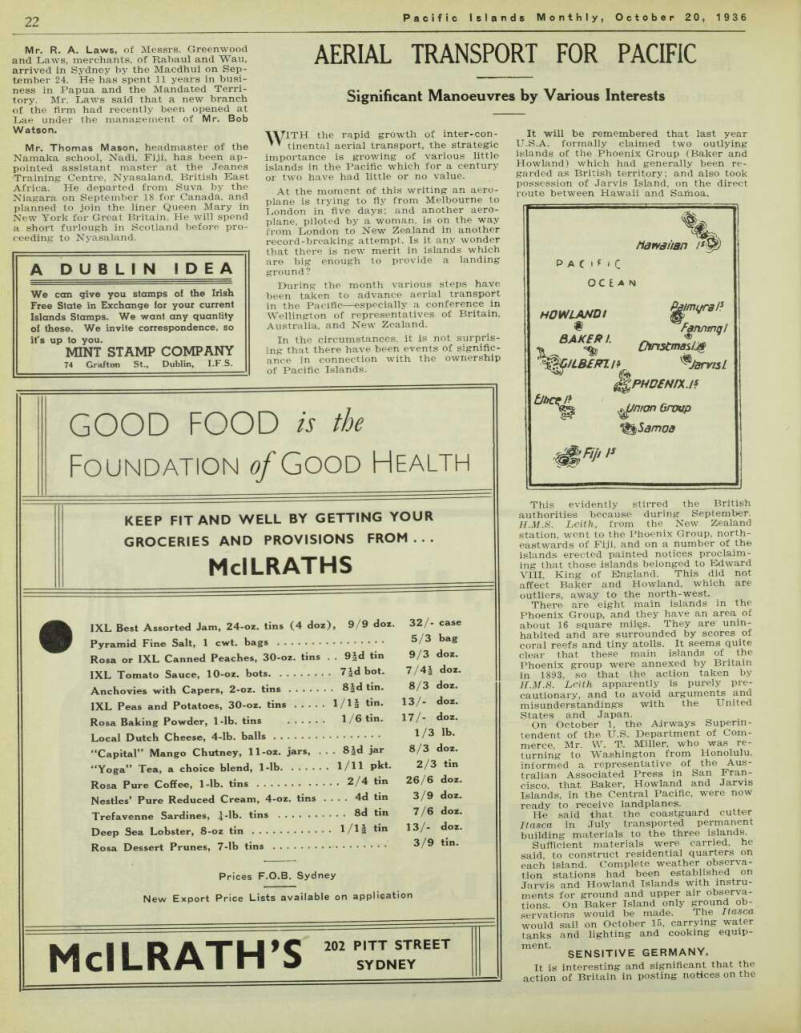
It will be remembered that last year U.S.A. formally claimed two outlying islands of the Phoenix Group (Baker and Howland) which had generally been re garded as British territory ; and also took possession of Jarvis Island, on the direct rout© between Hawaii and Samoa.
This evidently stirred the British authorities because during- September.
H.M.S. Leith, from the New Zealand station, went to the Phoenix Group, north eastwards of Fiji, and on a number of the islands erected painted notices proclaim ing that those islands belonged to Edward VIII, King of England. This did not affect Baker and Howland, which are outliers, away to the north-west.
There are eight main islands in the Phoenix Group, and they have an area of about 16 square They are unin habited and are surrounded by scores of coral reefs and tiny atolls. It seems quite clear that these main islands of the Phoenix group were annexed by Britain in 1893, so that the action taken by H.M.S. Leith apparently is purely pre cautionary, and to avoid arguments and misunderstandings with the United States and Japan.
On October 1, the Airways Superin tendent of the U.S. Department of Com merce, Mr. W. T. Miller, who was re turning to Washington from Honolulu, informed a representative of the Aus tralian Associated Press in San Fran cisco, that Baker, Howland and Jarvis Islands, in the Central Pacific, were now ready to receive landplanes.
He said that the coastguard cutter Itasca in July transported permanent building materials to the three islands.
Sufficient materials were carried, he said, to construct residential quarters on each island. Complete weather observa tion stations had been established on Jarvis and Howland Islands with instru ments for ground and upper air observa tions. On Baker Island only ground ob servations would be made. The Itasca would sail on October 15, carrying water tanks and lighting and cooking equip
Ment’ Sensitive Germany.
It is interesting and significant that the action of Britain in posting notices on the
Phoenix Islands (which was almost simultaneous with certain actions confirm ing the annexation by Australia of a large section of Antarctica) was made the occasion of a sharp attack on Britain by a German journal called Angriff, which is the leading organ of the Nazi Govern ment. The article bore the headlines, “Gigantic increase of Territory for the British Empire,” “Australia Doubles Its Territory,” “Injustice to Germany.”
The article ran through only an early edition of the paper and was then with drawn. British comment was calm. It was pointed out that Britain already had title to the Phoenix Islands (16 square miles!) since 1893, and that the section of Antarctica which Australia holds (and has held for many years) is covered with snow and ice.
The incident, however. shows how in tensely sensitive the landless nations are to territorial movements in the Pacific.
Japan And The Marshalls.
Japan is just as sensitive and suspicious in these matters as Germany. Sydney newspapers during the month published the story of Mr. H. F. Beeton, a world wandering English schoolmaster, who had been desirous of spending a few months in the Marshall Islands. But Mr. Beeton never got beyond Japan. When he said he wished to go to Japan’s Mandated Territory he received the concentrated at tention of officials and detectives to such good effect that he left the country altogether. He complained that he was regarded as a spy.
Anyone can go to the Mandated Ter ritories held by Britain and her Dominions, and by France; but very few Europeans ever have been permitted to enter the Marshall and Caroline Islands, and permission to enter is becoming evermore difficult to obtain.
America And Britain.
It was reported early in October that the aviation conference in New Zealand dealt with the position of New Zealand in relation to the proposed trans-Paciflc air routes. Pan-American Airways, it was stated, was seeking an arrangement to enable it to found a service, using Hawaii and Samoa as bases. On the other hand, it was pointed out, Britain is seek ing a reciprocal arrangement with the United States Government for the use of Hawaii as a base by aircraft engaged in a British service between Canada and other parts of the British Empire in the Pacific.
It was stated that an agreement virtu ally had been reached for a new aviation service between Australia and New Zea land; but, although the proposed Pan- American Airways’ service between Auck land and Hawaii was discussed, it was not stated that any agreement was reached. It is quite clear that there is some hold-up in this plan owing to the inability of the British and American aviation authorities to agree, but the exact nature of the trouble has not been disclosed.
We still hold the opinion that we have expressed several times —namely, that a service between Hawaii and New Zea land will not come very soon, simply be cause there are not enough passengers and freight in sight to make it profitable.
The collection of New Guinea birds of paradise, which was presented to the Commonwealth by Mr. W. B. Carpenter, of Woolstonecraft (N.S.W.) was on dis play in Melbourne recently. The collection, which is housed at the Institute of Anat omy, at Canberra, comprises 11 brilliantly coloured birds.
Mr. George Preece, an Englishman who was for some years in the employ of the Colonial Sugar Refining Co. Ltd., in Fiji, died in the War Memorial Hospital, Suva, on September 12, at the age of 74.
Mr. Leslie C. Ankers, manager of Tokua Estate, Kokopo, New Guinea, died at Na manula Hospital, Rabaul, on August 16.
Arriving in the Territory in 1924, he was for some years employed by the Expro priation Board on coconut plantations in the Manus district. Later as manager of the New Guinea Club he was one of Rahaul’s most popular citizens.