C.S.R. To Can Fiji Pineapples
pp. 19-20 · Read in the full issue
Millionaire Co. Launches a New Industry
THE decision of the Colonial Sugar Refining Company, Ltd., to purchase the plant and interests of the West Coast (Viti Levu) Pines and of the Fiji Pineapple Canning Company, on the island of P Ovalau is of outstanding importance.
It adds another industry to those already established in Fiji, under conditions which seem to guarantee success. 5 . .
Many tests by leading experts, including those of Hawaii, showed that the Fiji article could more than hold its own with any other canned pineapple in the world.
Two varieties of pineapple are widely established in Fiji—the Ripley, a delicious fruit with deep eyes and firm flesh, which is easily transported: and Smooth Cayenne, a barrel-shaped fruit, very juicy, which does not carry well, but is admirable for canning, and which, in fact, forms the basis of the great canning industry in Hawaii. The Hawaiian production in 1926 was 8,800,000 cases, each of 24 tins, worth about £7,000,000 sterling.
Fiji’s natural conditions (soil, climate and labour) are comparable with those of Hawaii, so far as the canning of pineapples is concerned. There is a huge market in Canada, New Zealand and, probably, Europe.
In 1926 it was agreed that the Fiji Government should grow the fruit, and Canadian Canners Ltd should erect a factory for canning, and that the expert ment should extend over two years. The experiment was a complete success. I demonstrated that the quality and appearance of Fiji canned pineapples are quite equal, if not superior, to the Hawaiian. It was proved that second class undulating land was the best for pineapples, and that production costs allowed a fair margin of profit, j n 192 8, the Fiji Pineapple Co. Ltd., was formed, and took over the experimental canning factory on the island of Ovalau.
West Coast Pines (Fiji) was formed to operate in the north-west of Viti Levu, near Nadi; European and Indian tenant farmers were established, and canning commenced in 1930.
Both companies should have succeeded, but both walked straight into the de pression. Fiji Pineapple Co. went into liquidation in 1932, and West Coast Pines ceased operations in 1933.
The C.S.R. Company has been investi gating the position for several months, and it is certain to make a commercial success of the new industry. It has all the facilities, as well as the capital, the prestige and the organisation for effective marketing.
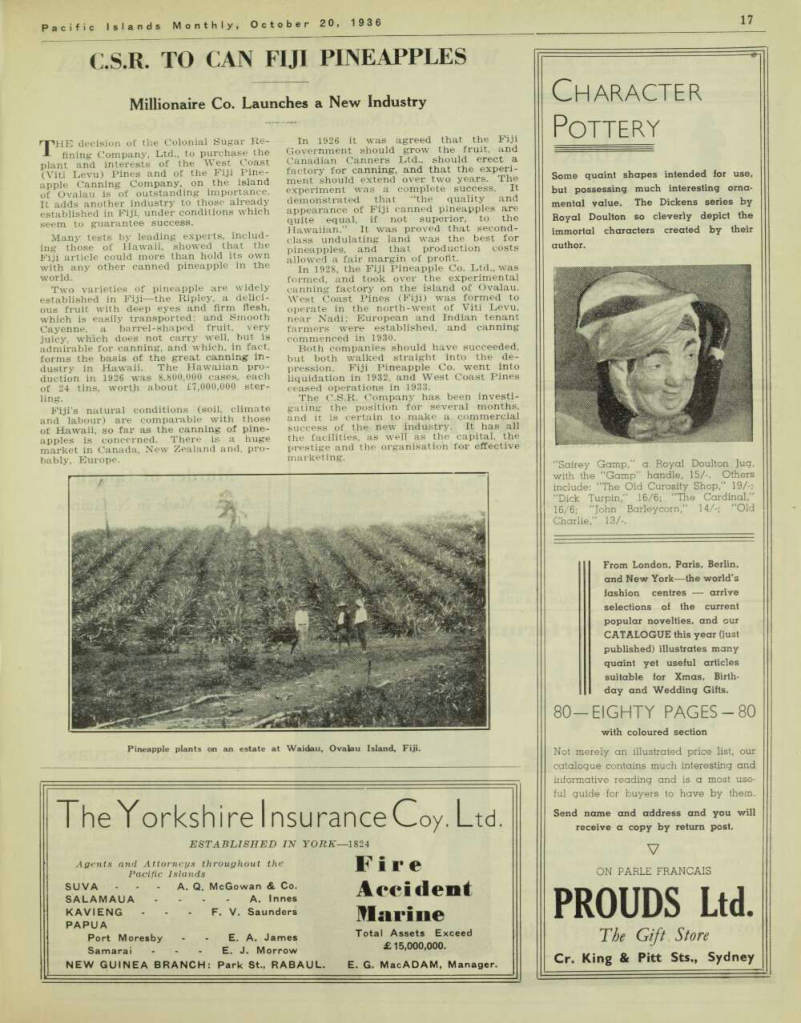
Pineapple plants on an estate at Waidau, Ovalau Island, Fiji.
£Hon. H. H. Page, Government Secre tary in New Guinea, arrived in Sydney from Rabaul by the Neptuna on October 10, on nine months’ furlough.