Tropicalliies
p. 13 · Read in the full issue
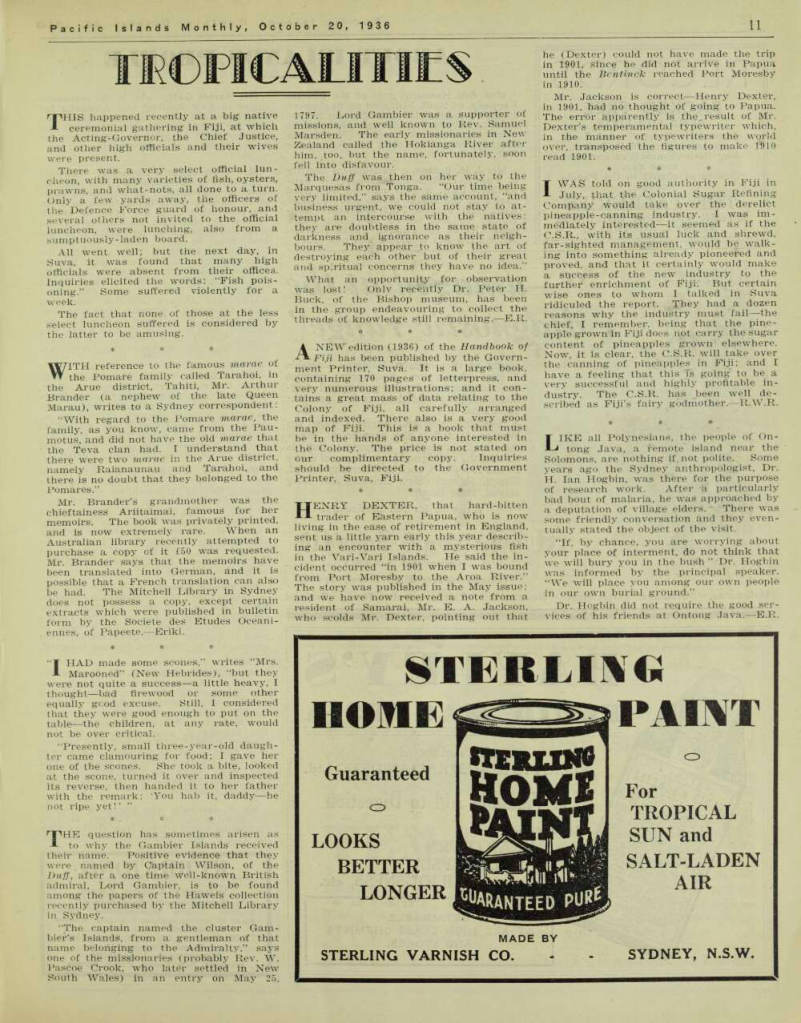
THIS happened recently at a big native ceremonial gathering in Fiji, at which the Acting-Governor, the Chief Justice, and other high officials and their wives were present.
There was a very select official lun cheon, with many varieties of fish, oysters, prawns, and what-nots, all done to a turn.
Only a few yards away, the officers of the Defence Force guard of honour, and several others not invited to the official luncheon, were lunching, also from a sumptuously-laden board.
All went well; but the next day, in Suva, it was found that many high officials were absent from their offices.
Inquiries elicited the words: “Fish pois oning.” Some suffered violently for a week.
The fact that none of those at the less select luncheon suffered is considered by the latter to be amusing. « * * WITH reference to the famous marae of the Pomare family called Tarahoi, in the Arue district, Tahiti, Mr. Arthur Brander (a nephew of the late Queen Marau), writes to a Sydney correspondent: “With regard to the Pomare marae, the family, as you know, came from the Pau motus, and did not have the old marae that the Teva clan had. I understand that there were two marae in the Arue district, namely Raianaunau and Tarahoi, and there is no doubt that they belonged to the Pomares.”
Mr. Brander’s grandmother was the chieftainess Ariitaimai, famous for her memoirs. The book was privately printed, and is now extremely rare. When an Australian library recently attempted to purchase a copy of it £5O was requested.
Mr. Brander says that the memoirs have been translated into German, and it is possible that a French translation can also be had. The Mitchell Library in Sydney does not possess a copy, except certain extracts which were published in bulletin form by the Societe des Etudes Oceani ennes, of Papeete.—Eriki. * * * IHAD made some scones,” writes “Mrs.
Marooned” (New Hebrides), “but they were not quite a success —a little heavy, I thought—bad firewood or some other equally good excuse. Still, I considered that they were good enough to put on the table—the children, at any rate, would not be over critical.
“Presently, small three-year-old daugh ter came clamouring for food; I gave her one of the scones. She took a bite, looked at the scone, turned it over and inspected its reverse, then handed it to her father with the remark: ‘You hab it, daddy—he not ripe yet!’ ” *. * * THE question has sometimes arisen as to why the Gambier Islands received their name. Positive evidence that they were named by Captain Wilson, of the Duff, after a one time well-known British admiral, Lord Gambier, is to be found among the papers of the Haweis collection recently purchased by the Mitchell Library in Sydney.
“The captain named the cluster Gam bier’s Islands, from a gentleman of that name belonging to the Admiralty,” says one of the missionaries (probably Rev. W.
Pascoe Crook, who later settled in New South Wales) in an entry on May 25,
1797. Lord Gambier was a supporter of missions, and well known to Rev. Samuel Marsden. The early missionaries in New Zealand called the Hokianga River after him, too, but the name, fortunately, soon fell into disfavour.
The Duff was then on her way to the Marquesas from Tonga. “Our time being very limited,” says the same account, “and business urgent, we could not stay to at tempt an intercourse with the natives: they are doubtless in the same state of darkness and ignorance as their neigh bours. They appear to know the art of destroying each other but of their great and spiritual concerns they have no idea.”
What an opportunity for observation was lost! Only recently Dr. Peter H.
Buck, of the Bishop museum, has been in the group endeavouring to collect the threads of knowledge still remaining.—E.R. * * * ANEW edition (1936) of the Handbook of Fiji has been published by the Govern ment Printer, Suva. It is a large book, containing 170 pages of letterpress, and very numerous illustrations: and it con tains a great mass of data relating to the Colony of Fiji, all carefully arranged and indexed. There also is a very good map of Fiji. This is a book that must be in the hands of anyone interested in the Colony. The price is not stated on our complimentary copy. Inquiries should be directed to the Government Printer, Suva, Fiji. * * * HENRY DEXTER, that hard-bitten trader of Eastern Papua, who is now living in the ease of retirement in England, sent us a little yarn early this year describ ing an encounter with a mysterious fish in the Vari-Vari Islands. He said the in cident occurred “in 1901 when I was bound from Port Moresby to the Aroa River.”
The story was published in the May issue: and we have now received a note from a resident of Samarai, Mr. E. A. Jackson, who scolds Mr. Dexter, pointing out that
he (Dexter) could not have made the trip in 1901, since he did not arrive in Papua until the Bentinck reached Port Moresby in 1910.
Mr. Jackson is correct —Henry Dexter, in 1901, had no thought of going to Papua.
The error apparently is the_result of Mr.
Dexter’s temperamental typewriter which, in the manner of typewriters the world over, transposed the figures to make 1910 read 1901. * * * IWAS told on good authority in Fiji in July, that the Colonial Sugar Refining Company would take over the derelict pineapple-canning industry. I was im mediately interested —it seemed as if the C.S.R., with its usual luck and shrewd, far-sighted management, would be walk ing into something already pioneered and proved, and that it certainly would make a success of the new industry to the further enrichment of Fiji. But certain wise ones to whom I talked in Suva ridiculed the report. They had a dozen reasons why the industry must fail —the chief, I remember, being that the pine apple grown in Fiji does not carry the sugar content of pineapples grown elsewhere.
Now, it is clear, the C.S.R. will take over the canning of pineapples in Fiji; and I have a feeling that this is going to be a very successful and highly profitable in dustry. The C.S.R. has been well de scribed as Fiji’s fairy godmother.—R.W.R. * * * LIKE all Polynesians, the people of On tong Java, a remote island near the Solomons, are nothing if not polite. Some years ago the Sydney anthropologist, Dr.
H. lan Hogbin, was there for the purpose of research work. After a particularly bad bout of malaria, he was approached by a deputation of village elders. There was some friendly conversation and they even tually stated the object of the visit.
“If, by chance, you are worrying about your place of interment, do not think that we will bury you in the bush ’’ Dr, Hogbin was informed by the principal speaker.
“We will place you among our own people in our own burial ground.”
Dr. Hogbin did not require the good ser vices of his friends at Ontong Java. —E.R.