Husbands And Wives On Rapa
pp. 20-22 · Read in the full issue
Strange Customs of Isolated Community
WRITTEN FOR THE PACIFIC ISLANDS MONTHLY BY “BORNEO ”
pOR 12 years I the lone white man on Rapa (that outlying southerly island of French Oceania) and it may be interesting to others to know the ways of those natives who are among the most primitive in the South Seas to-day.
Isolated as Rapa certainly was then, there was sometimes no communication with the world for as long as three years.
Those natives were living much as lived their forefathers of centuries ago, except for a few things such as axes and knives.
They were true to type—pure native.
For some reason beyond my ken the females outnumbered the males, as they do to this day. As near as I could judge without taking a census, it was 4 to 1.
From the years of puberty, sex had its innings with both. The boys when of age, say at 14, are circumcised; and the girls, from 12 onwards are given com plete liberty. It is considered no crime for the girls to become mothers and no lad denies the fact of fatherhood.
In my day, the common talk of the home was sex; and the children, from their earlier years, knew more than most grown-ups in civilised countries.
It is the same with death. With them, I saw that it meant nothing. It had to be, so let it be! A baby is a simple event; so is death. Death, however, means a crowd in the house to see you dying; and, when you are dead, there is a grand feast, with plenty of praying and singing.
But though the sex relationship is very free, it has strict limitations. Blood relationship is a bar which none dare ignore, not even the wildest boy or girl.
An incident within my own experience shows it clearly. A girl took a fancy to a white man and asked him to make her a mother. He refused. She poured out her tale of woe. There was no man for her on the island. She was related to them all, and her only chance was to get one from abroad. No chance for her to go to another island —no money even if the chance came. There is the same rule for the boys. But, luckily, they are not all Rapa-born.
I have lived on Pitcairn. It is alto gether different there. They are all blood relations and badly need an introduction of new blood. If only there could be an exchange between the two islands!
There is no difficulty in finding a really fine young mate on Rapa. But there is something more to be thought of than merely grabbing her. What about food and what about the chores? The women do all the work and are the suppliers of food. There is only one condition. You must marry her, tie the lasting knot. No marriage, no grub.
And grub is very important, for one is not in the tropics, but far south, where the nippy air creates a healthy appetite.
Those Rapans are large eaters. I am a fair performer myself, but one native meal did me for a couple of days. Raw fish is their daily menu and they make a
Poi-Poi out of taro. One lusty helping of that and you feel replete.
They go really hungry at times. I know it. There is a sudden shortage, the fish are calling somewhere else, and bad weather, or lack of rain means that vegetables have gone awry. Then it’s look out! I took lean times as good training for a man’s stomach. Most civi lised people eat to a timetable. On Rapa you eat when you have the goods.
So, to get a status, a home and grub, I married. Yes, I am tied up all right.
A girl marries you to get a standing in the church—neither cares whether there is any love in the business. The aim of each party is clearly understood.
For him, once married, all the taro, kumaras, bananas, pineapples, coffee, etc., etc., together with the house and land of the woman whose heritage these are from the family possessions. For her, the pride of place amongst her fellows.
But, look out! Once married, there is no further running wild. Any attempt at quiet polygamy is looked upon as the work of the devil, and there’s plenty of trouble. A native man or woman is for bidden the church and, for months, there is no praying or singing—a terrible punishment. They all want to get to heaven. No church, and there can be no heaven. They have but one ireligious code. There is no half-way house where they can mend their ways—it is heaven or hell. The first missionaries knocked that into them. The native pastor is the boss of the future.
Here is my experience of marriage in Rapa, You choose your mate. You take her on trial for a few weeks. Nothing is said. You appear to suit each other, so
far as can be seen, A paper is made out by the local authority, maybe a gen darme, maybe someone else, and it is tacked on to a tree in your village for 14 days. * There being no objections, everybody goes out and gathers enough food to make a real feast, enough to feed 250 people (children, of course, included).
On the morning of the marriage day, you are taken into a house by two married women and not only given a bath willy nilly, but critically examined
all over, front and behind, to see if you are a fit and proper person to marry. If their report is adverse there is no mar riage. If 0.K., the big church bell is rung. So off to the church.
The girl’s nearest re lation leads the way, tak ing the man’s hand. Next come all the relations, two by two. In the church, after a bit of praying and singing, it is all over and done with.
Away to the feast, which lasts a couple o f days sleep inter mittent, eat ing prodigi ous. In my case, my con
tribution was flour and 12 bottles of rum.
My gift to the bride was three yards of dress material and a bottle of scent. Hers to me was a pair of blue jean trousers.
Private polygamy is made hell for a native man, and hot for the white man.
The Rapans will punish you alright. No home, no grub—it pays to stick to your wife. Tied for life you surely are, for if your wife dies, you have got to take her sister or her nearest relation. They
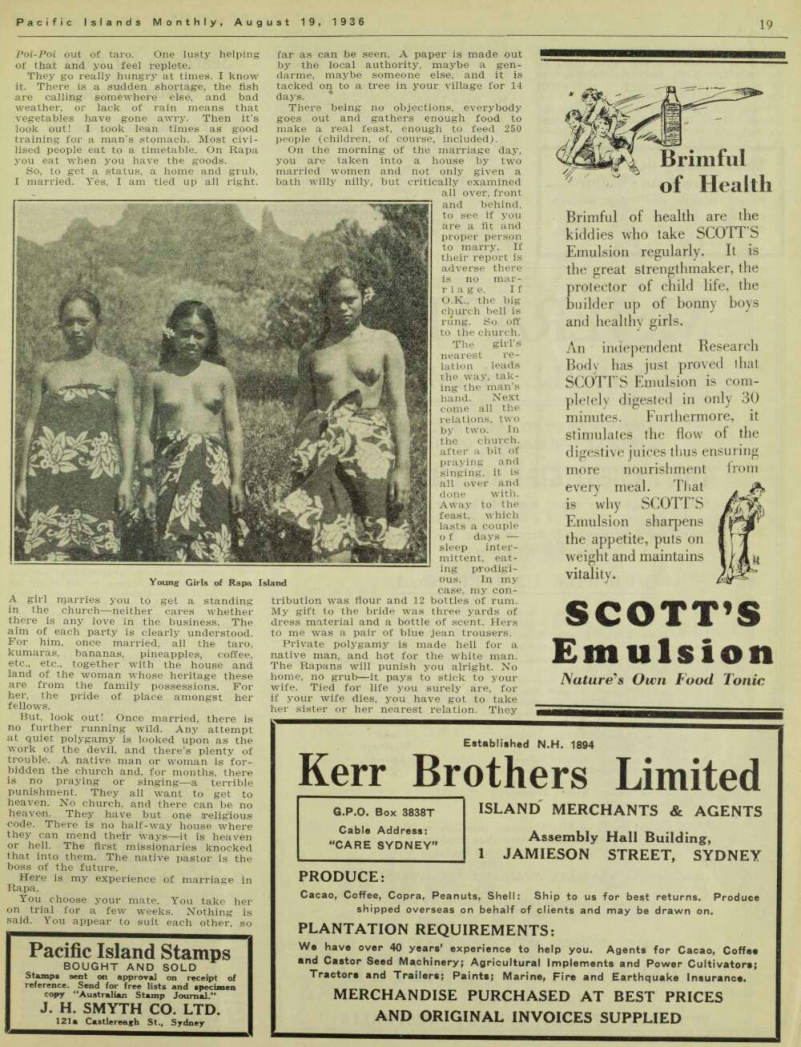
Young Girls of Rapa Island
keep you in the family; no breaking away, no foolish business with them as to bewailing your loss. One woman is as good as another —love is not given even a thought on Rapa.
Thus was it when I was alone on the island. Since then, others have drifted in, but not (save one trader) to make
permanent stay. That is my privilege; and, once again, after a visit to Outside, I am At Home. Mr. Dave Lyall, who is well-known on the Morobe goldfield, New Guinea, left Sydney by the Montoro on July 29 for Port Moresby, Papua.
Dr. H. lan Hogbin, lecturer in anthro pology at the Sydney University, was the guest of honour and principal speaker at the July gathering of the Polynesian Club of Sydney. He took as his subject the island of Ontong Java, near the Solomons, which is inhabited by the descendants of early Polynesian rovers. Fellow guests at the meeting were Captain and Mrs. Pat Bowyer, of Chicago, who recently called at Tahiti.