Relations
pp. 17-18 · Read in the full issue
Pacific Education and Race Relations Notable Conference at Honolulu
From a Special Correspondent
Honolulu, July 26.
THE first few days of the sessions of the International Conference on Race Relations, with special reference to Edu cation of Native Peoples, has served to show the variety and the complexity of the problems in different parts of the world. Originally intended to confine its discussions to education as the agent of race development and the adjustment of non-European cultures and peoples to changing social orders due to Western dominance and contact, the assembly of delegates and the final programme illus
trate the breadth of the Conference dis cussions and the truly international nature of its members.
Fascinating lectures and “film-talks” have been given to illustrate the recent history and present condition of the Indians in North America, the aborigines of Australia, and the Maoris of New Zea land.
Messrs. F. E. Williams and W. C.
Groves, of Papua and New Guinea re spectively (known jocularly to the other delegates as “the two cannibals”), each contributed papers on the conditions of native life, systems of administration and education in their respective areas. Mr.
Williams is billed to give a public even ing lecture next week; and his recent flights over the Mt. Hagen region have caused considerable interest in the Hono lulu press, one journal referring to him as “a slight sandy-haired man with a soft English voice.”
Interesting figures at the Conference, and all estimable persons in private, are:
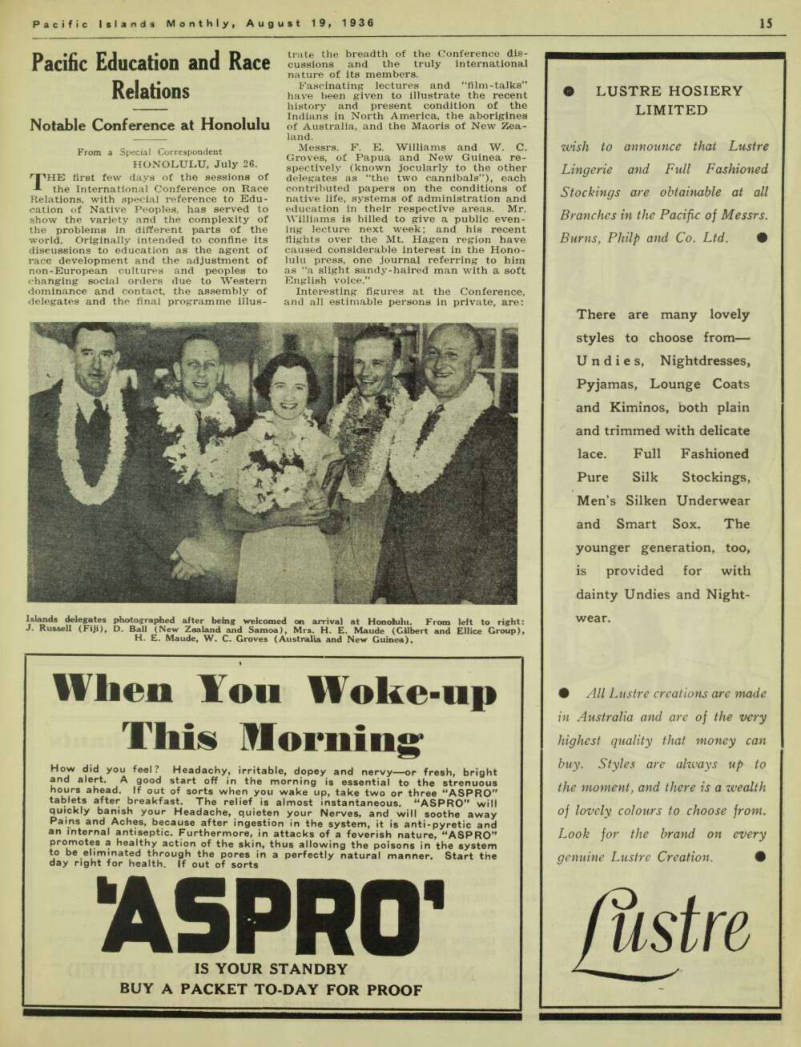
Islands delegates photographed after being welcomed on arrival at Honolulu. From left to right: J. Russell (Fiji), D. Ball (New Zealand and Samoa), Mrs. H. E. Maude (Gilbert and Ellice Group), H. E. Maude, W. C. Groves (Australia and New Guinea).
Mtimkulu, African Negro now complet ing a Ph.D. degree in race relations at Yale University, under Professor C. T.
Doram, formerly of South Africa, who. with Dr. Felix M. Keesing, of the Uni versity of Hawaii Department of Social Anthropology (and a New Zealander), shares the onerous duties of “steering” the Conference through its comprehensive programme.
Dr. George Sanchez, brilliant Spanish- American, educationist, of Mexico.
Dr. Thomas Jesse Jones, a world figure in native educational movements because of his work with the Phelps-Stokes Com mission in Africa and elsewhere.
Arthur Mayhew, C.M.G., breezy English gentleman and classical scholar, who, after a lifetime of educational work in India, now occupies the important post of secretary to the Colonial Office Advisory Committee on Native Education. What Mayhew does not know about British Colonial administration is not worth knowing, though the Australian delegates have found it necessary to teach him that Papua is not a mandated territory, and that the island of Nauru does exist. May hew is by universal assent the leader of the British groups of delegates—though there is no obtrusive consciousness of nationality in the Conference proceedings at all.
One cannot help wishing, for the sake of education and the future of the native, that the educational systems of Aus tralia’s territories were under the guid ance of the Colonial Office Advisory Com mittee direct. Since this is impossible the next best thing would certainly be for those territories to keep in close touch with the Advisory Committee for educa tional stimulus and help. This applies particularly to the Territory of New Guinea at present, when it is apparently about to face the perplexing task of attacking the native education problem on more comprehensive and less haphazard lines.
H. E. Maude, of the Gilbert and Ellice Islands service (who, by the way, has found masses of material in the Hawaiian official archives that throw light on the history of the Gilberts during last cen tury, and is working assiduously with his typewriter on it), presented an illuminat
ing and exhaustive paper on native life, administration, and the education situa tion in his Territory. Everyone felt a conviction, after hearing Mr. Maude’s ex cellent survey that the Gilbert and Ellice Administration, though far removed from the crossroads of the Western world, had much to teach other Pacific territories.
J. Russell, Director of Education of Fiji, contributes his share to the deliberations.
Miss Collier, M.A., of Sydney University, who is acting as secretary to Professor Elkin at the Conference, is universally liked for her breezy, typically Australian personality. She is a graduate of Elkin’s in social anthropology.
Other Pacific delegates include Dr. Gor don Brown, of the Barstow Foundation experimental native school in American Samoa; D. A. J. Rutherford, of the Edu cation Department in Western Samoa; Ernest Beaglehole, Polynesian anthropolo gist, who has worked under the Bishop Museum: Dr. I. J. Brugmans, of the Netherlands Indies; Messieurs Bernard and Ner, of French Indo-China; Edwin Burrows, ethnologist of Polynesian peoples; Dr. Chan, of Lingnan University, China; Alex. Keir, genial Scot, from the Inspectorial Branch of the British Malay Educational service; and his fellow-Scot, William Kay, of Hong Kong; Dr. and Mrs. Kwei, of Wuchang, Central China; Dr, Frank Daubach and Mr. McCormick, of the Philippine Islands; Charles F.
Doomis, of the Institute of Pacific Rela tions at Honolulu; Drs. Nakaseko and Oshima, educationists of Japan (who spoke of the Japanese administrative system in the Mandated Islands); Stanley D. Porteus, formerly of Melbourne, now Director of Psychological Clinic and Pro fessor of Clinical Psychology in the Uni versity of Hawaii; and Dr. Peter Buck.
D. 5.0., New Zealand Maori, Professor of Anthropology of Yale (U.S.A.), and Director of the Bernice Bishop Museum at Honolulu.
Mr. Don Waugh, District Officer at Rabaul, arrived in Australia in August by the Macdhui to spend three months’ furlough. He is one of the original Dis trict Officers of the Military Occupation days. During his absence D. O. Oakley is relieving at Rabaul.