Changes In Fiji-Indian Conditions After 20 Years
p. 11 · Read in the full issue
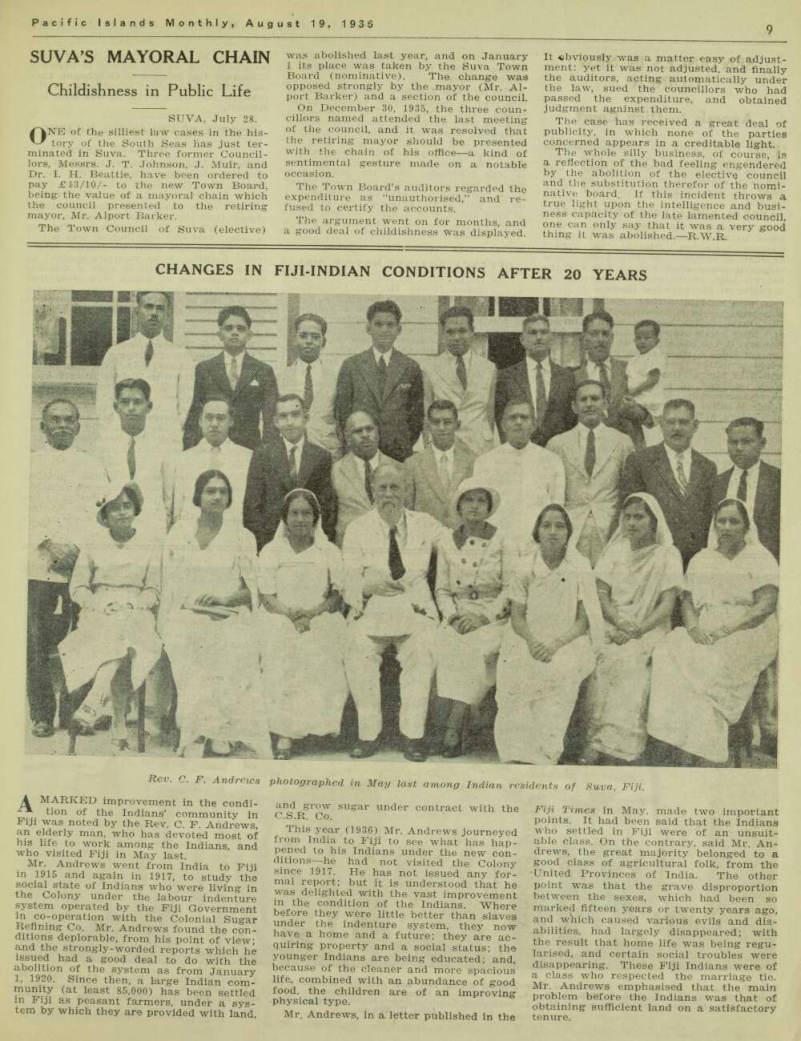
A MARKED improvement in the condi tion of the Indians’ community in Fiji was noted by the Rev. C. F. Andrews, an elderly man, who has devoted most of his life to work among the Indians, and who visited Fiji in May last.
Mr. Andrews went from India to Fiji in 1915 and again in 1917, to study the social state of Indians who were living in the Colony under the labour indenture system operated by the Fiji Government in co-operation with the Colonial Sugar Refining Co. Mr. Andrews found the con ditions deplorable, from his point of view; and the strongly-worded reports which he issued had a good deal to do with the abolition of the system as from January 1, 1920. Since then, a large Indian com munity (at least 85,000) has been settled in Fiji as peasant farmers, under a sys tem by which they are provided with land,
and grow sugar under contract with the
C.S.R. Co.
This year (1936) Mr. Andrews journeyed from India to Fiji to see what has hap pened to his Indians under the new con ditions —he had not visited the Colony since 1917. He has not issued any for mal report; but it is understood that he was delighted with the vast improvement in the condition of the Indians, Where before they were little better than slaves under the indenture system, they now have a home and a future; they are ac quiring property and a social status; the younger Indians are being educated; and, because of the cleaner and more spacious life, combined with an abundance of good food, the children are of an improving physical type.
Mr. Andrews, in a letter published in the
Fiji Times in May, made two important points. It had been said that the Indians who settled in Fiji were of an unsuit able class. On the contrary, said Mr. An drews, the great majority belonged to a good class of agricultural folk, from the •United Provinces of India. The other point was that the grave disproportion between the sexes, which had been so marked fifteen years or twenty years ago, and which caused various evils and dis abilities, had largely disappeared; with the result that home life was being regu larised, and certain social troubles were disappearing. These Fiji Indians were of a class who respected the marriage tie.
Mr. Andrews emphasised that the main problem before the Indians was that of obtaining sufficient land on a satisfactory tenure.
Rev. C. F. Andrews photographed in May last among Indian residents of Suva, Fiji.