Check To Hides Expedition
pp. 7-8 · Read in the full issue
Explorer Forbidden to Lead Gold Search In Region Which He Discovered
T EADING the best equipped Islands expedition ever sent out of Australia, Mr. Jack Hides sailed from Sydney by the Montoro on July 29 for Poit Moiesby.
The expedition, it is understood, consists of two Europeans (Mr. Hides and Captain P. G. Taylor) and 60 natives, and the original plan was that it would gen- .. nvnojitinw W TT-J 6 track of the expedition led by Mr. Hides early in 1935— namely, up the Fly and Strickland Rivers and across the limestone barrier into the Tari Furoro and Waga Furari valleys. It was understood that Mr. Hides would endeayour to locate a goldfield somewhere in the region he had previously traversed. close to the border between the Mandated Territory and Papua.
Investors Limited was registered m June. It has an issued capital of £16,250 in £1 shares and its composition is as follows : DIRECTORS Cliff Minter (chairman), F. Clapp (G.M., Aust.
General Electric Ltd.), Rod Dangar (owner of Peter Pan), Captain P. G. Taylor (aviator).
Shareholders
C. Minter, head of Minter, Simpson and Co., well-known Sydney solicitors; Telford Simpson, Chairman of the Consultative Council; Rodney Dangar grazier and owner of Peter Pan; E. R.
Knox, Chairman of Directors of the Colonial Sugar Refining Co. Ltd.; F. B. Clapp, Managing Director of the Australian General Electric Co. Ltd.; E. P. (“Monty”) Walker, stockbroker (and the only stockbroker allowed to take shares) ; T. Church, General Manager of the National Bank of Austraha; A. C. Davidson, General Manager of the Bank of N.S.W.; A. H. Stuart. General Manager of the "Sydney Morning Herald”; R. A. Henderson. Assistant Manager of the "Sydney Morning Herald”; N. P. Hunt, merchant; P. G. Taylor, well-known aviator; J R McGregor, art connoisseur and one of Australia s biggest woolbrokers; P. and B. Dowling, well-known accountants; A.
R. Wilshire, General Manager of the Bank of Australasia; L. Burdekin, barrister; A. G. Pitt,
barrister; A. C. and C. H. Crammond, estate agents; L A. Hooke Ccncval Manager of Amal secretary of John Fairfax and Son Ltd.; Sir John McKelvey, famous surgeon; E. S. Wolfenden, well-known accountant; C. E. Munro, General Manager of Hoyts Theatres Ltd.; L. Armstrong, Sr e v e u a n Manager of Burns, Phdp and Co. Ltd.; J.
Mitchell, a director of Burns, Philp and Co. Ltd.; anc j ot h er well-known men, such as N. Hill, A.
McVernan. R. W. (i. Swinson, A. G. White. J.
Massie, R. C. Osborne. a glance at the list of names suggests that this is on * G f the most powerful and influential companies ever formed in Syd ney. The members of the company could, i£ required, provide funds running far into seven fibres. In such circum stances it would appear that Mr. Hides wag completely justified in resigning his assured position in the Papuan Adminis tration; and. setting out under such aus pices, the success of the expedition assured Troubles developed early, however. It had been reported that Mr. Hides was bound for the Waga Furari country. The Acting Lieutenant Governor of Papua soon afterwards promulgated an ordin ance declaring that the Waga country was an “uncontrolled region,” and that no t-, „ . ... , European might enter therein without a license. Shortly afterwards it was re ported that the Hides expedition was going to the Tari Furoro country, and not the Waga Furari district. Immediately thereafter there come the mminnopmbni ™ e VTis te * . ™ ( ame the * nnouncement that the 111 y 1 * uroro was also an 'uncon trolled area” and barred to Europeans.
All this happened while Mr. Hides was on his way f rom Sydney to Port Moresby, R , r . v .. . , , r TT ., th ? m * ddle ° f Al “ ust ’ Mr. Hides was b . us y m Port Moresby making prepara tions for an expedition into the interior:
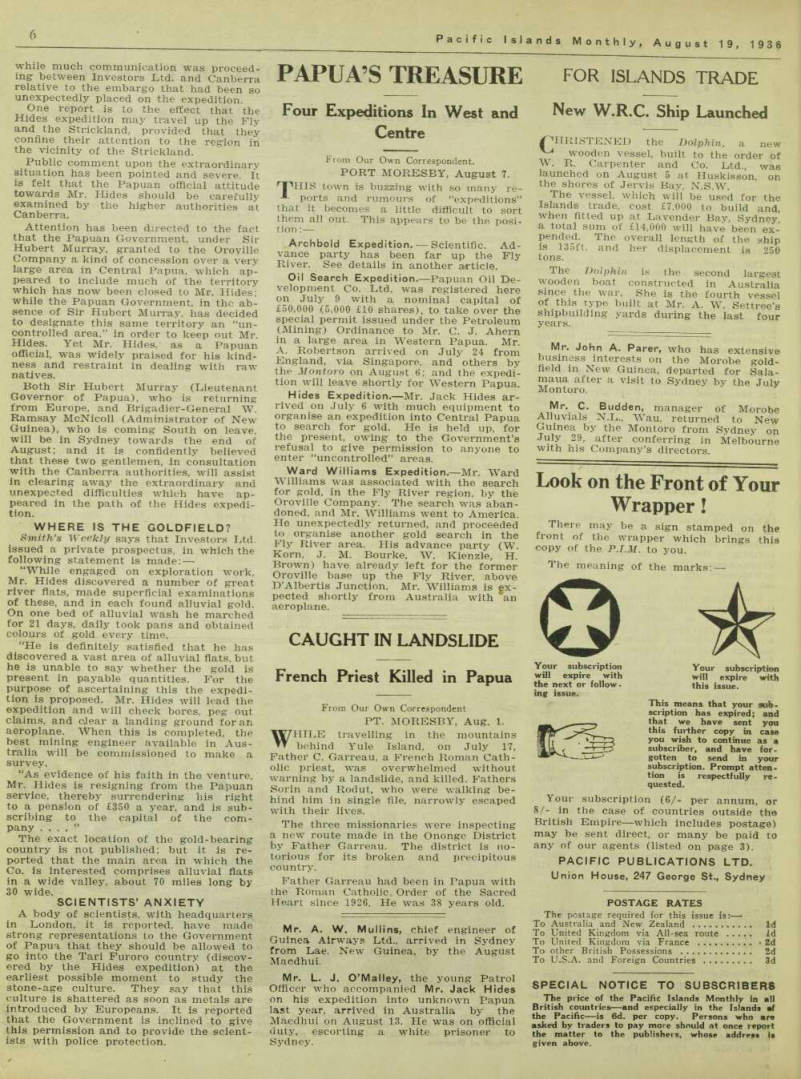
Two Japanese sampans captured in July while gathering trochus shell off the coast of New Cale donia were the subject of Court proceedings at Noumea on August 1. The captains were fined £60 each, and the vessels, fishing gear, and shell were confiscated by order of the Court. The Japanese have appealed to the Higher Court. The photograph shows one of the Japanese sampans tied up at the wharf at Noumea.
Photo: Marcel Medard
while much communication was proceed ing between Investors Ltd. and Canberra relative to the embargo that had been so unexpectedly placed on the expedition.
One report is to the effect that the Hides expedition may travel up the Fly and the Strickland, provided that they confine their attention to the region in the vicinity of the Strickland.
Public comment upon the extraordinary situation has been pointed and severe. It is felt that the Papuan official attitude towards Mr. Hides should be carefully examined by the higher authorities at Canberra.
Attention has been directed to the fact that the Papuan Government, under Sir Hubert Murray, granted to the Oroville Company a kind of concession over a very large area in Central Papua, which ap peared to include much of the territory which has now been closed to Mr. Hides; while the Papuan Government, in the ab sence of Sir Hubert Murray, has decided to designate this same territory an “un controlled area.” in order to keep out Mr.
Hides. Yet Mr. Hides, as a Papuan official, was widely praised for his kind ness and restraint in dealing with raw' natives.
Both Sir Hubert Murray (Lieutenant Governor of Papua), w r ho is returning from Europe, and Brigadier-General W, Ramsay McNicoll (Administrator of New' Guinea), who is coming South on leave, will be in Sydney towards the end of August; and it is confidently believed that these two gentlemen, in consultation with the Canberra authorities, will assist in clearing away the extraordinary and unexpected difficulties which have ap peared in the path of the Hides expedi tion.
Where Is The Goldfield?
Smith’s Weekly says that Investors Ltd. issued a private prospectus, in which the following statement is made: “While engaged on exploration w r ork.
Mr. Hides discovered a number of great river flats, made superficial examinations of these, and in each found alluvial gold.
On one bed of alluvial w*ash he marched for 21 days, daily took pans and obtained colours of gold every time.
“He is definitely satisfied that he has discovered a vast area of alluvial flats, but he is unable to say whether the gold is present in payable quantities. For the purpose of ascertaining this the expedi tion is proposed. Mr. Hides will lead the expedition and will check bores, peg out claims, and clear a landing ground for an aeroplane. When this is completed, the best mining engineer available in Aus tralia will be commissioned to make a survey.
“As evidence of his faith in the venture, Mr. Hides is resigning from the Papuan service, thereby surrendering his right to a pension of £350 a year, and is sub scribing to the capital of the com pany . . . . ”
The exact location of the gold-bearing country is not published; but it is re ported that the main area in which the Co. is interested comprises alluvial flats in a wide valley, about 70 miles long by 30 wide.
Scientists’ Anxiety
A body of scientists, with headquarters in London, it is reported, have made strong representations to the Government of Papua that they should be allowed to go into the Tari Furoro country (discov ered by the Hides expedition) at the earliest possible moment to study the stone-age culture. They say that this culture is shattered as soon as metals are introduced by Europeans. It is reported that the Government is inclined to give this permission and to provide the scient ists with police protection.