Home-Made Machine Grater
pp. 64-65 · Read in the full issue

By H.C.R. (Samoa)
A PRACTICAL and efficient machine- T*- grater for the rapid grating or rasp ing of coconuts, and all starch-bearing tubers, or for the purpose of making arrowroot or starch, can be inexpensively made at home by any one handy with tools. It has a self-feeding hopper, with hand power, and it is capable of dealing with about 6001 b. of Cassava-roots (Manioca), Pia, Canna-edulis, Sweet potatoes and Yams. Tubers, such as the Maranta-arundinacea are quickly rasped to a pulp in a cleanly and rapid manner.
Coconuts for the feeding of poultry and hogs or other stock, may be grated with the minimum of labour.
The designs given here are drawn from the specification of a self-feeding machine-grater, built and used by the writer, who has grown and processed the various starch and arrowroot bearing tubers; and they should enable the small
holder, the planter, the poultry-keeper, or the various farms and missions to save time and labour, and avoid the painful “skinned knuckles” usually resulting from the old-fashioned tin hand-graters com monly used.
For the purpose of making arrowroot for home use, the starch for laundry, or other purposes, the machine-grater will prove invaluable; while, in case of the preparation of cassava-meal for bread or cakes, the machine will save time, labour and trouble.
Needless to say, all tubers need to be clean, washed, and peeled before they are placed in the grater. Large tubers should be cut up into sections. Clean peeling is essential when the resulting arrowroot or starch is to be used for some household purpose.
Some of the starches will “deposit” in a few minutes—canna-edulis, for one. Other
tuber-starches may take several hours to settle or deposit. In order that the wheel grater may be free from “clogging” during the grating process, a small container holding sufficient water to moisten the grated mass is provided. This prevents the pulp adhering to the grater.
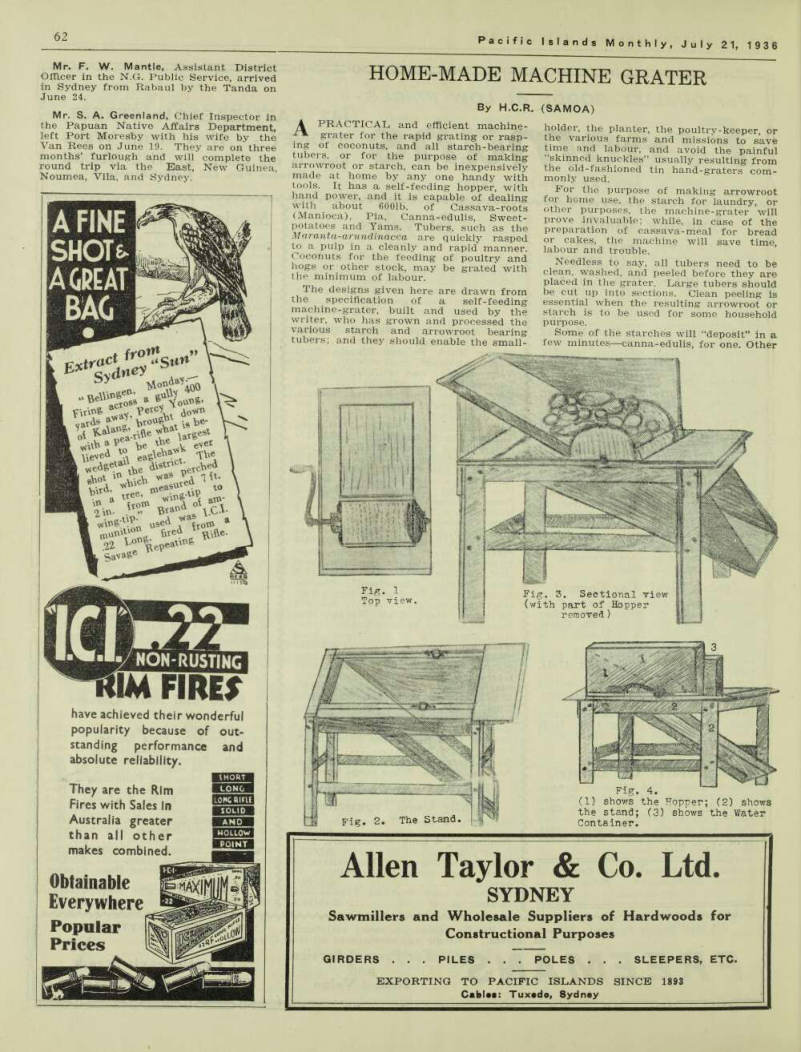
Illustration No. 1 gives some idea of the machine ready for use, seen as one looks down upon it.
How To Build The Grater
The machine consists of a “stand,” height 2ft. €in.; length, 3ft. 6in.; width, 2ft. This is merely a table with four legs, upon which is mounted the hopper-box.
Inside the hopper-box is fitted a piece of wood; at an angle which allows the cut-up tubers to slide down by their own weight on to a re volving metal grater. The grater may be made by punching holes closely together, all over a sheet of tin, such as a flattened-out benzine tin. The holes can be punched out with a stout nail by laying the tin over a piece of soft wood, and using a hammer.
For the grater, a piece of suitable wood is needed —a section of .an old mangle-roller would do; but the job is best done by having a small log turned down to suitable size, say 12 inches by 8 inches, and a hole bored through the centre to take a rod or spindle, to which is fitted a wheel, such as an old mangle wheel (or one cut from a tree-trunk).
A metal wheel is best, of any suitable size and not too heavy. The metal is tacked or nailed on to the roller with 1-inch nails, and can be renewed in time, when worn.
The grater revolves, and should be mounted in metal bearings (see Fig. 1).
The hopper may be simply a box of suitable size to cover the grater. In the case of a grater of less than 9| inches in width, a benzine-case will make a suitable hopper. But with a grater of larger dimensions, the hopper of suitable size can be adapted from a box or packing case.
Where it is difficult to obtain or turn a piece of wood suitable for the grater, it is advisable to construct a roller by nailing battens of 1| inches in width, closely together, on two round sections of circular wood to form the roller upon which the punched-tin grater is to be fitted.
The dotted line inside the hopper indicates the position of the board which conveys the tubers to the grater-wheel, and the size of the hopper should be in accordance with your requirements.
Where it is desired to rasp or grate coconuts, the machine will need to be of sturdy construc tion, well-braced, and bolted together with carriage-bolts and screws. The nuts must be halved; and care should be taken to prevent the “shells” getting ihto contact with the metal grater, or damage will ensue.
If a regular dripping of water can be maintained, so as to fall on to the revolving grater, so much the better. But this is not absolutely necessary, as a little water can be applied occasionally, during the grating process, by the worker.
The revolving grater is bolted down to the stand as shown; and the hopper-box fits as a separate unit, and may be secured to the stand by means of either a couple of small screws or by buttons.
This allows for washing or cleaning of the hopper box, and grater, at any time.
The diagrams illustrate the needful parts and fittings of the machine.