“Good Old Days” In The Louisiades
pp. 54-57 · Read in the full issue
When the Price of Trading In Eastern Papua was Adventure, Treachery, and Murder
By Molde Lett
OVER 60 years ago traders were attracted to the Louisiades (Papua) and the S.E. coast of New Guinea by wild tales of adventure and rich rewards gained from beche-de-mer and pearl-shell fishing.
The gold-tipped pearl-shell oyster, worth £2OO a ton, and a superior variety of beche-de-mer, were said to exist in considerable quantities along the coral beds that sketched from far-away Rossel Island to the mainland. And these men in schooners and cutters from Queensland fished the beds from the Engineer Group to the Calvados, and further south, to Sud Est and Rossel; threading their way through the intricate passages which separate one reef from another.
The enterprise provided plenty of ex citement, for not only did the islanders practise headhunting and cannibalism, but they fiercely resented interference from outside. Any newcomer was re
garded as an enemy and worthy of death.
Further, they were disturbed by the “blackbirding” traffic that had been con ducted in their islands for a number of years. The best of their manhood had
been carried away, never to return, and their resentment showed itself in con tinued acts of violence and treachery. For their custom required a white man’s skull, or compensation, for each of their lost friends, so that their spirits might return in peace to their original haunts. Many an unsuspecting trader met his dea k h. in accordance with this custom.
The natives, like many of the tribes of Malay and Borneo Dyaks of that time regarded the heads of those slain in raids as their most cherished possessions.
Bleaching them to ivory whiteness in ant hills, they placed them in prominent posi tions in their households, as trophies of prowess. As custom demanded the heads of enemy tribesmen, headhunting was one of their chief occupations.
It was said that a great fighting chief of the Engineer Group, named Yawar roopoo, made annual raids for this pur pose, in which he depopulated whole islands; and, after torturing his victims, he saw them eaten in ceremonial feasts.
He and his fighting men were more feared in the Louisiades than were the Tugeri in Western New Guinea.
One trader, Nicolas Minister, was for tunate to become friendly with Yawar roopoo and as a patron he was valuable.
But it was with misgiving that Nicolas accepted his hospitality later on, for near the “guest house” lay a collection of bones. Not wishing to add to their num ber, Nicolas weighed anchor and departed without ceremony.
It appeared that the Brooker Islanders were more treacherous towards the traders than others, and the reason given
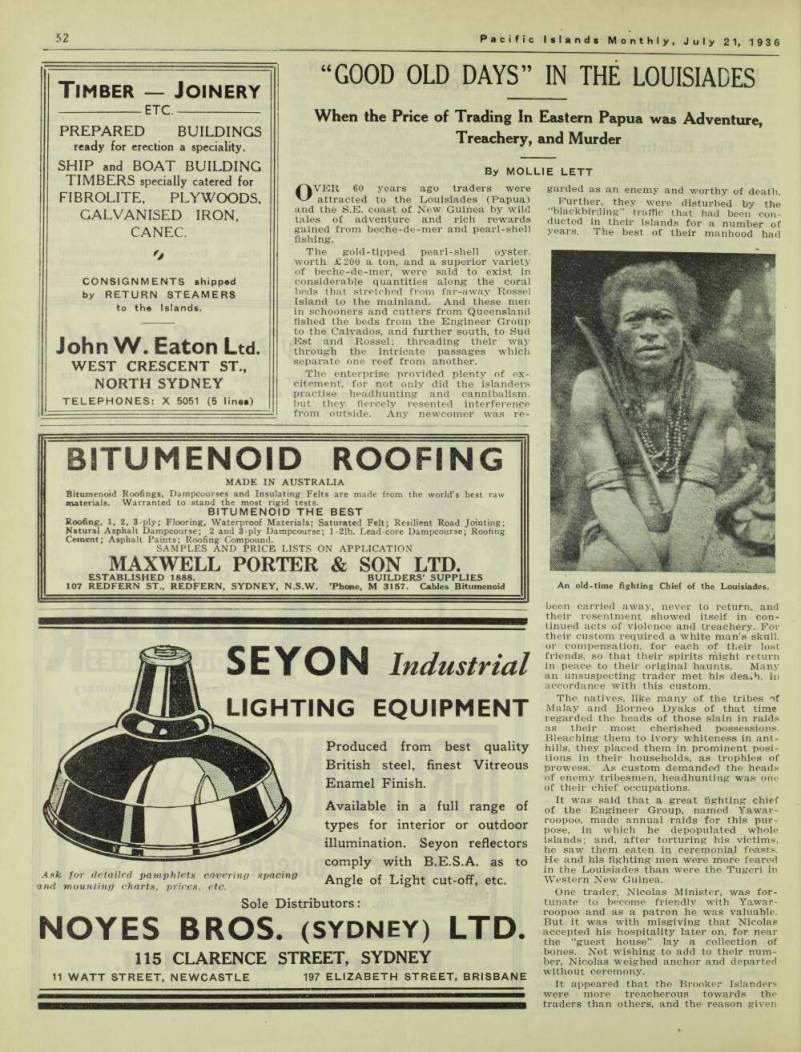
An old-time fighting Chief of the Louisiades.
was that they had inter-married at one time with a number of Solomon Islanders, who had murdered their European employers while fishing near Brooker. , „ , .
In 1880 they massacred Captain Forman and five Europeans of the Annie Brooks, stabbing them with the kmves they had unsuspectingly provided. The only survivor, the cook, held them at bay and weighed anchor but, not understanding navigation, he ran the Annie Brooks ashore and a Solomon Islander, pretending to assist him, tipped him overboard and shot him with his own rifle.
These murders increased and by 1885
they became a commonplace. Those of William Read, Frank Gerret, Captam Webb, and Miller followed one upon another in quick succession, and the posi tion became so serious that warships were sent the i s i an( j s most seriously con cerne(j. The Special Commissioner (Sir p e ter Scratchley) issued a caution to all traders that certain districts, including the Louisiades, were unsafe for their schooners. It appeared that he was hos tije to traders, and was inclined to take v j ew G f the missionaries who attri buted these murders entirely to traders’ violation of native rights.
The traders bitterly resented the impli
cation and demanded protection. They complained of the missionaries’ attitude, and attributed the open hostility to the lack of reprisals, stating that the warships did nothing to vindicate the murders of their fellow men, beyond destroying a few houses and coconuts, with the result that the natives became only more confident and insolent.
A well-known trader, Captain Fryer, happened to pass the wreck of the Annie Brooks a few days after the tragedy and the natives, jubilant over their recent acquisition of skulls, surrounded and attacked him. But Fryer was a man of great strength, subject to strange fits when unduly excited, and in a muscular frenzy he seized the foremost by his ankles and using him as a club, dispersed the mob with his human weapon.
Captain Fryer was a famous character in the Pacific. There were few Islands, from New Guinea to Peru, that he had not visited, either for pleasure or profit.
In his early years he had served in the Mexican wars and later taken service under King George of Tonga, sailing his private yacht to Fiji and Samoa.
He and the famous Nicolas Minister were friends. Both sea rovers and adven turers. they found the Louisiades a free field in which to impose their will, and to exercise their wild spirits without re straint. But the natives respected them.
Fryer went fully armed and, when refer ring to the numerous massacres that were taking place around him, expressed regret
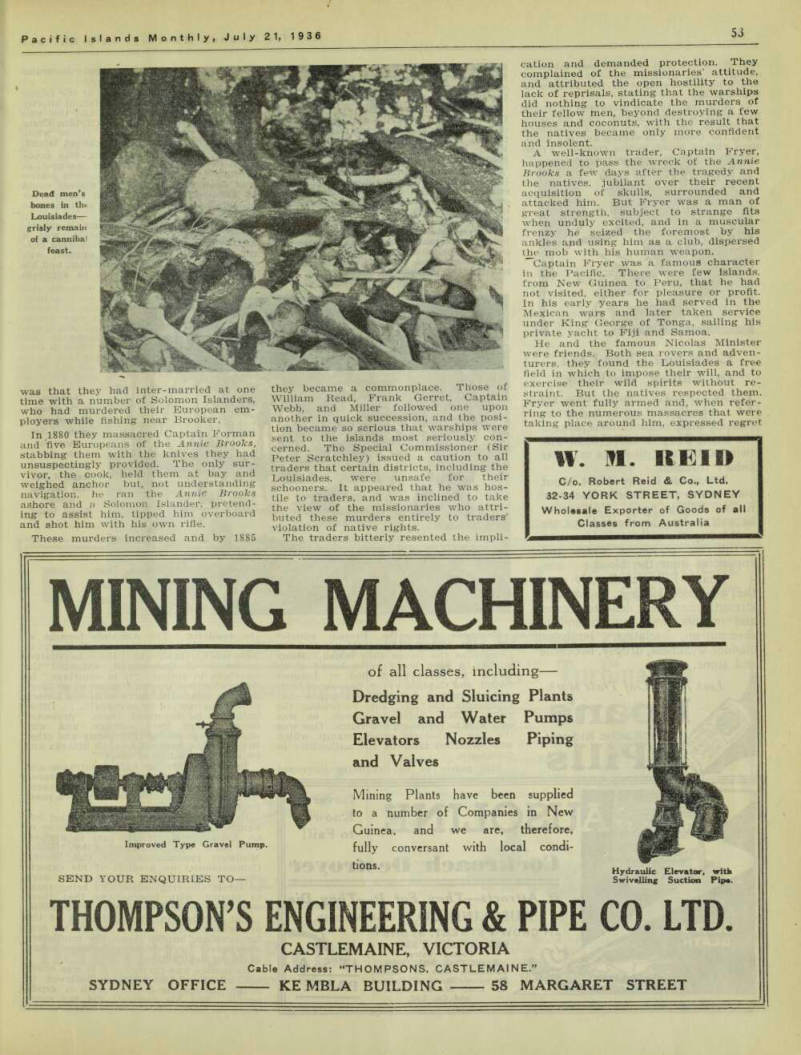
Dead men’s bones in the Louisiades — grisly remain of a cannibal feast.
that the white men had “all been taken so cheaply.” He little dreamed that he him self was to be caught in the same way before long!
In July, 1885, he was murdered off Hoop Iron Bay, Moresby Island, and his skull was given up later to H.M.S. Diamond when the island was visited and the prin cipal village burnt to the ground. Fryer
had been taken off his guard. Sending his boat’s crew ashore he allowed natives on board with coconuts and produce—and the old scene was re-enacted.
The Lalla Rookh, later, lay alongside the wharf in Townsville and, in the words of an eye-witness, “bore terrible testimony to the struggle that had taken place."
Fryer had deajt some execution before being finally overwhelmed by numbers.
It was said, at the time, that Fryer’s life was taken in accordance with native custom —that two natives had died in his employ without their relatives receiving compensation—but this was disputed.
Fryer was punctilious in his payments for “deaders,” as he called them, his payments being two tomahawks, two clay pipes and i lb. of tobacco for each native who died in his service—a payment that evidently had become established by custom.
Escapees from the French convict prisons in New Caledonia did not find the Louisiades the haven they hoped. Many landed in open boats to be heard of no more. In 1883 two landed at Joannet Island, and Captain Fryer, hearing of their arrival, rushed to their assistance—but apparently too late, for, surprising the guilty village before daybreak, he was only able to recover a few relics. One was the New Caledonia prison stamp, which was identified later the authorities in Cooktown.
The power of the vendetta increased
beyond bounds in 1886 and Australia became seriously alarmed.
Six Chinamen in the Pride of the Logan were murdered oft Moresby Island shortly after Captain Fryer’s death, and this was followed by the murder of Captain Craig and his crew of the Emily (three white men and five Malays) off Joannet Island.
Later, a murderous attack was made upon Captain Marx of H.M.S. Swinger, at Misima. It appeared that unless justice was dealt out swiftly, the natives could be excused if they regarded the murder of unoffending white men as legitimate sport.
Captain Craig, besides being an experi enced traveller in the Pacific, was a wealthy pearl-seller and a respected citi zen of Cooktown. Public opinion was aroused over his revolting murder, and his friends demanded measures to suppress
the vendetta. The demands became so insistent that Sir Arthur Palmer, in November, 1886, in the Legislative Assembly of Queensland, exhorted the members to action. “It is notorious,” he declared, “that the very name of an Eng lishman seemed to carry with it a licence to be tomahawked by savages! . . , Other nations,” he informed them, “protected their traders from outrage, and why should, the people of this colony and other Britishers be exposed to such attacks and no notice be taken of them?”
Th e apologists for native outrages and the exponents of club law were silenced at last. It was mainly due to their repre poneVsoVil. pums men a eenpost Early in 1887 a punitive expedition left Samarai for Joannet Island, consisting of an Assistant Magistrate and 45 natives.
Minister, recommended to the Special Commissioner on account of his experi ence and knowledge. Their orders were to justice, with^ instructions that there But Nicolas, in the excitement of the proceedings, took charge and, in his zeal for reve nge, hunted down the murderers mercilessly in their own fastnesses and So j ust i ce was carried out. It was crude but effective, for Minister believed in rough justice in dealing with a crude people. But his methods did not com mend themselves to the high ethics of the
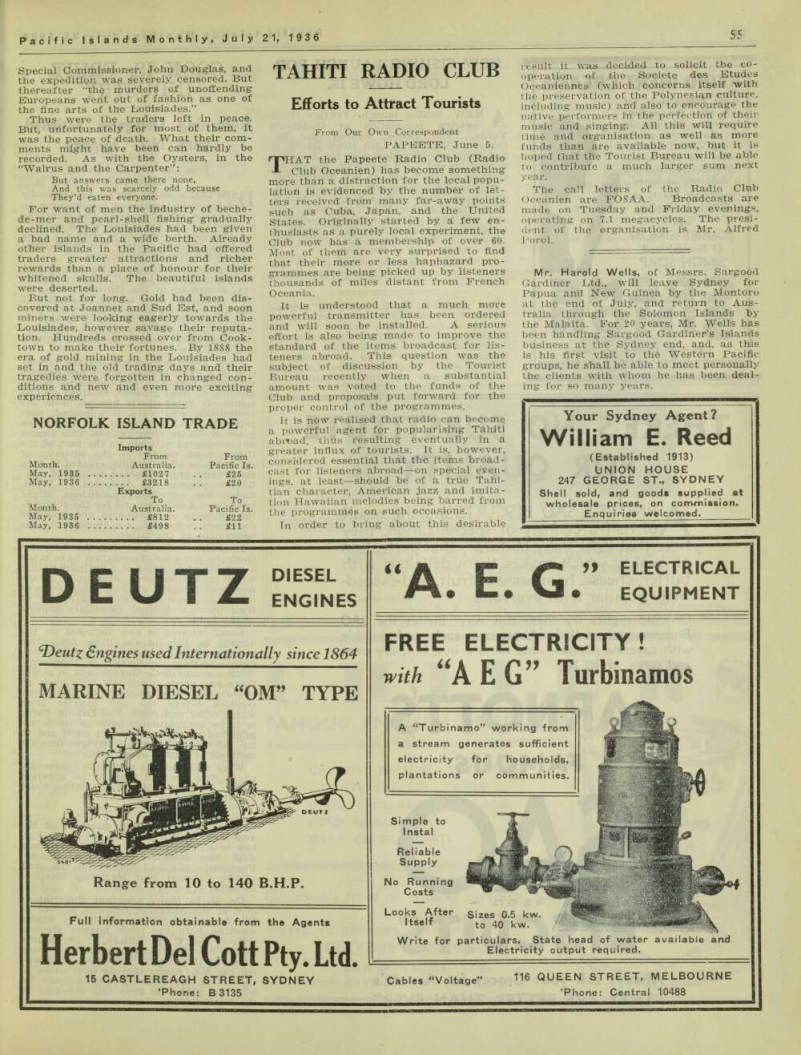
“Jabbega,” or “a sitting down place"— made of flat stones in circular formation— scene of old time cannibal feasts, Rossel Island.
Special Commissioner, John Douglas, and the expedition was severely censored. But thereafter “the murders of unoffending Europeans went out of fashion as one of the fine arts of the Louisiades.”
Thus were the traders left in peace.
But, unfortunately for most of them, it was the peace of death. What their com ments might have been can hardly be recorded. As with the Oysters, in the “Walrus and the Carpenter”: But answers came there none.
And this was scarcely odd because They’d eaten everyone.
For want of men the industry of beche de-mer and pearl-shell fishing gradually declined. The Louisiades had been given a bad name and a wide berth. Already other islands in the Pacific had offered traders greater attractions and richer rewards than a place of honour for their whitened skulls. The beautiful islands were deserted.
But not for long. Gold had been dis covered at Joannet and Sud Est, and soon miners were looking eagerly towards the Louisiades, however savage their reputa tion. Hundreds crossed over from Cook town to make their fortunes. By 1888 the era of gold mining in the Louisiades had set in and the old trading days and their tragedies were forgotten in changed con ditions and new and even more exciting experiences.