The Marsters Family
pp. 27-29 · Read in the full issue
Memories of Four Days Among the Palmerston Islanders at Suwarrow
By Dwight Long
IT took five days to sail my 32-foot ketch Idle Hour from Penrhyn to Suwarrow atoll. Before leaving Penrhyn, Philip Woonton, the Resident Agent, told us that 19 Palmerston Islanders were stationed at Suwarrow making copra for A. B. Donald Limited, of New Zealand. They were the first inhabitants to live for any length of time on the island since 1905.
We anchored in the lee of the largest motu. Soon canoes put off to greet us.
To my surprise out of the 19 people only three were men. All the rest were women and children, the families of these men.
They explained that the Company they were employed by would not let any man come without his family, because several years ago when a party of men were sent to make copra, some came with their wives and some without. As at Pitcairn Island, only on a smaller scale, trouble soon developed. Three white men were strung up on the high coconut trees by the native labourers.
All the people at Suwarrow are from one family, the Marsters family of Pal merston Island. About 150 years ago Marsters, an Englishman working for a half-caste who owned Palmerston, planted the entire island with coconuts, following the orders of his employer who took a trip to Tahiti. Upon his return after three years he was unable to pay Marsters for all the work, and Marsters was given the island.
The Englishman married three Poly nesian women, and started three families. tbpn. ereneration after generation
has married and intermarried with no outside blood being introduced. New Zealand has a protectorate over the island as it is in the Cook Group. She has kept the motu under strict isolation, observing this unique family as an experiment, and apparently the intermarriage has not de generated the descendants to any marked degree. Recently a hurricane swept all
the coconuts off their isle of Palmerston, and the Cook Administration had to move many of the Marsters away to other islands in the group where food was plentiful.
As they talked, the 19 Palmerston Islanders at Suwarrow used many old English phrases of the Elizabethan Age.
Mr. William Marsters, the father of this enormous family, with over 200 descendants all intermarried, strictly taught his wives English, and no native tongue is spoken. To hear little Poly nesian children talking English was
unique. Never before had I heard native children talk good English!
Timi (my Tahitian companion) and I were introduced to the wives and children of Tom, Thomas and Ned Marsters. The family call one Tom and another Thomas to distinguish between them. Mrs. Tom Marsters said, “We are very glad you have come to pay us a visit.’’ A sentence in perfect English was a novelty, for all the natives I had met to date, even in Hawaii, talked pidgin-English, using short, broken phrases, like: “No good,” “Me go get knife,” “You like go eat here,” etc.
Thomas Marsters invited me to go sail ing with him in his 18ft. canoe, gathering bird eggs. The sail and the mast were tied up tightly before we started out, and unless the canoe was brought into shallow water so we could get out and unfasten the various lashings it was impossible to lower the sail.
We had sailed halfway across the lagoon when suddenly the outrigger broke away. This was the worst thing that could happen to a canoe, much less a sail ing canoe with all the sails tied fast. We tried to attract the attention of the one and only other canoe at Suwarrow, half a mile in our lee. Finally with frantic gestures that almost upset out craft we got their attention. The wind freshed, and the waves became higher and higher as the trades swept across the lagoon. My
two native companions balanced the canoe while I busied myself bailing with half a coconut shell.
Sharks! Soon fins were showing up on the surface all around the canoe. As a monster darted under our tiny craft, Tom had to pull in his hand that was bracing
the strut which formerly held the out rigger. Two of his toes and a portion of his foot were missing from a previous experience. A shark hit the side of our canoe, and almost turned us over. They must have sensed our predicament for they surrounded us, and between scoops I counted over a dozen.
Gradually the other canoe gained on us as the winds temporarily weakened. As it came alongside one shark almost got sandwiched in between the two frail dug outs. Thomas got the canoes lashed together, and the immediate danger was
over. As I continued bailing I looked at the Idle Hour with longing eyes, and never cared whether I saw any birds or eggs, ever.
However, next day we started off again for a motu across the lagoon and this time I made sure the outrigger’s fasten ings were secure before we set sail.
Reaching the distant motu we found booby birds, frigate birds, and man-of war birds nesting everywhere, some on the ground and others in low branches. I was amazed how easy it was to get the birds. Not a shot had to be fired; one
merely picked the young birds out of their nests. The smaller birds were not taken, only those almost ready to fly. The frigates had a wing spread of six feet, but could not fly. We would grab the booby birds quickly behind the head, and then string them on a reed of coconut fibre, tieing them by their bills.
Often as we approached, the young birds nesting would throw up fish they had just been fed on. Some threw up five or six fish that had not yet been disintegrated, and these were gathered up and carried in a banana leaf. One booby bird threw up eleven fish, but only six were good enough to keep—the rest had almost been digested. The fish were warm and tasted half cooked. I had never eaten fish cooked this way before, but they were delicious.
After we had collected 146 birds, our friends climbed the trees and gathered about a hundred coconuts. With our booty we sailed back and had a real feast.
The birds were not all killed as the meat would spoil. While in captivity each bird was refed one of the fish it had thrown up while being captured.
That evening following supper, all the family joined in singing hymns in Eng lish. Many I recognised, such as “Onward Christian Soldiers,” “Hark the Herald Angels Sing” and “Holy, Holy, Holy.” It was good to hear them, but it seemed so strange to listen to natives on a remote atoll in the South Seas singing them just as we do in the States.
Sunday we went to church, held in the house where all the natives live. Here the Palmerston Islanders praised God and were thankful for the little bit they had.
Their own island had been hit the worst of any motu in the entire Pacific in 1927 and again in 1934. All the new coconut trees planted in 1928 and 1929 were
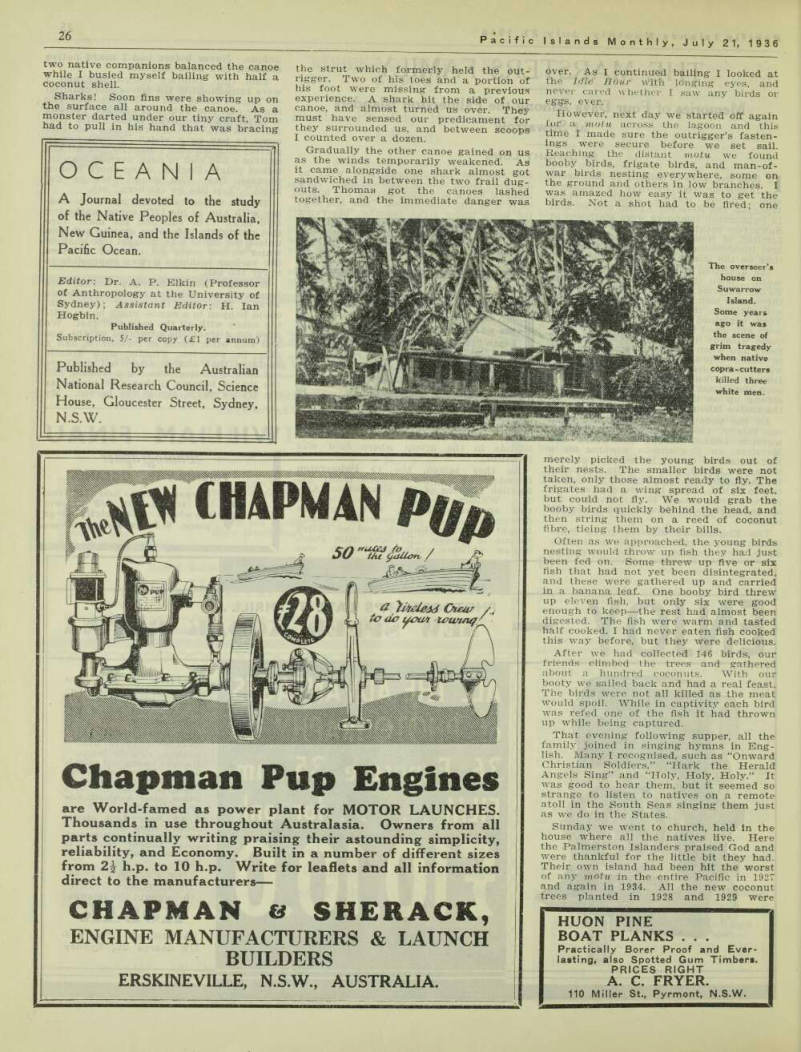
The overseer’s house on Suwarrow Island.
Some years ago it was the scene of grim tragedy when native copra-cutters killed three white men.
washed out to sea as the hurricane swept over the inotu. Their houses and copra sheds vanished and the Islanders clung to coconut trees on the “Hill.” a 20-ft. sand mound, the highest land on their island.
Fortunately, or maybe unfortunately, only two were drowned.
A trading schooner calls at Palmerston once a year. After the seas had swept the island the poor people were without sufficient food for over three months until a schooner arrived with supplies. The Marsters community we visited at Suwar row had been removed from Palmerston about the same time as three other groups were taken to Penrhyn, Manihiki and Mauni —isles where the hurricane had not devastated the entire mytus. William Marsters, the son of the original Marsters, is now over 80 years old, and is still living with 60-odd members of his family on Palmerston. The Cook Island Govern ment has furnished them with food and sent along new coconut shoots so that they can replant the island.
After four days of unforgettable experi ences on Suwarrow Island we returned aboard the Idle Hour. Our calendar told us the sad story that we must up anchor and be on our way lest we be caught in the paths of oncoming hurricanes. We had become attached to this unique family and really regretted our departure as we bid farewell to the Palmerston Islanders, and sailed away from Suwarrow.