How “Granny” Sits On Samoa’S Head
pp. 11-12 · Read in the full issue
Lack of Transport, Plus Liquor Regulations, Have Made Tourist Traffic Impossible
By R. W. Robson
STOLID, unimaginative, well-intentioned New Zealand sits like a hroad-hottomed grandmother upon the head of gay and temperamental Samoa; and the resulting picture, while very funny, is a tragedy in administration.
Samoa kicks and screams; hut the only effect is that the dear old Presbyterian lady purses her mouth grimly, and settles herself more firmly in her corrective seat.
Samoa must either be good, or be smothered.
'VT OWHERE in the South Seas is there a place more colourful and charming than this island of Upolu. I am looking out, now, over the bay of Apia, and the
sheer beauty of it takes away my breath.
And, so far as the Pacific Islands are con cerned, I am “hard-boiled”.
Between the blue sea and the dark-blue mountains there is a variety of glowing colours that beggars description—green and sparkling lagoon, white coral beach, feathery palm-trees, picturesque brown native houses, a riot of gorgeous flowers; a clean-skinned, merry, laughing people; languorous scents and a profusion of tropical fruits —a tourists’ paradise.
But when a tourist arrives here, hav ing survived incredible difficulties of transportation, “Granny” either dances on his neck or kicks him in the pants.
For years, people have reached this Islands paradise through a transportation purgatory. The only way to get directly to Samoa is to travel from Wellington by the Maui Pomare, or be sworn in at Auck land or Suva as second assistant cabin boy on an occasional freighter. The other way is to go by Matson liner to Pago; and then spend twelve seasick, sun burned hours on a tiny launch, between Pago and Apia.
As for the Maui Pomare, she is about 1,100 tons, and can carry 22 passengers (with the aid of a shoe-horn and the in
genuity of a sardine-packer); and she is staffed by the cheeriest officers and most attentive stewards in the South Seas. But old Father Neptune was annoyed at the moment of her launching; and, ever since then, whenever she puts to sea, he pro duces the dirtiest weather in his reper toire. j n th e cabin next to mine there was a W oman tourist. I knew she was there be cause of the sounds of resigned regurgita tion which reached me from the time the Pomare left Wellington, and began to buck the steep, Antarctic rollers. There was no complaint, until we were off the Kermadecs. Then I heard a feeble, bitter
voice: “My God, to think that I paid money for this!”
The Maui Pomare, being only a little ship, does everything in a choppy sea ex cept bite her own tail; and the reactions which she can produce in a normal stomach deserve the pen of a Milton. If ever I travel on the Maui Pomare again it will be because I am curious to know whether the little ship can do again to my internal economy the extraordinary things she achieved in that bitter weather off the coast of New Zealand.
Tourists do travel on the Maui Pomare; but they seem to be mostly hard-bitten Scots from Dunedin way, who can appre ciate the “round trip reduction”, and for whose cast-iron, porridge-built interiors seasickness has no terrors.
Samoa deserves more than half a dozen Scottish tourists per three weeks. If these beautiful islands were in the hands of any country capable of understanding and catering for the pleasure-loving section of mankind, hundreds of travellers every month would be spending thousands of pounds here in making firsthand ac quaintance with the beauty and fascina tion of Samoa.
As it is, “Granny” seems deliberately to
put every obstacle in the way of the pleasure-seeker —doubtless on the hypo thesis that every pleasure-seeker is a potential sinner. When the Maui Pomare is in a quiet sea she is a jolly, comfort able, friendly little ship; and if she ran out of Auckland, northwards, much of the terror of the trip might be avoided.
But “Granny” resolutely sends her to Lyt telton and Wellington, which is the home of stormy weather; and the tourists cap able of tackling those seas in a little ship are not numerous.
The Matson Company might have been induced to drop a regular anchor in Apia roadstead, which would have brought into Samoa a flow of American dollars and Australian pounds. The Monterey and Mariposa already pass regularly within sight of this coast. But New Zealand did not encourage the idea —I do not know why.
The ferocious port charges which have ruled here for many years discourage any idea of shipping and tourist enter prise. When cruising liners like the Stella Polaris or Monowai come in here, packed with tourists eager to spend money in Samoa, “Granny” socks them with port charges in a manner that gives the managers heart failure. Although the port facilities are small —the ships anchor out in a roadstead sheltered by the natural reef, and there are lights at Apia and at four or five points along the coast —the charges are double those at Suva, where port facilities are considerable.
Last night, the freighter Limerick hung about all night out at sea —if she had come straight in, on arrival, and allowed her men an evening ashore, she would have been obliged to pay another £2O or so in port charges.
In the natural order of things, the transportation for Western Samoa would have been a job for the Union S.S. Co., v\ hich has innumerable interests in the South Seas. The Aorangi and Niagara pass within sight of the Upolu coast, every three or four weeks; and one would have expected to see the big British shipping concern, and the New Zealand Government co-operating in building up a tourist traffic for Samoa. But, for some reason that no one seems to know, the two institutions do not play in each other’s backyard. The Government runs its little Maui Pomare as a State enter prise, and the Union Co. sends an oc casional freighter into Samoan waters.
This is about to be altered. The Union Company’s fine new motor-vessel Matua is about to take up a new itinerary that will link the Fijian, Samoan, Tongan, and Cook Island ports with Auckland; and Samoa, for the first time for many years, thus will escape her crippling isolation.
BUT, if a profitable tourist industry is to be established in Samoa, “Granny” must be persuaded to relax her hold a little. The free-spending tourists de finitely do not like a “prohibition” com munity; and “Granny” long years ago, fastened upon helpless Samoa the most extraordinary liquor-control system I have seen.
“Granny” starts with the hypothesis that liquor is an evil, but may be necessary for medicinal purposes. Liquor, there fore, may not be regarded as a beverage or a pleasure; but, in order to ward off colds, colic, and snakebite, each Euro pean is entitled to two bottles of whisky per month.
So far, so good. But certain Europeans pointed out that they had trouble with their kidneys—could they not have gin?
“Granny” saw the point, and the rule be came “two bottles of whisky or gin.”
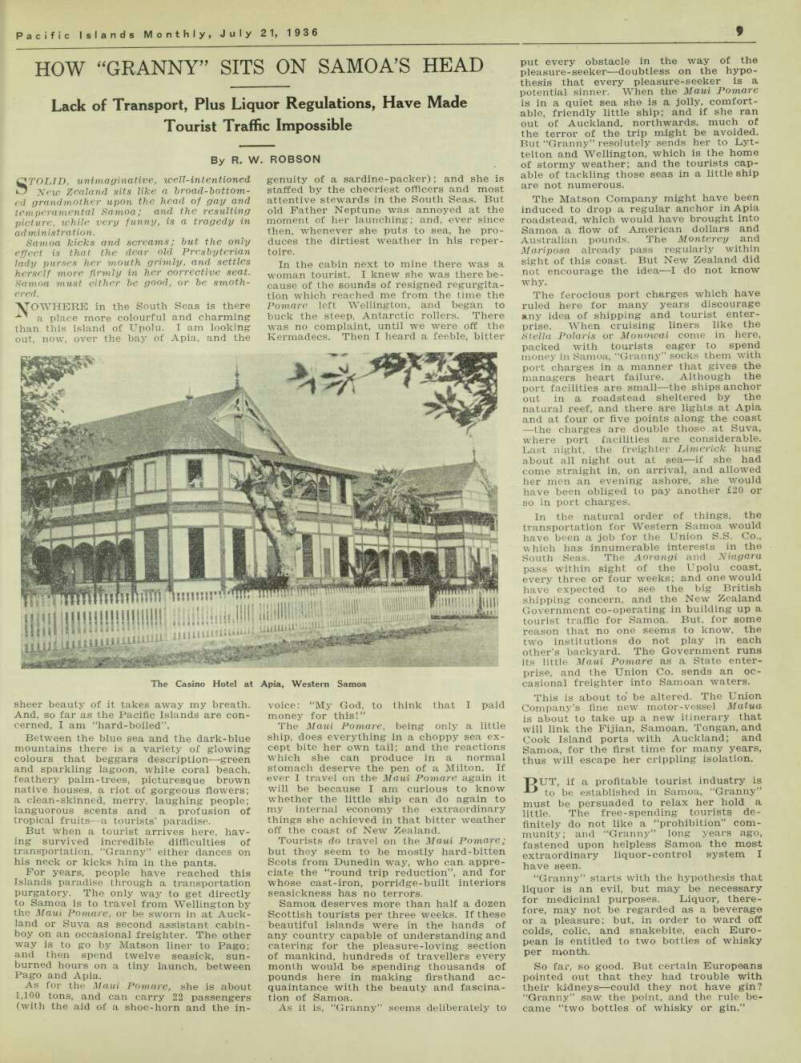
The Casino Hotel at Apia, Western Samoa
Certain pesky beach-dwellers still were not satisfied. They argued that as they could not drink whisky or gin, and as they found beer a nourishing food, they were entitled to beer instead of the dis tilled stuff. “Granny” rolled a very sus picious eye upon them, and sniffed disdainfully: but finally agreed that, if they wished, they could take it out in beer—three dozen of beer being regarded as the equivalent of two bottles of whisky or gin per month.
Some people like a good deal of liquor —others little. But all were entitled to the same quantity per head. The obvious thing was for the teetotallers to trade their liquor rights to the drinkers. But “Granny” saw to that. Every person who claimed monthly liquor rights had to go personally to the Customs-house and personally carry their bottles—there was to be no pooling of liquor rights through a centrally organised system.
And that, with some recent modifica tions, is the system which obtains to this day. The one hotel has no bar—one can purchase nothing stronger than lime juice. Because of the liquor disability, I presume, there is no club, except the un licensed German Concordia. The very hospitable European residents usually have liquor in their homes; but, because of the system under which they procure it, they produce it in a curious way—with a combination of pride, apology, and con spiracy.
The Europeans who, for medicinal reasons, obtain liquor from the Admini stration, have to pay for it at rates which return “Granny” a good margin of profit.
They have a limited choice of brands — “Granny” gives them what she thinks will be good for them. But she is a shrewd old lady. A N.Z. brewery fell into the hands of the Public Trustee; and the product of that brewery, a sour, offensive production, was sent to Samoa, to be doled out—as a medicinal necessity! until the harassed, thirst-wracked resi dents rebelled, and threatened to blow up the Customs-house.
I have been here a week, but I have not yet seen wine of any description.
A Dr. Cotterill—a rich man, with a good yacht—came here some time ago, with the intention of buying a home in this beauti ful tropical island. But when he found that he would have to plead with “Granny” to obtain two bottles of whisky or 36 bottles of beer per month, and undergo various similar humiliations, he departed for climes where a man’s private life is permitted to be his own affair.
The Casino Hotel was built by the Germans—a huge, attractively designed place, with large, airy rooms, balconies back and front, private flats—and set attractively amid palms, shrubberies and lawns. It easily could be made the social centre of Samoa, and a first-class, com fortable tourist resort. But it is three quarters empty—merely a home for a handful of public servants. Samoa resi dents seldom go there, because there is no liquor refreshment. Tourists cannot fill the place, because of “Granny.” If the Casino Hotel were functioning as it should, it would be distributing many thousands of pounds of tourist money annually in Samoa.
Nothing I have seen in Samoa seemed to throw greater ridicule upon the “Granny”
Government than this liquor system—a quaint survival of the Prohibition laws of New Zealand, which certain fanatics flogged to death a quarter-century ago.
There can be no worth-while tourist traffic in Samoa while such a system remains.
A TOP of all, there is the cost of living.
Samoa is compelled, by the stark facts of transportation, to buy much of her necessary goods from New Zealand.
New Zealand is not to any extent a manufacturing country, and herself im ports many of her requirements. These goods go on to Samoa, where they are subject to a flatfooted import duty of about 22§ per cent., and the iniquitous “port and service tax,” equal to about 5 per cent. Still, tourists would not worry unduly about that, if other facilities were adequate and reasonable. It is the resi dent of Samoa who takes it in the neck.
Many sweeping reforms are mooted — transport, port charges, liquor laws, etc., and perhaps it now is a little late to jeer at “Granny.” She has taken her job seriously in Samoa, and conscientiously has tried to do her very best for the Samoans. She has brought little joy into their lives, but medically she has cleaned them up in a truly marvellous way.
Judged from the point of view of per sonal hygiene, absence of skin diseases and general health, there are no cleaner and better-looking people in the Pacific: and they were not like that when New Zealand took charge of them 20 years ago.
And, if there had been no Maui Pomare, providing the Territory with a sound, three-weekly market for bananas in New Zealand, the Samoans would have had a thinner time than they did in the de pression years, when the bottom fell out of the copra and cocoa industries.
Many beach politicians in Samoa hope that, somehow, sometime, this Territory will get loose from New Zealand. I can not see it. For better or worse, until the status quo in the Pacific is completely destroyed, New Zealand and Samoa are joined. New Zealand, ultimately, may make Samoa a happy home for a model little lot of natives.
But I do wish that old “Granny” would get off the head of pretty little reckless Samoa, and encourage liveliness and some laughter, and give the profitable tourist trade a chance.