“Too Much Revenue!”
p. 66 · Read in the full issue
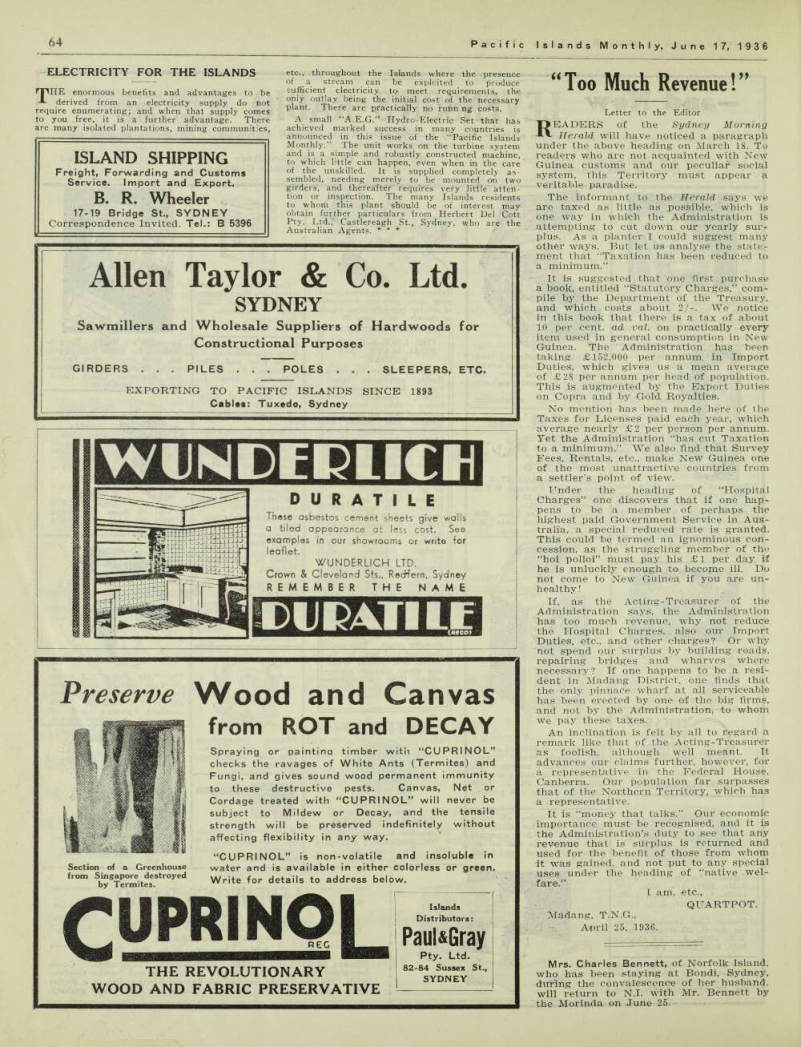
Letter to the Editor READERS of the Sydney Morning Herald will have noticed a paragraph under the above heading on March 18. To readers who are not acquainted with New Guinea customs and our peculiar social system, this Territory must appear a veritable paradise.
The informant to the Herald says we are taxed as little as possible, which is one way in which the Administration is attempting to cut down our yearly sur plus. As a planter I could suggest many other ways. But let us analyse the state ment that “Taxation has been reduced to a minimum.”
It is suggested that one first purchase a book, entitled “Statutory Charges,” com pile by the Department of the Treasury, and which costs about 2/-. We notice in this book that there is a tax of about 10 per cent, ad val. on practically every item used in general consumption in New Guinea. The Administration has been taking £152,000 per annum in Import Duties, which gives us a mean average of £2B per annum per head of population.
This is augmented by the Export Duties on Copra and by Gold Royalties.
No mention has been made here of the Taxes for Licenses paid each year, which average nearly £2 per person per annum.
Yet the Administration “has cut Taxation to a minimum.” We also find that Survey Fees, Rentals, etc., make New Guinea one of the most unattractive countries from a settler’s point of view.
Under the heading of “Hospital Charges” one discovers that if one hap pens to be a member of perhaps the highest paid Government Service in Aus tralia, a special reduced rate is granted.
This could be termed an ignominous con cession, as the struggling member of the “hoi polloi” must pay his £1 per day if he is unluckly enough to become ill. Do not come to New Guinea if you are un healthy!
If. as the Acting-Treasurer of the Administration says, the Administration has too much revenue, why not reduce the Hospital Charges, also our Import Duties, etc., and other charges? Or why not spend our surplus by building roads, repairing bridges and wharves where necessary? If one happens to be a resi dent in Madang District, one finds that the only pinnace wharf at all serviceable has been erected by one of the big firms, and not by the Administration, to whom we pay these taxes.
An inclination is felt by all to regard a remark like that of the Acting-Treasurer as foolish, although well meant. It advances our claims further, however, for a representative in the Federal House, Canberra. Our population far surpasses that of the Northern Territory, which has a representative.
It is “money that talks.” Our economic importance must be recognised, and it is the Administration’s duty to see that any revenue that is surplus is returned and used for the benefit of those from whom it was gained, and not put to any special uses under the heading of “native wel fare.”
I am, etc..
Quartpot.
Madang, T.N.G..
April 25, 1936.
Mrs. Charles Bennett, of Norfolk Island, who has been staying at Bondi, Sydney, during the convalescence of her husband, will return to N.L with Mr. Bennett by the Morinda on June 25.