Lautoka's Town
pp. 54-55 · Read in the full issue
Services
An Appeal To Caesar
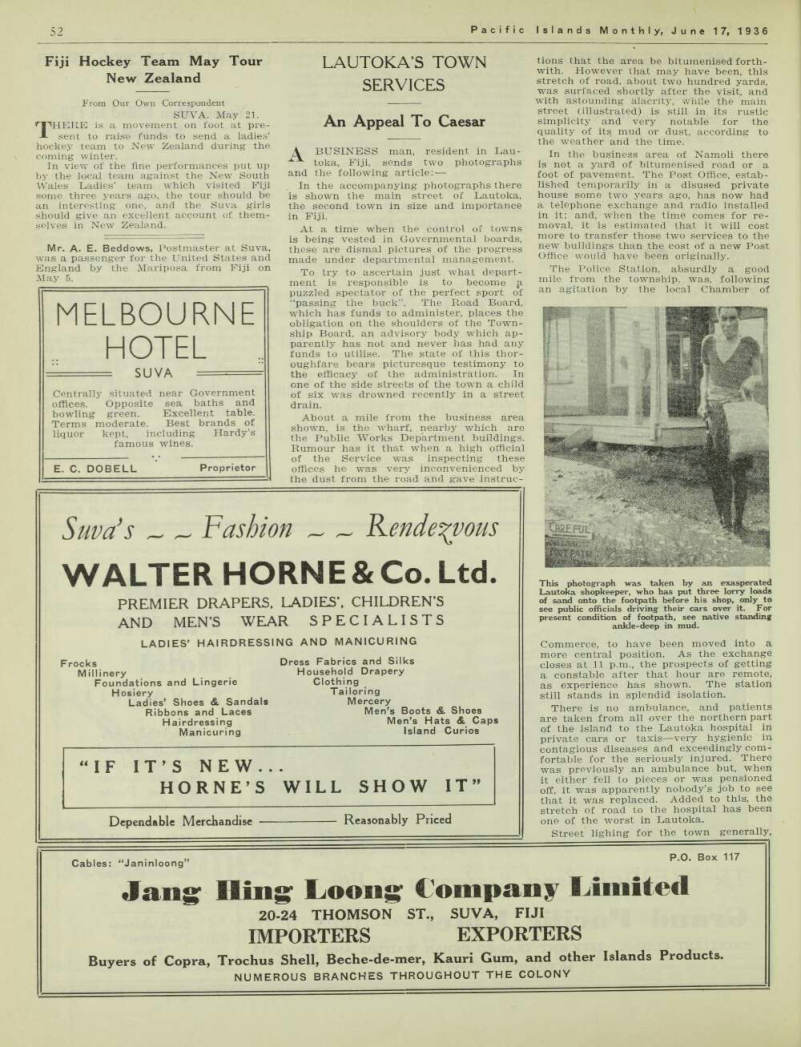
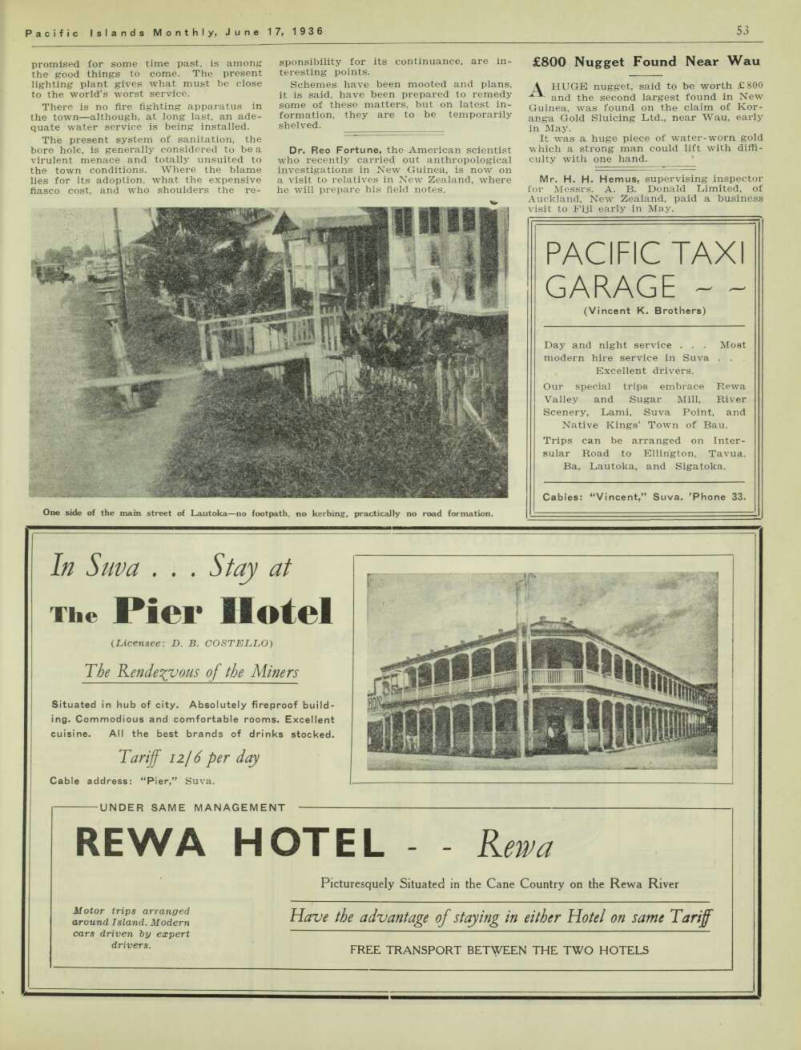
A BUSINESS man, resident in Lau toka, Fiji, sends two photographs and the following article: In the accompanying photographs there is shown the main street of Lautoka, the second town in size and importance in Fiji.
At a time when the control of towns is being vested in Governmental boards, these are dismal pictures of the progress made under departmental management.
To try to ascertain just what depart ment is responsible is to become gt puzzled spectator of the perfect sport o*f “passing the buck”. The Road Board, which has funds to administer, places the obligation on the shoulders of the Town ship Board, an advisory body which ap parently has not and never has had any funds to utilise. The state of this thor oughfare bears picturesque testimony to the efficacy of the administration. In one of the side streets of the town a child of six was drowned recently in a street drain.
About a mile from the business area shown, is the wharf, nearby which are the Public Works Department buildings.
Rumour has it that when a high official of the Service was inspecting these offices he was very inconvenienced by the dust from the road and gave instruc
tions that the area be bitumenised forth with. However that may have been, this stretch of road, about two hundred yards, was surfaced shortly after the visit, and with astounding alacrity, while the main street (illustrated) is still in its rustic simplicity and very notable for the quality of its mud or dust, according to the weather and the time.
In the business area of Namoli there is not a yard of bitumenised road or a foot of pavement. The Post Office, estab lished temporarily in a disused private house some two years ago, has now had a telephone exchange and radio installed in it; and, when the time comes for re moval, it is estimated that it will cost more to transfer those two services to the new buildings than the cost of a new Post Office would have been originally.
The Police Station, absurdly a good mile from the township, was, following an agitation by the local Chamber of
Commerce, to have been moved into a more central position. As the exchange closes at 11 p.m., the prospects of getting a constable after that hour are remote, as experience has shown. The station still stands in splendid isolation.
There is no ambulance, and patients are taken from all over the northern part of the island to the Lautoka hospital in private cars or taxis —very hygienic in contagious diseases and exceedingly com fortable for the seriously injured. There was previously an ambulance but, when it either fell to pieces or w'as pensioned off, it was apparently nobody’s job to see that it was replaced. Added to this, the stretch of road to the hospital has been one of the worst in Lautoka, Street lighing for the town generally,
This photograph was taken by an exasperated Lautoka shopkeeper, who has put three lorry loads of sand onto the footpath before his shop, only to see public officials driving their cars over it. For present condition of footpath, see native standing ankle-deep in mud.
promised for some time past, is among the good things to come. The present lighting plant gives what must be close to the world’s worst service.
There is no fire fighting apparatus in the town —although, at long last, an ade quate water service is being installed.
The present system of sanitation, the bore hole, is generally considered to be a virulent menace and totally unsuited to the town conditions. Where the blame lies for its adoption, what the expensive fiasco cost, and who shoulders the re
sponsibility for its continuance, are in teresting points.
Schemes have been mooted and plans, it is said, have been prepared to remedy some of these matters, but on latest in formation, they are to be temporarily shelved.
Dr. Reo Fortune, the American scientist who recently carried out anthropological investigations in New Guinea, is now on a visit to relatives in New Zealand, where he will prepare his field notes.
One side of the main street of Lautoka-no footpath, no kerbing, practically no road formation.