Still Seeking Cocos Treasure
pp. 35-38 · Read in the full issue
Activities Which Harass Costa Rica’s Navy
TT appears that the search for the Cocos Island treasure still goes on, and that the Central American republic of Costa Rica is still on the warpath.
The extraordinary and amusing story, up to that date, was told in the Pacific Islands Monthly of May, 1935.
An expedition organised by Treasure Recovery Limited, of Carlton House, Re gent St., London, sailed from London in the luxurious yacht, Queen of Scots, in September, 1934; and, with much expen sive equipment, landed upon Cocos Is land, in the Pacific Ocean, 550 miles south-west of Panama. Everything had been planned in lavish style, and the leaders were confident that they would find the pirates’ treasure, estimated at from £12,000,000 to £25,000,000, which had been buried there in the eighteenth century.
But one thing was forgotten—and it was vital. Everyone had assumed that Cocos Island was No-Man’s-Land, where as it is claimed as part of the empire of Costa Rica. On October 13, 1934, an armed force left Punta Arenas, in Costa Rica, and arrested the British expedition on Cocos Island, and confiscated all their equipment. The treasure-seekers, who had departed from home in a blaze of publicity (during which the shares of Treasure Recovery Ltd. were sold freely and profitably) returned disconsolately to London.
The expedition’s leader, Commander F.
A. Worsley, was not daunted. Early in 1535, he left London in the motor drifter Veracity, 45 tons, for Panama, Costa Rica and Cocos; and it was announced that the trouble with the Costa Rica Govern ment had been overcome, and that the expedition would be allowed to land on
Cocos and resume operations, on the understanding that Costa Rica would re ceive one third of any treasure recovered Nothing much was published about de velopments in 1935. It was reported that Costa Rica, “for the second time in two years,” had chased another British ex
pedition off the island; but this may have been the party of a Captain Bellamy, who in 1935 left Vancouver to make his second attempt to find the treasure. There seems, as a matter of fact, to have been four or five separate enterprises centred on the Cocos Island treasure; and the Costa Rican army and navy —reported to consist of 14 officers and 29 men—has had an exhausting year, protecting the trea sure isle from the rovers.
Upheaval In Treasure Co.
The search of Treasure Recovery Ltd. evidently did not prosper in 1935; be cause, towards the end of the year, a sec tion of dissatisfied shareholders called a meeting, threw out the old directorate, and appointed an entirely new board. A friend has sent us a copy of a circular issued to shareholders by the new board.
It is dated from Carlton House, Regent St., London, on January 21, 1936, and its careful phraseology is worth quoting in full: The Extraordinary General Meeting of Share holders, of which you received formal notice, was duly held at Central Hall, Westminster, S.W.I, on Thursday, December 19, 1935, and the Share
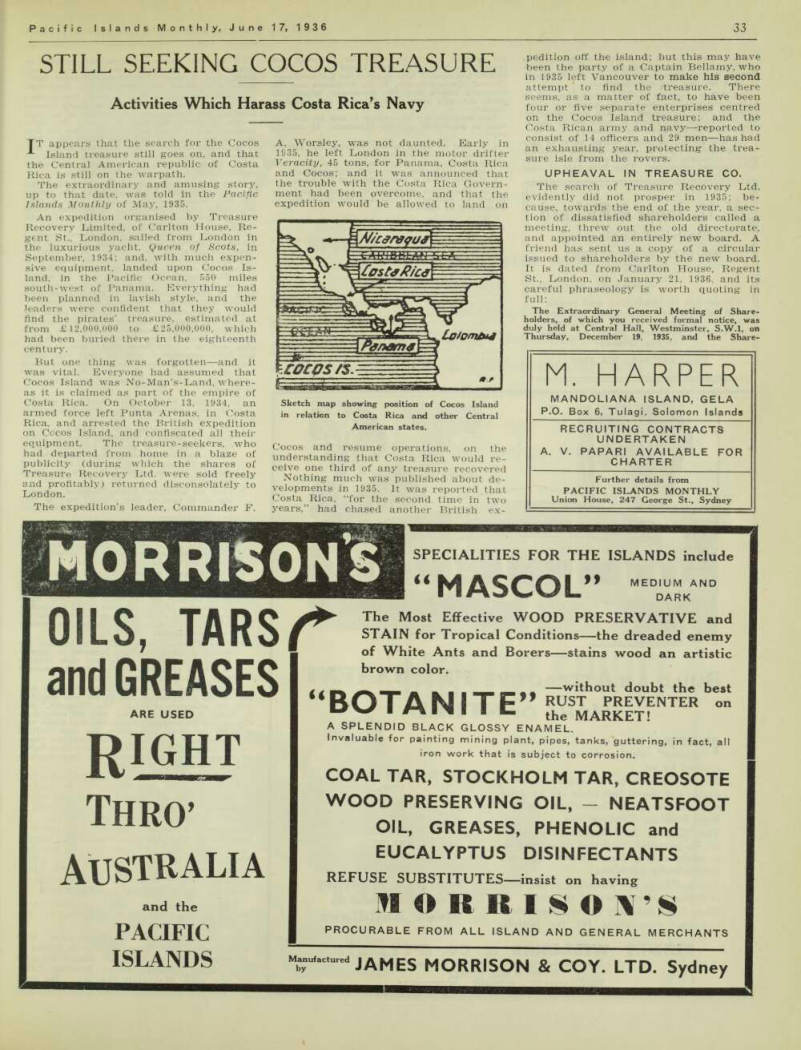
Sketch map showing position of Cocos Island in relation to Costa Rica and other Central American states.
holders present passed the Resolution appearing on the Notice of Meeting and elected Messrs. Baron, Bevan, Arthur, Mendelssohn, Thorp and Bergmans to form the new Board of Directors.
The full proceedings of this Meeting proved to be too protracted to warrant the expense of circulation to the Shareholders, as had been proposed, but a verbatim report may be inspected by Shareholders at the Offices of the Company. urgent attention, including the question of finance TWr « eP t in m nd
the primary object for which the Company was formed—the location of Cocos Island treasure. Re ference has already been made at the Extraordinary General Meeting to Mr. P. A. Bergmans and the Directors believe that Mr. Bergmans’ information holds the only sure road to early and complete success.
This documentary information is now for the first time in possession of your Directors. It consists of:— 1. A plan of Cocos Island, showing the general location of the treasure cave. 2. A large-scale plan, showing the site and approach to the cave, with instructions. 3. A description of the contents of the cave.
The information contained in 1 and 2 obviously cannot be disclosed herein, but the description in 3 above is as follows: “When arriving in cave you will first notice on your left the form of a person (sceleton) “Further on the left are sacks with gold nugets and more sacks further inside on the same left.
“You will have to walk on silver coins and other metals which is filled up in abundance.
“On the right from the entrance are seven little barrels containing gold coins and in the farther and middle are eight boxes or trunks and many different pieces of ornement from churches, together with statuettes.
“Two of the boxes have been opened by me and jewels have been removed.
“Notice an old shirt was used to make a sack from, but was later left in the cave and gold nugets of all sizes are spread on the ground in order to use two of the bags to. fill them with
jewels.”
NOTE.—The above is reproduced exactly as written by Mr. Bergmans who, it will be remem bered, is a Belgian. The above-mentioned docu ments were drawn and signed by Mr. Bergmans.
As will have been evident to those Shareholders who were able to attend the Extraordinary General Meeting, the Company’s finances are in no state to-day to defray the cost of turning the above information to account and your Directors feel that their proper course is to advise Shareholders fully of the highly important new facts and of the con sidered recommendations of the Board, so that the steps taken shall be those having the fullest approval and support of the Shareholders The information now in the Directors’ hands has been carefully studied, particularly by Mr. Arthur and Mr. Studdert, both of whom have a close acquaintance and knowledge of Cocos Island. These two gentlemen—both Directors of the Founder Company, Spanish Main Exploration Limited, as well as of this Company—have formed such a favourable opinion that they have intimated that their Company, as the largest shareholder in Treasure Recovery Limited, will be prepared to advance to your Company, on loan, immediately, such funds as are necessary to meet its present urgent commitments and to maintain your Com pany in good standing until Shareholders have decided upon the future policy of the Company.
This gesture of confidence has been made, not only as the result of Mr. Bergmans’ documentary information and an examination of samples of the treasure which he has brought to London, but also, and to a very large extent because, there has been accumulated over the past year much contributory information from entirely independent and separate sources, all tending to corroborate and confirm the genuineness of Mr. Bergmans’ documents.
The proposals which the Directors now put for ward for the approval and support of Shareholders are as follows: 1. That the information now in the hands of the Board be turned to immediate account, utilis ing “Veracity” to proceed to Cocos Island with a selected personnel from those already in the Company’s employ with any special additions to personnel that may be found necessary. 2. That the additional finance required, amount ing as it does to but a small part of that already invested in the Company, be subscribed by Shareholders. 3. That such subscriptions shall be by way of loan to the Company and that the loans shall constitute a first charge upon the proceeds of all treasure recovered, after the agreed Costa Rican Royalty has been deducted. 4 That a bonus of one fully-paid share of the Company shall be issued free to Lenders in respect of every £1 advanced. This has been made possible by the offer of Spanish Main Exploration Limited to place at the Company’s disposal, free of charge, a sufficient number of fully-paid shares from its holding, to provide the above Bonus. 5. That Shareholders be asked to indicate the extent to which they are prepared to support these proposals and to forward their cheques in respect of same, together with the enclosed form, duly completed and signed.
By this means, the proposals, receiving the sup port of the Shareholders can be put into operation with the minimum of delay. The “Veracity,” now at Punta Arenas, Costa Rica only 300 miles from Cocos, can be recommissioned and the whole pro gramme completed well within the time limit of the Company’s Concession. The Directors there fore recommend with confidence every Shareholder to support this programme in their own interests and to subscribe to the Loan.
Miss Eleanor Fellowes, of Philadelphia, who arrived in Sydney early in March, 1936, told of a day spent only a few weeks before at Cocos Island, where she said a band of Englishmen are looking for treasure. They had spent nine months searching the mountainous and forest clad island, but had met with no success.
They lived in the huts erected by prev ious explorers, and had an electric plant which enabled them to have a refriger ator for keeping their supplies fresh.
This, presumably, was Captain Wors ley’s party, which left London in the Veracity early in 1935.
Captain Bellamy, of Vancouver, who spent some months searching on Cocos in 1932, reported that he had found 133 gold and silver Spanish coins, bearing dates of the 16th and 17th century. He said the pirates’ cache seemed to be in quick
sand, and that it would require compre hensive engineering equipment to recover it. Obsessed by the idea that he might be the discoverer of treasure, variously estimated up to 20 millions sterling in value, Bellamy fitted out a small schooner at Vancouver last summer. After a dis pute with his partners, he set out alone, but his vessel was wrecked in British Columbia waters. A trading vessel, which arranged to drop him at the island, met a similar fate on the Costa Rica main land.
Some History
Mr. Frederick Wall, writing in Gibbon’s Stamp Monthly a few months ago, said; “It has been the Central American re public’s custom for quite a time to grant licenses to those who thought they could unearth the Spanish and Portuguese gold which is said to be hidden there. * I thought that the matter of ownership was settled in 1897 when British Admiral Palliser and a party of blue-jackets landed on the island and calmly started blowing it to pieces in the hope that the explosions would reveal something more valuable than upturned earth and rock!
As a result of this intrusion upon foreign territory Cocos was put out of bounds by the Admiralty!
“The island is first found marked on a French map of the sixteenth century and no doubt was a hiding place for pirates for a number of years. There are com monly supposed to be two vast treasures hidden there, that belonging to a Portu guese pirate, Benito Bonito (buried about 1820), and that raided from Lima about the same time, during the Peruvian war
of independence. Looking at the map, Bonito’s hoard is said to be on the shores of Wafer Bay (the westerly of the two bays at the north of the island) while the great treasure of Lima lies somewhere in the other and nearby bay, Chatham Bay.
“Whether they do exist still remains to be seen; it is quite likely that they are there somewhere in the island which is hilly and almost impenetrable with vege tation. Dozens of exploring parties have tried their luck (including one led by Sir Malcolm Campbell) and, in spite of so many failures, the attraction still re mains.”
The Lima Treasure
Admiral B. M. Chambers, in a letter published in the London Daily Telegraph in August, 1934, described lengthy searches which he had made, all over the wmrld, for any kind of contemporary his tory or documentary evidence which might support the story of the Lima treasure. The story is that when Cor dova was approaching Lima, the church authorities gathered together an im mense treasure, the property of the church, and shipped it away in an Eng lish ship, the Mary Dyer, or Dier; and that the crew of the ship murdered the priests who were in charge of the trea sure, and seized it and buried it on Cocos Island. The Admiral said he could find no evidence whatever that any such crime had been committed or that any such ship had ever sailed the seas. The indi cations were that the treasure from the Lima churches was taken away inland.