Men Who Knew Yesterday
pp. 28-30 · Read in the full issue
By Eric Ramsden
6.—Sherwin, of New Britain
THERE is nothing of the namby-pamby, meek and gentle cleric about Vernon Henry Sherwin. Strong and muscular, athletically built, slim, and trim, in physique he recalls the Melanesian Mis sion’s great leader, the first Bishop Selwyn.
Like the bishop, he takes rivers, forests, and mountains in his stride; difficulties for him are made to be surmounted; dangers to be ignored; and situations to be ex ploited. Robust, virile, eager, Reverend V. H. Sherwin is of that British type which his own countrymen admire, and the native always respects.
As he will tell you, the modern mission ary has to be navigator, anthropologist, lawyer, linguist, butcher, cowpuncher, bushman, doctor, schoolmaster, mechanic, priest and, above all, friend to both white and coloured. Rev. Sherwin was a pioneer worker in New Britain—the first white man to cross the mountain ranges in the south of that still little known island. When the story of missionary enterprise in New Britain and New Guinea is written his name will have an honoured place. Nowa days, he is associated with the “parish” of
Wau. Fifteen hundred European souls are in his keeping; thousands of natives are in an area into which several English bishoprics might be placed. When he makes a parochial “visitation” it is by air, for the simple reason that he has no other method of transport. Churches have yet to be built in the outposts—this ex-cattle man missionary preaches in the open or in a shed.
If he had not rolled a milkcan down the
streets of Cambridge and, later, assisted by some fellow students, attempted to place a pair of trousers upon the statue of Eros in Piccadilly, it is just possible that he might not have seen the Pacific. How ever, the fact remains that after those escapades, he went out to Western Aus tralia. For a time he wandered along the coast, saw something of pearling at Broome and the cattle stations of the north, and then became interested in mis sionary work in the Kimberleys. Later, he decided to enter a theological college in Perth.
In that city he met a typical northern cattleman whom he had last seen in a mustering camp.
“What are you doing down south?” in quired Andy.
“I’m at a theological college,” replied Sherwin.
“Good God!” said Andy. “Don’t tell me you’re going to be a parson! Why, what’s wrong with you?”
“Well, after all, human beings are really more interesting than Hereford-Short horns.” replied the student. “Among hu man beings there are clean-skins to be
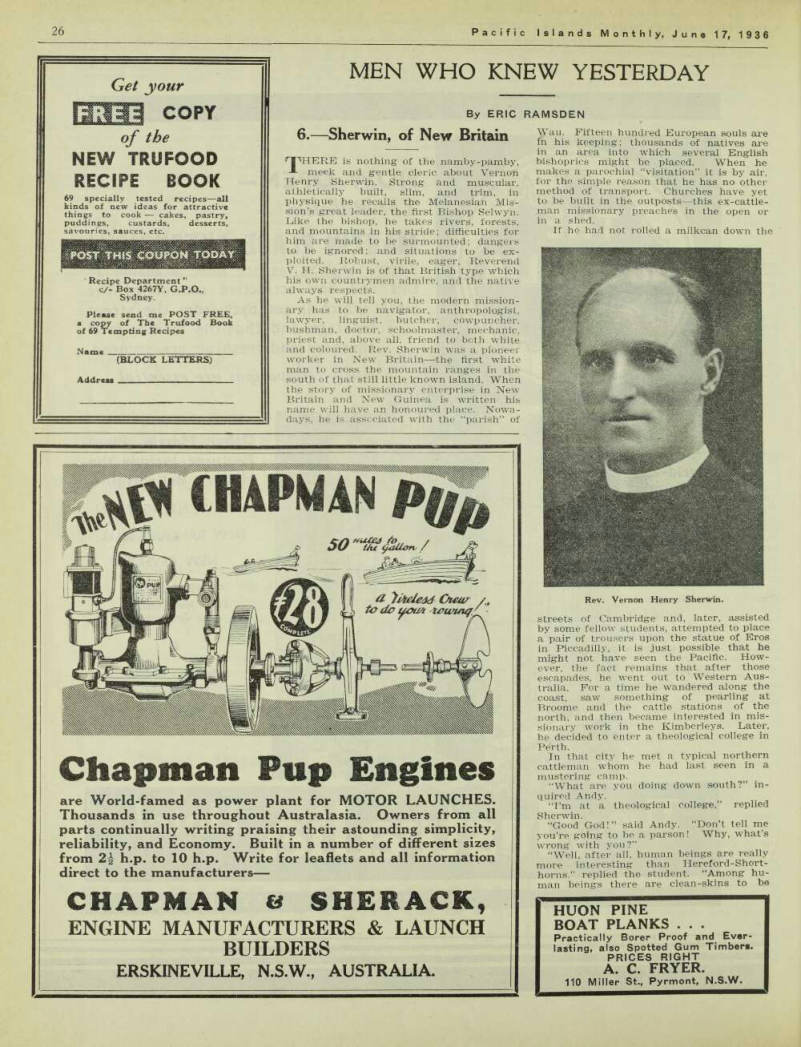
Rev. Vernon Henry Sherwin.
branded, stores to be nursed, outlaws to be mustered, and good horses to be found.”
“Well, what about a drink?” suggested the cattleman, “or are you on the water waggon now?”
When they departed the old man de clared: “Well, good luck. I am glad you are still human —even if you are going to be a parson! ”
Missionary enterprise in the Pacific to day can be just as adventurous as when John Williams built his frail craft at Raiatea in the Society Islands and sailed the Southern Seas.
Vernon Henry Sherwin was in New Britain from 1928 until 1933 when he was selected by his bishop for work on the mainland of New Guinea. On his first attempt to reach New Britain he was blown almost back to the New Guinea coast. To quote his own words: “Excite ment becomes almost monotonous when one has been blown out to sea in a native canoe for three days with a hat as a bailer and four coconuts for food, or when one has to eat snake-flesh at a native banquet, or dive deep into the Pacific with dynamite charges to blow up fish to feed one’s hospital patients. The thrills have gone on happening ever since.” Although he is apt to dismiss the sea adventure somewhat flippantly, it might easily have terminated seriously. The danger was enhanced by the loss of the canoe’s out rigger.
On the second occasion Sherwin visited New Britain the schooner in which he was travelling ran on a reef. The native skip per had not even a chart. The missionary had to improvise his own navigating “instruments.” When the schooner was well and truly aground, he had to strip off and dive into the hold to salvage the cargo. Later the vessel was got off, and the voyage resumed —after this muscular Christian had patched up the hull!
Some people are still inclined to think that the missionary walks around the bush in a top hat and black coat, that he sits beneath a tree awaiting the approach of the Gospel-seeking natives. “I have known natives come up and ask for tobacco,” he says, “but never for the Gospel.”
In New Britain, Sherwin’s day com menced with divine service at 5.30 a.m.
Two hours later he was at work in the mission hospital making perhaps 30 or 40 injections, attending to abscesses, dressing wounds, even on occasion having to ampu tate a limb. At 10 a.m. he ceased to be a doctor and became a schoolmaster until noon. After lunch more school, then another round of the hospital, followed by court cases, gardening, with perhaps time spent in supervising the building of new houses, and then evensong.
Not a bad day’s work even if carried out in a temperate climate. But that is not all, for as the missionary remarked “Patrols had to be made on fdot through the hill villages, doing medical work, advis ing about houses, diet, sanitation, and a hundred other things. Sometimes I was
away in the bush for six weeks on end, crossing torrential rivers, climbing mountains, wending a fearful way over shaky bamboo bridges with an abyss stretching far below. Dealing with savages is educafive and humanising when one realises that revenge is sweet to them, and is usually accomplished by means of a spear or arrow, minus abstruse legal arguments.
In New Britain he had to accept malaria, wet blankets and stores, as part and parcel of his daily existence. The climate there plays havoc with a man even with the constitution Sherwin possesses. Only the fittest can survive. After a particularly
bad bout of blackwater fever on one occa sion he left a note for the administration authorities stating that if he died his natives were not to be blamed. Natives of New Britain still attribute not a few deaths (and probably with good cause) to poison.
What one likes particularly about this energetic young missionary is his sane out look. For instance, he does not believe in clothing natives. “By clothing them,” he says, “you are paving the way for skin diseases and respiratory troubles. In the humid heat of the tropics the more the body is exposed the better. The native.
in his normal state, very sparsely clothed —or wearing nothing at all—is perfectly moral.”
Neither does he desire to interfere with their primitive culture: “Within my area of work, both in New Britain and now on the New Guinea mainland, native customs have been carefully preserved. In fact, those in danger of being forgotten have been carefully revived. It is arrogant,
criminally wrong, and foolish to try to Westernise natives. To smash their in herited customs is an intolerant, puri tanical step.”
Again, he is emphatic that-all mission aries should possess anthropological train ing. He, himself, underwent a course at Cambridge.
“Missionary mistakes in the past,” he says, “were due to ignorance and in
tolerance.” Further, he is strongly in favour of sectional control in the mission field. The recent sectarian bitterness engendered between the Roman Catholic and Lutheran sects in the Mount Hagan area have not enhanced the reputation of missionaries in the eyes of white residents in New Guinea. “What must be the effect on the untutored native?” he asks.
Last but not least —he is entirely sym pathetic towards the native. Not merely sentimentally so. But he realises that the native must bear the impact of civilisation whether he wants to or not. While pre serving what is best in the primitive cul ture, it is only fair that some spiritual compensation be given when native belief is shattered in the gods of old.