The Wealth That Lies East Of Papua
p. 11 · Read in the full issue
Her Unexploited Islands Wonderland
By R. B. Moffat
PAPUAN residents generally, and the Government in particular, seem to be quite Unappreciative of the potential wealth which lies behind the charm and beauty of Papua’s South Seas scenery.
Six months’ residence in Papua has not in any way given me cause to alter that, my first impression.
Since June, 1935, when with a com panion, Roy Vicary, I arrived in Papua from Melbourne, from whence we had sailed in our double-ended yawl, Gitana 11., I have sailed over 6,000 miles among the islands of Eastern Papua.
From Samarai, the vicinity of which has been described by some visitors as the most beautiful spot in the whole South Seas, I have sailed northward through the China Straits and encircled every island in the D’Entrecasteaux Group. There I have seen for myself, not once but several times, the inspiring grandeur of the Dobu Passage and the Moresby Straits, narrow strips of water as blue as blue can be, and on either side of which mountains tower up to 7,000 feet and more. From the D’Entrecasteaux, I have gone further northward through the wonderfully clear, if somewhat reef-strewn waters, to the Trobriands, truly Papua’s “Isles of Desire.”
Again, with Samarai the starting point, I have frequently travelled eastward past the low sandy atoll islands of the Conflict
Group, and thence onward through the peerless Deboyn© Lagoon. Still further on, I haye sailed in and out among the islands of the Calvados Chain, and skimmed along through the smooth, rippling waters about Sud-Est Island, In these latter islands alone—the Louisiade Archipelago—there is scenery
the like of which it would be difficult to find anywhere else in the world.
Just imagine it. A huge oval-shaped lagoon, some 120 miles long and 30 miles wide, a truly dazzling sheet of blue water profusely studded with scores upon scores of emerald isles, of every shape and size and description, from mountainous Sud- Est, 50 miles long and 12 broad, right down to the tiniest of atolls, whose area should be reckoned in square yards!
The names of some of these islands are alone enough to set one’s imagination working—Pano Rora, Pana Numaara, Pana Tinani, Nimoa, Sahara, Panasia!
And then, too, there are those hosts of little bays, lagoons and passages, with intriguing names like Imadi Bay, Coral Haven and the Gold Rush Channel.
To those people who see these islands fairly frequently—traders, missionaries and Government officials, for instance — the sight may be commonplace; but let me state with all the emphasis at my command that, to the visitor who sees them for the first time, and particularly
to the visitor from crowded cities, these islands, their names, their inhabitants, everything about them, represent the very pinnacle of beauty—plus romance.
Quite recently, it fell to my lot to con vey two lady friends, visitors from Mel bourne, to the little islet of Managun, which lies off the eastern end of Misima Island. The trip, which was from Bwagaoia Harbour, was only a short one —a matter of a few miles across a shallow lagoon. The day was far from being fine; one of those dull, cloudy days which seem to sap all colour from land and sea. Yet when we arrived at Managun the ladies went simply into raptures about the “paradise-like little island,” and the beauty of the view they had of Misima’s rugged, gold-bearing hills. They were not newchum tourists. Both had travelled extensively.
Governments the world over realise very well the value of good scenery.
Yet Papua hasn’t got the slightest semblance of a Tourist Bureau, let alone any facilities to enable tourists to see the glory of the outlying islands. Surely something could be done.
In many respects, Papua is in an advan tageous position to attract tourists, who want to see the real thing in South Seas scenery. Not only is it close to centres of population like Melbourne, Sydney and Brisbane, but the whole of its island archipelagos lie snugly behind a great barrier reef, which ensures comparatively calm water among the islands, at most times.
“Impossible!” “Impractical!” “Too cost ly!” have been some of the answers to a few inquiries I have made as to the possi bility of the Government providing facili ties for tourists to see something of Papua’s island wonderland. Another objection I have heard is that Port Moresby, being the seat of government, would never acquiesce to the spending of public money on tourists, as Samarai, a vassal state, would grab all the trade!
It is not my place to say how the Government should go about creating facilities for tourists. I’m no tourist expert, but I do know attractive scenery when I see it, and I have seen enough of Papua to know that the country has a superabundance of the sort of goods the tourist will pay handsomely to buy.
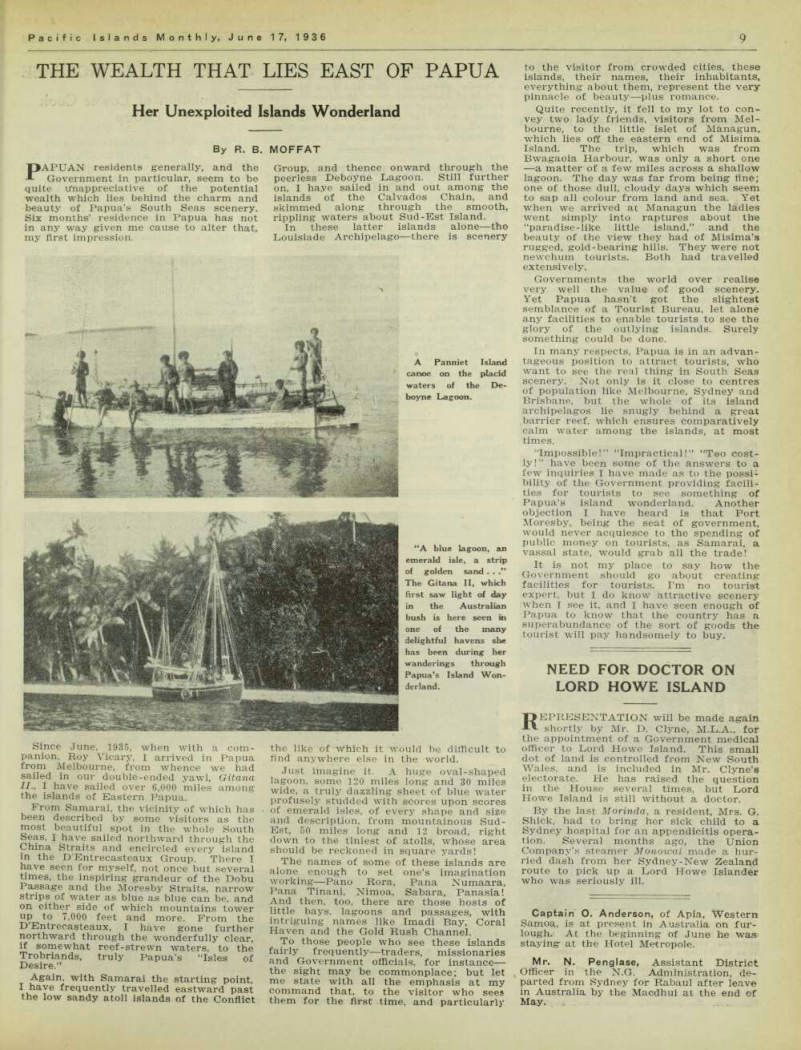
A Panniet Island canoe on the placid waters of the De boyne Lagoon.
“A blue lagoon, an emerald isle, a strip of golden sand ...”
The Ghana II, which first saw light of day in the Australian bush is here seen in one of the many delightful havens she has been during her wanderings through Papua’s Island Won derland.