The Ramu
p. 67 · Read in the full issue
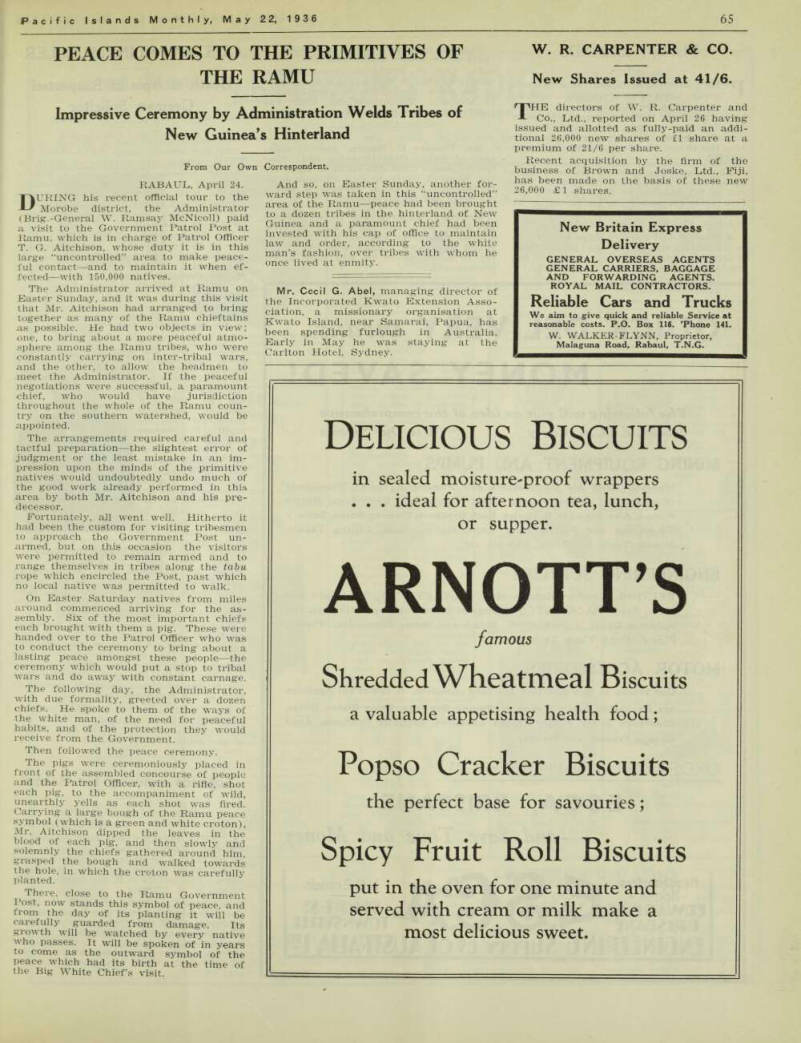
Peace Comes To The Primitives Of
Impressive Ceremony by Administration Welds Tribes of New Guinea’s Hinterland
From Our Own Correspondent.
RABAUL, April 24, DURING his recent official tour to the Morobe district, the Administrator (Brig.-General W. Ramsay McNicoll) paid a visit to the Government Patrol Post at Ramu, which is in charge of Patrol Officer T. G. Aitchison, whose duty it is in this large “uncontrolled” area to make peace ful contact —and to maintain it when ef fected —with 150,000 natives.
The Administrator arrived at Ramu on Easter Sunday, and it was during this visit that Mr. Aitchison had arranged to bring together as many of the Ramu chieftains as possible. He had two objects in view; one, to bring about a more peaceful atmo sphere among the Ramu tribes, who were constantly carrying on inter-tribal wars, and the other, to allow the headmen to meet the Administrator. If the peaceful negotiations were successful, a paramount chief, who would have jurisdiction throughout the whole of the Ramu coun try on the southern watershed, would be appointed.
The arrangements required careful and tactful preparation—the slightest error of judgment or the least mistake in an im pression upon the minds of the primitive natives would undoubtedly undo much of the good work already performed in this area by both Mr, Aitchison and his pre decessor.
Fortunately, all went well. Hitherto it had been the custom for visiting tribesmen to approach the Government Post un armed, but on this occasion the visitors were permitted to remain armed and to range themselves in tribes along the tabu rope which encircled the Post, past which no local native was permitted to walk.
On Easter Saturday natives from miles around commenced arriving for the as sembly. Six of the most important chiefs each brought with them a pig. These were handed over to the Patrol Officer who was to conduct the ceremony to bring about a lasting peace amongst these people—the ceremony which would put a stop to tribal wars and do away with constant carnage.
The following day, the Administrator, with due formality, greeted over a dozen chiefs. He spoke to them of the ways of the white man, of the need for peaceful habits, and of the protection they would receive from the Government.
Then followed the peace ceremony.
The pigs were ceremoniously placed in front of the assembled concourse of people and the Patrol Officer, with a rifle, shot each pig, to the accompaniment of wild, unearthly yells as each shot was fired.
Carrying a large bough of the Ramu peace symbol (which is a green and white croton), Mr. Aitchison dipped the leaves in the blood of each pig, and then slowly and solemnly the chiefs gathered around him, grasped the bough and walked towards the hole, in which the croton was carefully planted.
There, close to the Ramu Government Post, now stands this symbol of peace, and from the day of its planting it will be carefully guarded from damage. Its growth will be watched by every native who passes. It will be spoken of in years to come as the outward symbol of the peace which had its birth at the time of the Big White Chief’s visit.
And so, on Easter Sunday, another for ward step was taken in this “uncontrolled” area of the Ramu —peace had been brought to a dozen tribes in the hinterland of New Guinea and a paramount chief had been invested with his cap of office to maintain law and order, according to the white man’s fashion, over tribes with whom he once lived at enmity.
Mr. Cecil G. Abel, managing director of the Incorporated Kwato Extension Asso ciation, a missionary organisation at Kwato Island, near Samarai, Papua, has been spending furlough in Australia.
Early in May he was staying at the Carlton Hotel, Sydney.