of Fijian Official
pp. 60-61 · Read in the full issue
Picturesque Native Ceremonies Mark Installation of Fijian Official High Chief George Tuisawau Is New Roko Tui Rewa
From a Special Correspondent
SUVA, April 26.
AN interesting ceremony took place at the native towm of Lomanikoro, in Rewa province on April 16, when Ratu George Tuisawau, High Chief of Rewa, w T as installed by His Excellency the Gov ernor (Sir Murchison Fletcher) as Roko Tui Rewa, a high post in the native ad ministration, which has been vacant since the death in 1934 of Ratu Joni Mataitini, the grand old man of the province. It was estimated that there were 3,000 natives present.
Native ceremonies, which have been customary with these people for hundreds of years back, marked the day. After His Excellency, who w T as accompanied by sev eral senior officials, had been received on the village green by a guard of honour of the native Defence Force, he was ac corded the various ceremonies always as sociated with the visit of a Chief.
The distance from where His Excellency landed from his launch to the village green, some 400 yards, was covered with
a woven native mat, all in one piece, a markable specimen of workmanship. Lin ing both sides of this were native school children and Boy Scouts, and to escort the Governor to the village there was a body guard of massive Fijian warriors in full costume,' complete with spears and clubs.
The first ceremony performed was that of qaloqalovi, or presentation of whale’s teeth ( talma ), the greatest honour a Fijian can bestow, and one always accorded per sons of rank. This presentation was made by Ratu Etuate Mataitini, Buli Rewa and son of the late Roko. This was followed by the sevusevu, or presentation of the root of yaqona, from which the drink of yaqona ( kava ) is made. Then came the most im pressive ceremony—the making and pre sentation of ceremonial yaqona. To the accompaniment of chanting from those assembled round the tanoa (bowl) the drink was prepared, and the server, in full native costume and glistening with coconut oil, made his obeisance and presented the first bowl to the Governor. Then came the other officials interspersed with the Chiefs.
After the Roko-designate had taken the necessary oaths, His Excellency presented him with the staff of office, beautifully
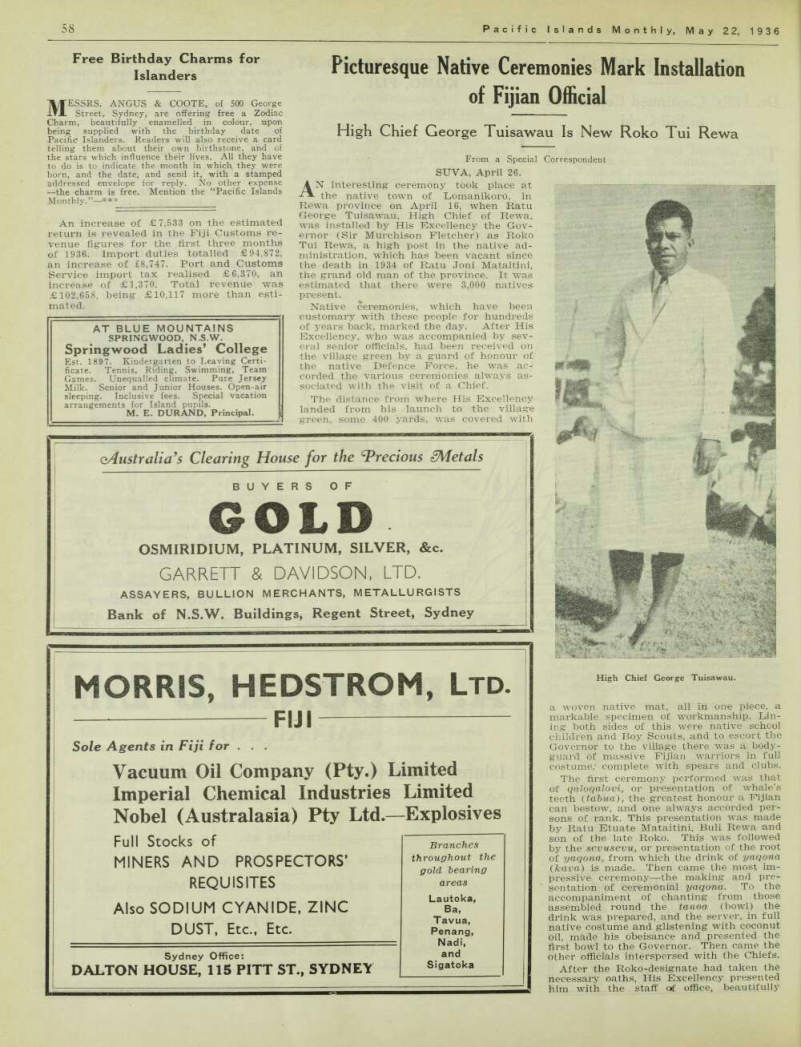
High Chief George Tuisawau.
made of inlaid native woods. Sir Murchi son addressed the assembled people through the interpretation of one of nis A.D.C.s, Lieutenant Ratu J. L. V. Sukuna.
His Excellency stressed the importance of the appointment so far as the native people were concerned, saying that the Roko had direct and separate responsibility for the well-being of all Fijians in his pro vince, and that the duties and authority of the Roko and the Provincial Commis sioner and District Commissioner were complementary. The Government required the District Administrator and the Roko to advise and assist each the other, thus ensuring good rule.
Continuing, His Excellency referred to the fact that throughout his term of office, Mr. A. J. Armstrong had been Provincial Commissioner of Rewa, and he was glad to have a public opportunity of expressing his appreciation of the good work he had done on behalf of the Rewa people.
The formalities over, several fine melees (dances) were performed in honour of the occasion, and a magiti (feast), which had been prepared for the visiting natives, w r as divided. This magiti was in the form of a stockade of native food—bananas, taro, yam, and several pigs, roasted whole, being spaced along it.
The new Roko is a man slightly over 30 years of age, and has for some years been employed in the Department of Native Affairs in Suva, and as an interpreter.
Mr. O. B. Hart, constructional engineer, arrived in Sydney from America early in May. He will sail for New Guinea to supervise the erection of No. 5 Dredge for Bulolo Gold Dredging Limited by the June Neptuna.