America Bridges North Pacific
pp. 27-29 · Read in the full issue
Inauguration of 'Frisco-China Air Mail Is Most Marvellous Development of 1936
By Nell Murray, writing to the “Melbourne Herald” from Los Angeles on March 31
BEGINNING last November, every two weeks a giant flying boat, weighing 25 tons, now thunders cut above the Golden Gate at San Francisco. For four months now the China Clipper and her sister ship, the Philippines Clipper, have bridged the 9,000 miles of ocean tempest between Cali fornia and the Orient in just 65 flying hours!
The romance of the project, the sheer wonder of these vast ships braving typhoon and hur ricane across the trackless wastes of the Pacific, has caught the imagination of the American public. The movements of Clipper airships are front-page news.
Guam, Wake and Midway are tiny dots of islands in the Pacific, and six months ago their names were unknown to the average person. To-day every American is aware of their signi ficance. It may not be long before Australia, too, claims them as household words. An official of Pan-American Air ways told me that the ultimate intention of his company was to link the service with Australia.
Whether a subsidiary line would be run down from Macao, in China, to link up with the
England-Australia, or the alternative taken of establishing a separate exclusive service, branching off from Guam direct to Australia, is a matter which his com pany has not decided yet.
For the immediate future, organising and experimental work is still being car ried on. with the object of fitting up the bases for accommodation of passengers on
the existing mail route. So far, no pas sengers have been earried, but there is a waiting list of more than 2,000 Americans who want to be among the first 52 pas sengers to experience the thrill of follow ing in the wake of the Yankee sailing clippers of long ago—annihilating time and distance for thousands of miles in the sky.
Awed In Wonder
All California seemed to have mustered in San Francisco when, at the end of last November, the China Clipper took off on her inaugural trip with mails. It so happened that I sailed for China out of the Golden Gate the same afternoon, but by prcsaic steamer route.
Intense excitement reigned in the city all morning, and reached fever height at 3.30 in the afternoon. A huge crowd of proud citizens, awed in wonder and amaze, were out at Alameda airport to bid God speed to the clipper.
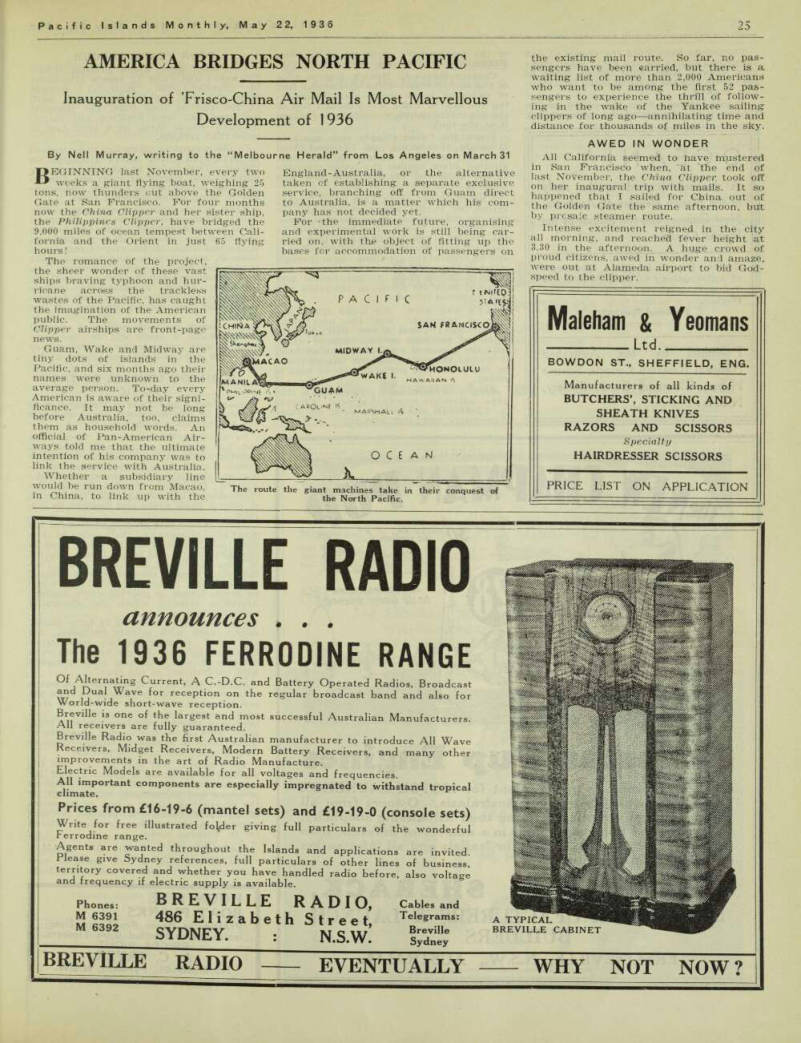
The route the giant machines take in their conquest of the North Pacific.
Thousands more lined the shores of San Francisco Bay to see the great silver monster heavily laden with 150,000 items of mail, soar into the sky and make for Honolulu, Hawaii.
A gasping roar from the crowd as the Clipper narrowly missed the cables on top
of the uncompleted structure of the San Francisco-Oaklands Bay bridge. . . .
Captain Edwin C. Musick, famous pilot of the ship, performed the spectacular feat of swooping below them —actually break ing the law by doing so—although few of the fascinated onlookers could have realised it at the time.
I saw the China Clipper once again in Honolulu, thundering past Diamond Head with all her great engines in full blast, glinting silver against the tropic greenery of the hills, and the turquoise blue and dazzling whiteness of the sea.
I heard of her again 3,000 miles further across the Pacific, riding at ease high in the sky 200 miles south of the spot where our 20,000-ton ocean liner lay helpless in the grip of a five-day typhoon. Our radio operator talked with hers —told the Clipper and its crew of the appalling storm through which we were passing, so intense that our liner could not face it, but turned and steamed back for hours on the route she had traversed already.
“All’s well here. We make Guam to morrow morning,” was the nonchalant reply. As I gazed across that desolate waste of tumbling water, whipped-white with the spume of a 100-mile-an-hour gale, it seemed incredible that the Clipper could be zooming along peacefully above such a storm.
Only five years have elapsed since this great adventure was first mooted. Charles A. Lindbergh had a hand in it, as Pan- American’s technical adviser.
Four Years’ Labour
Two other men, Andre Priester (Chief Engineer) and Juan T. Trippe (President of Pan-American Airways) worked patiently with him for four years, until at the end of that time, the requisite machines had been designed and manu factured—six of them, at a total cost of more than £185,000.
In the meantime, pilots had to be trained in navigation never before attempted in the air. They had to be grounded in inter national law, taught at least one foreign language in addition to English, and quali fied in innumerable different ways.
Then, just a year ago, the supply ship North Haven stole out of San Francisco Harbour unobtrusively, laden with 6,000 tons of cargo. She was off to put Midway, Wake and Guam on the map of commerce.
Midway, up till then, had been a cable station inhabited by only a few men. This tiny island, on the northern tip of the Hawaiian group, automatically became American territory when Hawaii became voluntarily annexed at the end of last century.
Only lonely sea birds cried and swooped above Wake, a mere dot in the huge Pacific, until the coming of the supply ship. No one has ever been known to live there.
Robinson Crusoes Of The
Pacific
Guam came into America’s possession at the end of the war with Spain, and has but a primitive population.
So small is Wake that its whole area does not cover one square mile. Electrical lighting and water systems have had to be installed in all three bases. The men work ing on the islands at present are like modern Robinson Crusoes —for so far “civilisation” has not advanced far enough to permit their wives and families to join them.
There is adequate accommodation for the giant mail clippers and their crews as they come winging in from the ocean hops to rest and refuel —and, before long a “chain” of three hotels will have been built. Pre fabricated wooden ones have been shipped out to Guam, Wake and Midway, and will be erected soon to provide every modern American comfort which the discerning traveller desires.
Each on© will consist of 24 large double rooms, each with private bathroom, hot and cold running water, and other luxurious fittings. Tennis courts are even being built, and swimming pools complete with cocktail bar at the edge!
Midway will have a small fleet of beach automobiles to convey passengers from the aerodrome to the hotel. These are shod with outsize balloon tyres in order that they may travel easily over the soft coral sand. One of the few sewing machines in those parts is located at Guam, complete with a spare belt and 100 needles.
The company will have to face soon the problem of obtaining a domestic staff for their hotels, for even the most adventurous of cooks and housemaids might flinch at the prospect of taking a post in the midst of the Pacific Ocean! At present, the men engaged in construction work are catered for by Filipino cooks.
Naturalist’S Task On Guam
The development of this romantic new civilisation has opened up fascinating fields
of enterprise. The American Government, for instance, has just despatched a noted naturalist to Guam, instructing him to make a thorough study of the flora, fauna and native customs, so that they be placed on record at the Bishop Museum, Hono lulu, which is recognised as the world’s most complete collection relating to Poly nesian life.
Philatelists, too, have found that the establishment of the new airways system was swift to affect the stamp market.
Ordinary dollar stamps which were sold for the inaugural flight and affixed to letters addressed to Honolulu were valued within three days of arrival at 25 dollars.
For the first four months of the mail service, the terminal point in the Orient has been Manila. Throughout its incep tion, Japan had strenuously objected to every move, and it is because of the ten sion between China and Japan that China has been slow to grant permission to land at Macao. Officials are confident, however, that permission will come at any time now, and that soon the Clippers will be landing on Chinese soil.
Next . . business men boarding the ’planes in San Francisco and waking up in Honolulu next morning. On to Midway, Wake, Guam and Manila—with the huge trade possibilities of closer contact with China opening up before them.
Nine hundred dollars from San Francisco to Macao is the tentative passenger fare fixed upon for a beginning. This works out at 10 cents a mile —about 7Jd in Aus tralian currency.